
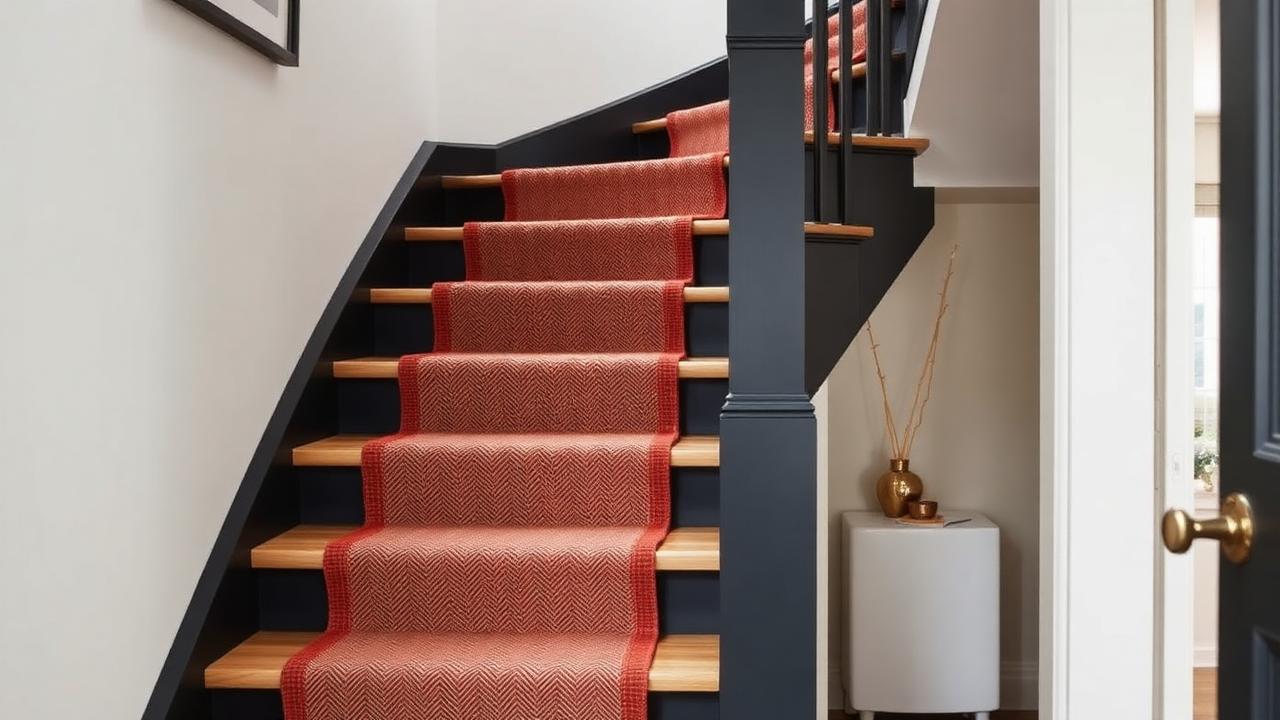
What makes loft stairs different
Loft-style staircases, the sort you find in converted warehouses, mezzanine additions and open-plan new builds, are usually designed to be seen rather than hidden. Open risers, exposed steel or timber stringers, and floating treads are common, and the staircase is frequently a genuine architectural feature rather than a corridor you walk past without noticing. That changes the brief for a runner considerably compared with a boxed-in Victorian flight tucked against a wall: on a loft stair, the runner has to complement an already visually strong structure rather than dominate it, and on an open-riser flight it may only be practical to run the carpet across the tread itself, with no riser coverage at all since there's no riser to cover.
The other big difference is width and proportion. Loft stairs are frequently wider than a standard residential flight, sometimes 42-48 in (107-122 cm) rather than the more typical 36 in (91 cm), because they're often designed as a statement piece rather than a purely functional route. On a stair this wide, a narrow runner, say 24-27 in (61-69 cm), reads as a deliberate architectural accent rather than the full-width coverage you'd expect on a narrower traditional stair, leaving generous bands of exposed tread material, often oak, steel or polished concrete, visible on both sides.
Choosing a runner that suits an open-tread flight
On open-riser loft stairs, check first whether the tread itself is deep enough and structurally suitable to carry a fitted runner; some floating tread designs are thin engineered slabs that aren't meant to be stapled into, in which case an adhesive-fix runner or a set of individual non-slip tread pads is the safer route rather than a continuous fitted length. Where the tread does support a fitted runner, a flat weave or low, tight loop pile in a neutral tone, charcoal, natural jute-look, or a warm grey, tends to sit best against exposed timber or steel, since a busy pattern can visually clash with an already strong architectural statement.
Check the tread before you order
On open-riser or floating-tread loft stairs, confirm with whoever built the staircase whether the treads can take staples or a stapled gripper strip - some engineered or steel-framed treads need an adhesive-only fixing instead.
How much runner do I need?
Take a US example: a 14-step loft flight with a generous 10.5 in tread run and a gentle 7.25 in riser height (loft stairs, being purpose-designed rather than retrofitted, often have a more comfortable rise-and-run than an older converted attic or basement flight), plus a 0.75 in nosing wrap allowance. Per step that's 10.5 + 7.25 + 0.75 = 18.5 in. Across 14 steps that's 259 in, or 21.6 ft. Add a 24 in combined finishing allowance for a clean top and bottom finish, giving 283 in, or 23.6 ft. Apply a 6% waste margin for a straight, unpatterned flight and you land at roughly 25 ft, so order about 25 ft.

In UK metric terms: 14 steps at 26.5 cm tread run and 18.5 cm riser height, plus a 1.9 cm nosing wrap, gives 46.9 cm per step. Across 14 steps that's 656.6 cm. Add a 61 cm combined finishing allowance for 717.6 cm, then apply the 6% waste margin to reach roughly 760.6 cm, so order about 7.6 m. Because loft flights are often wider than average too, remember this length calculation is entirely independent of width; you'll need to work out your chosen runner width separately based on how much exposed tread you want either side, which a stair runner length calculator handles as a distinct input from the length itself.
| Measurement | US (in/ft) | UK (cm/m) |
|---|---|---|
| Tread run | 10.5 in | 26.5 cm |
| Riser height | 7.25 in | 18.5 cm |
| Nosing wrap per step | 0.75 in | 1.9 cm |
| Per-step total | 18.5 in | 46.9 cm |
| 14 steps subtotal | 21.6 ft | 6.57 m |
| Plus finishing allowance | 23.6 ft | 7.18 m |
| With 6% waste margin | ~25 ft | ~7.6 m |
Know your numbers in 30 seconds
Enter your step count, tread depth and riser height — the stair runner calculator gives you the exact length to order, in metres and feet, with waste included.
Open the stair runner calculatorWidth proportion on a wide, open flight
Getting the width right on a loft stair is more of a design decision than a safety one, since there's usually plenty of tread either side regardless of runner width. As a general guide, a runner covering roughly 55-65% of the total tread width tends to look intentional rather than either too narrow (looking like an afterthought) or too wide (hiding too much of the feature material). On a 42 in (107 cm) wide loft flight, that works out to a runner around 24-27 in (61-69 cm) wide, leaving 7.5-9 in (19-23 cm) of exposed tread on either side, which reads as a considered, proportioned accent rather than a corridor runner scaled up.
- Confirm the tread construction can take a stapled fixing before committing to a continuous fitted runner.
- Favour flat weave or low pile in a neutral tone over busy patterns on architectural flights.
- Aim for a runner covering roughly 55-65% of total tread width for a proportioned look.
- Check whether risers are open before assuming riser coverage is even possible.
- Treat length and width as two separate calculations, not one combined guess.
Practical trade-offs on statement stairs
One thing worth being upfront about: adding any runner to an architecturally exposed loft stair is a genuine style trade-off, not a neutral choice. Some clients want the runner purely for noise reduction and grip and are happy to compromise the visual purity of the structure slightly; others want to keep every tread fully exposed and instead add individual adhesive-fix non-slip pads that barely register visually, sacrificing the softness and warmth a runner gives underfoot. Neither approach is wrong, but it's worth deciding which priority matters more to you, sound and comfort versus maximum visibility of the structural material, before you start shopping for stair runners, since the two priorities pull in genuinely different directions on this kind of stair.
Fitting-wise, a professional installer experienced with open or steel-framed stairs is worth the extra call-out over a standard residential carpet fitter, since fixing methods, tread thickness and structural tolerances differ meaningfully from a conventional timber-boxed staircase.
Whatever you decide, get the numbers first: the stair runner calculator doubles as a stair runner length calculator, adding nosing wrap, landings, winders, pattern repeat and waste so you order the right length the first time.
Frequently asked questions
Can I fit a stair runner on open-riser loft stairs?
Yes, provided the tread material and construction support a fixing, either stapled gripper strip or adhesive. Coverage is limited to the tread surface since there's no riser to wrap onto, so the finished look is different from a boxed staircase.
How wide should a runner be on a wide loft staircase?
Aim for roughly 55-65% of the total tread width rather than defaulting to full coverage. On a 42 in (107 cm) wide flight that typically means a runner around 24-27 in (61-69 cm) wide, leaving generous exposed tread either side.
What pile or weave suits a modern loft stair best?
A flat weave or low, tight loop pile in a neutral tone, such as charcoal, natural jute-look or warm grey, generally suits exposed timber or steel stair structures better than a busy pattern or a deep plush pile.
Do floating treads need special fixing for a runner?
Some do. Thin engineered or steel-framed floating treads aren't always suitable for stapling, so confirm with the staircase builder whether an adhesive-fix runner or individual non-slip pads are the safer option instead.
Why would I add a runner to an architectural stair at all?
Mainly for noise reduction, grip and warmth underfoot, since bare timber, steel or concrete treads can be noisy, slippery when damp and cold in winter. It's a genuine style trade-off against showing the full structural material.
Is loft stair width usually bigger than a standard staircase?
Often yes, loft-style flights are frequently 42-48 in (107-122 cm) wide compared with a more typical 36 in (91 cm) residential stair, since they're commonly designed as a visual feature rather than a purely functional route.
Should I hire a general carpet fitter for loft stairs?
A fitter experienced specifically with open or steel-framed staircases is a better choice than a general residential fitter, since fixing methods and tread tolerances differ from a standard timber-boxed flight.
Do I need to calculate length and width separately for a loft stair runner?
Yes, treat them as two independent decisions. Length depends on step count, tread run and riser height, while width is a proportion-and-style choice based on how much exposed tread you want either side.
Know your numbers in 30 seconds
Enter your step count, tread depth and riser height — the stair runner calculator gives you the exact length to order, in metres and feet, with waste included.
Size your loft flight with the stair runner calculatorReady for real prices?
Get quotes from vetted stair runner suppliers and fitters near you. Free, no account, no obligation.
Every guide is written from hands-on measuring and fitting experience, checked against the calculator’s own maths, and re-reviewed whenever prices or methods change. Read our editorial standards.