
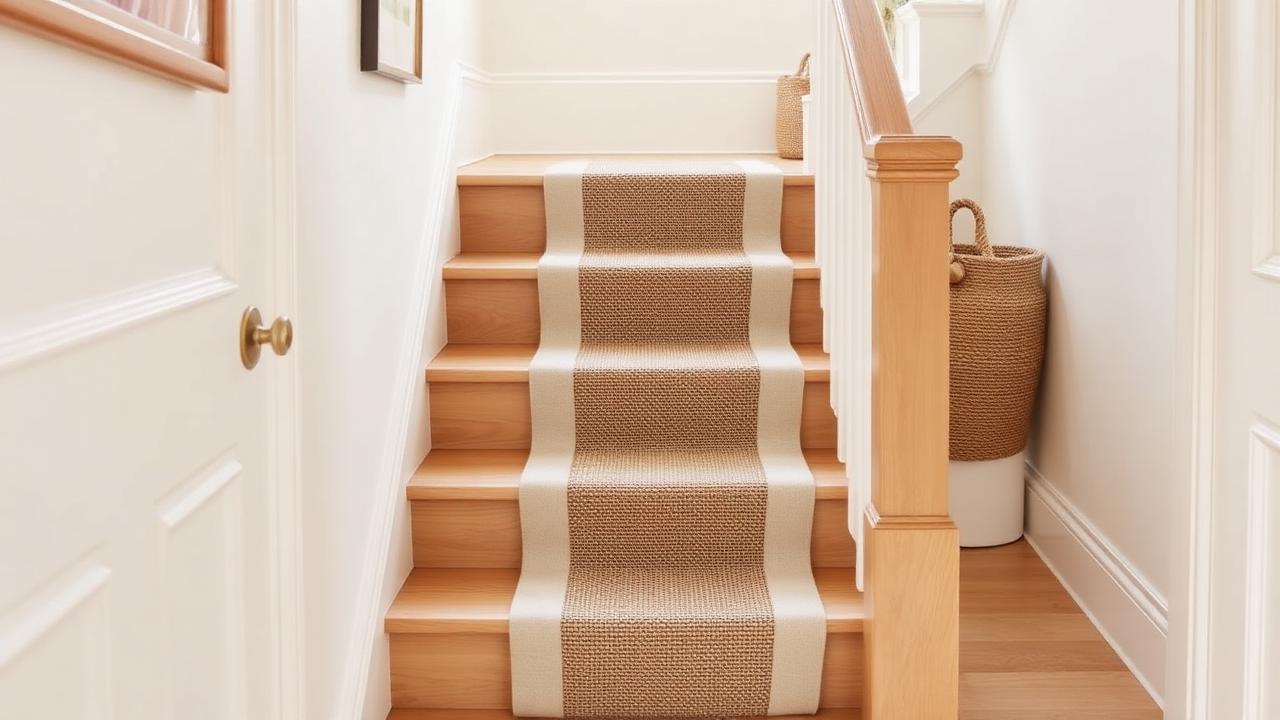
What sisal is and how it is woven
Sisal fibre comes from the agave plant, harvested and dried into long, stiff strands, then woven into a flatweave, herringbone, boucle or basketweave construction. Unlike wool or nylon, there is no pile to crush; the surface is the weave itself, which is what gives sisal its distinctive ribbed texture and hard, slightly abrasive hand.
Spec sheet
| Property | Typical value |
|---|---|
| Fibre origin | Agave sisalana leaf |
| Construction | Flatweave, herringbone, boucle |
| Face weight | 1,800–2,600 g/m² |
| Abrasion rating | Excellent (commercial-grade wear) |
| Roll widths | 66cm (26in), 68cm (27in), 4m (13ft) broadloom |
| Price per linear ft (US) | $18–$45 |
| Price per linear m (UK) | £25–£65 |
Stain and moisture behaviour
This is sisal's real weakness on a staircase. The fibre has no natural stain resistance and it wicks liquid, so a spilled drink leaves a dark tide-mark that rarely comes out fully. Sisal also swells when it gets wet, so it is unsuitable for basement stairs, bathroom-adjacent landings, or any home with young children and open drinks. Some suppliers offer a stain-treated sisal, which buys reaction time but does not make it washable.
Wear, crush and static
- Wear resistance at the nosing is excellent, better than most wool loop pile, because the flat weave has no loops to crush.
- Sisal does not generate static and does not shed, unlike some cut-pile wools.
- It is naturally rougher underfoot than wool or nylon, which some households actively want for grip.
- Direct sun exposure fades sisal over years; runners near a stairwell skylight should be checked for UV-stable dyeing.
Know your numbers in 30 seconds
Enter your step count, tread depth and riser height — the stair runner calculator gives you the exact length to order, in metres and feet, with waste included.
Open the stair runner calculatorSisal and bare feet
The coarse texture that makes sisal grippy also makes it uncomfortable for bare feet and hard on dogs' paw pads. If comfort matters more than authenticity, synthetic sisal or a wool-sisal blend is a better fit.
Where sisal makes sense
Sisal suits dry, adult households, hallways with low spill risk, and anyone wanting a natural, textural look with genuinely long wear life. It pairs well with painted stair spindles and works particularly well in a herringbone weave on a straight flight, since the diagonal pattern reads clearly at nosing height, unlike on tight winders.
Wear rating and warranty comparison
Most sisal is sold without a formal Martindale or wear-cycle rating because it is a natural flatweave rather than a tufted pile, but mills grade it by weave density and yarn thickness instead. Warranties reflect this: expect a 5 to 10 year wear warranty on branded sisal ranges versus 10 to 25 years on a comparable 80/20 wool blend, mainly because sisal cannot be steam-cleaned or spot-treated as aggressively without breaking the fibre.
| Range tier | Typical wear warranty | Weave density |
|---|---|---|
| Budget sisal | None to 3 years | Loose, visible gaps |
| Mid-range sisal | 5 years | Medium, even weave |
| Premium sisal | 10 years | Tight, heavy face weight |
How sisal behaves at the nosing over five years
Because sisal has no pile to crush, its main five-year risk is not flattening but fibre breakage at the fold: the sharpest bend in the weave, right over the nosing edge, takes repeated flexing every time someone steps down. On a well-fitted, correctly padded install, expect a slight lightening of colour at the nosing by year three as surface fibres abrade, with visible thinning of the weave by year seven to ten on a busy main stair. A thin foam or felt pad specifically rated for flatweaves reduces this by cushioning the fold.

- Year 1-2: colour settles, minor fibre shedding stops, no visible wear.
- Year 3-4: light sheen or fibre polish appears at nosing edges under raking light.
- Year 5-7: visible thinning at nosing on high-traffic stairs; edges of herringbone weave may fray first.
- Year 8-10+: replacement or nosing-only repair typically needed on a daily-use main stair.
Sisal versus a jute-blend on hallway landings
On a landing that continues from the stairs, many buyers ask whether to keep pure sisal running through or switch material at the flat section. Pure sisal on a landing wears extremely well since there is no nosing fold to stress, so continuing the same weave is usually fine structurally; the main reason to switch is comfort, since a landing gets more standing and bare feet traffic than a flight of treads.
DIY fitting versus hiring a fitter for sisal
| Factor | DIY | Professional fitter |
|---|---|---|
| Cost | Save $150-$400 (£120-£320) in labour | Adds labour but guarantees the fold |
| Risk | Sisal cracks if over-bent at the nosing | Fitter knows the minimum bend radius |
| Tools needed | Staple gun, knee kicker, chisel-edge tool | Same tools plus experience |
| Best for | Confident DIYers on a straight flight | Winders, curves, expensive sisal runs |
Sisal versus coir on entry stairs
Coir is sometimes proposed as a cheaper alternative to sisal for entry staircases because both are coarse, hard-wearing plant fibres, but coir is stiffer, sheds more grit, and has a rougher, more abrasive surface than sisal. Sisal is the better choice wherever bare feet or pets use the stairs regularly, while coir is better reserved for exterior-facing doormats and the very first tread inside a door.
| Factor | Sisal | Coir |
|---|---|---|
| Abrasion resistance | Excellent | Good |
| Underfoot comfort | Coarse but even | Very rough, coarser |
| Colour range | Wide, dyes well | Limited, mostly natural tan |
| Typical stair use | Full flights | Entry mats, first tread only |
Regional sourcing and lead times
Most sisal sold in the UK and US is imported from East Africa or Brazil and woven either at source or by a European mill, so lead times for a bespoke colour or wider broadloom order commonly run 4 to 8 weeks, longer than a stocked synthetic range. Ordering early, especially for a house move or renovation with a fixed completion date, avoids a last-minute scramble to a faster but less suitable in-stock alternative.
Sisal on winders versus straight flights
Herringbone sisal reads cleanly on a straight flight because the diagonal weave lines up consistently tread after tread, but on a tight winder the weave direction has to twist to follow the turn, which can look visually busy compared with a plain boucle weave. If your staircase has more than one or two winders, ask to see a sample turned around a mocked-up winder before committing to herringbone sisal for the whole flight.
Binding and edge finishing
Sisal frays at a cut edge faster than wool or synthetic fibre, so any cut edge, whether at the runner width or a bespoke length, should be serged or bound rather than left raw. Cotton or wool binding tape in a matching or contrasting colour is standard; budget serging alone can work but tends to wear through sooner on a high-traffic run and is worth avoiding on a main staircase.
Whatever you decide, get the numbers first: the stair runner calculator doubles as a stair runner length calculator, adding nosing wrap, landings, winders, pattern repeat and waste so you order the right length the first time.
Still deciding on material, width or pattern? Our hub on stair runners compares weaves, widths, backings and fitting styles side by side, then hands the numbers straight to the calculator.
Frequently asked questions
Does sisal come in a wide range of colours?
Yes, sisal takes dye well and is available in a broad range of solid colours and two-tone weaves, though natural undyed tones remain the most popular for stair runners because they show soiling less.
How long does a sisal order typically take to arrive?
Stocked colours can ship within a week or two, but bespoke colours or wider broadloom widths often take 4 to 8 weeks since much sisal is woven to order rather than held in large ready stock.
Is sisal a good stair runner material?
Yes for durability and looks, but it stains permanently with water and liquids and swells when wet. It suits dry, low-spill households more than families with young children or pets.
How long does a sisal stair runner last?
A quality sisal runner typically lasts 10 to 15 years on a domestic staircase, since the flat weave resists nosing wear better than most looped carpets.
Can sisal stair runners get wet?
No. Sisal absorbs and holds moisture, which causes swelling, discolouration and eventually mildew. Keep it away from basements, entryways and bathroom landings.
What roll widths does sisal come in?
Most sisal is woven at 66cm (26in) or 68cm (27in), with some suppliers offering wider broadloom rolls up to 4m for cutting bespoke runner widths.
Does sisal need a special underlay?
Yes, use a thin, dense felt or rubber pad made for flatweaves rather than a thick cushioned underlay. Too much give under sisal accelerates fibre breakage at the nosing fold because the flatweave has no pile to absorb the flex itself.
Know your numbers in 30 seconds
Enter your step count, tread depth and riser height — the stair runner calculator gives you the exact length to order, in metres and feet, with waste included.
Cost my sisal runnerReady for real prices?
Get quotes from vetted stair runner suppliers and fitters near you. Free, no account, no obligation.
Every guide is written from hands-on measuring and fitting experience, checked against the calculator’s own maths, and re-reviewed whenever prices or methods change. Read our editorial standards.