
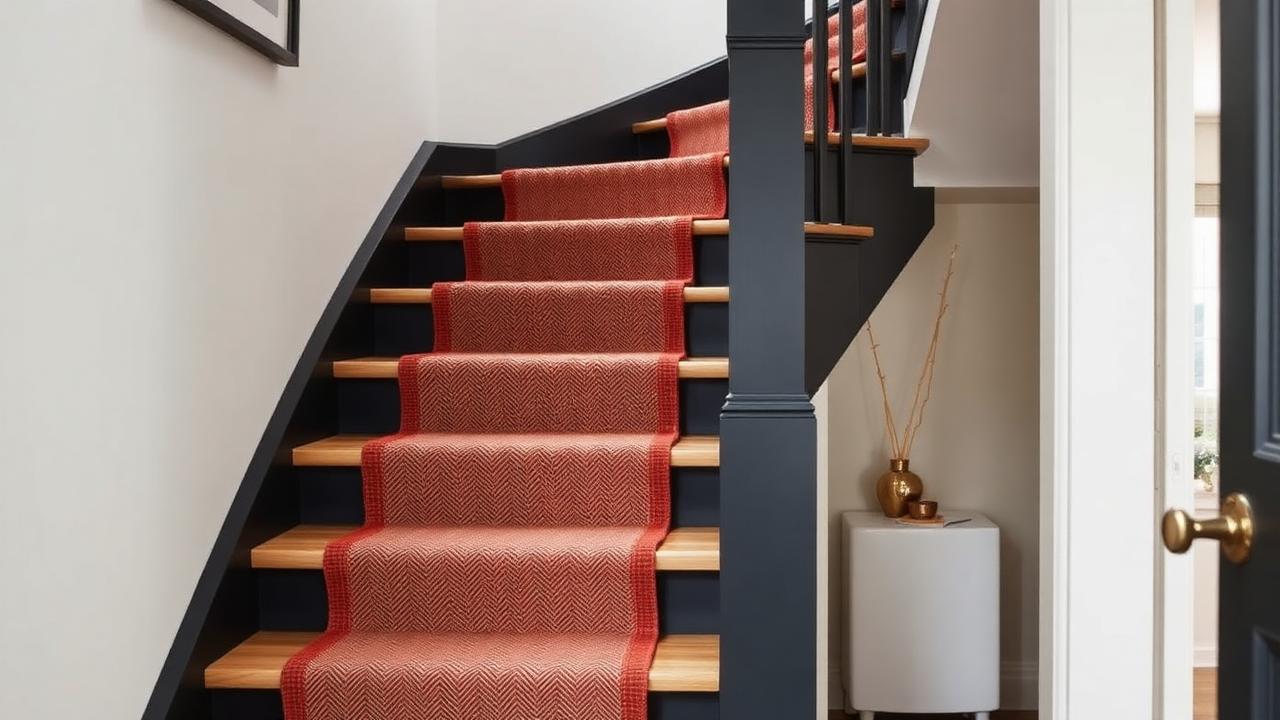
The modern appeal of ombre on stairs
Ombre is a relatively new trend in the world of stair runners, but it has quickly gained traction among homeowners looking for something truly unique. Unlike a solid colour or a repeating pattern, an ombre runner creates a sense of 'story' as you move up the stairs. In my work as a fitter, I've seen two main types of ombre runners: the 'vertical' ombre, where the colour changes as you go up the flight, and the 'horizontal' ombre, where the colour fades from the center out to the edges. A vertical ombre is particularly dramatic, as it can make a staircase feel like it's ascending into light or grounding itself into a deeper hue.
The transition in an ombre runner can be subtle or bold. A soft fade from charcoal to silver grey is sophisticated and calming, perfect for a contemporary home. A more daring transition, such as from deep navy to a bright teal or even a sunset orange, can make the staircase the most talked-about feature of the house. When choosing an ombre runner, consider the lighting in your hallway. A dark-to-light ombre can help brighten a staircase that feels a bit gloomy at the top. When using a stair runner length calculator, be aware that vertical ombre runners are often sold in 'pre-determined' lengths to ensure the gradient fits a standard staircase, so check the specifications carefully.
Vertical vs. Horizontal
Horizontal ombre runners (fading from center to edge) are much easier to install on winding stairs, as the colour transition remains consistent along the whole length, regardless of turns.
Measuring and sizing for ombre
If you are using a standard 'off the roll' ombre where the pattern repeat is long, measuring is critical. Let's look at the US example: 13 steps, 10 inch tread, 7.5 inch riser, 1 inch nosing wrap = 18.5 inches per step. 18.5 x 13 = 240.5 inches (20.04 ft). Add 2 feet for ends = 22.04 ft. With a 10% waste margin, you need 24.25 feet. However, if you have a vertical ombre that transitions over a specific length (say, 20 feet), you need to make sure your total stair length doesn't exceed the gradient's 'stretch'.
For UK fitters, a 13-step flight (25 cm tread, 19 cm riser, 2.5 cm nosing wrap) totals 604.5 cm (6.05 m). Adding 60 cm for finishing = 6.65 m. With a 10% waste margin, the total order is 7.32 metres. If the ombre transition is intended to happen exactly over the course of the stairs, you may need to start the runner at a specific point in the colour cycle. A professional stair runner calculator is essential here to ensure you don't cut off the 'best' part of the colour transition because you didn't account for the waste margin at the start.
| Feature | US Measure | UK Measure |
|---|---|---|
| Per Step Length | 18.5 in | 46.5 cm |
| 13 Step Total | 20.04 ft | 6.05 m |
| Finishing Margin | 2 ft | 0.6 m |
| Total Before Waste | 22.04 ft | 6.65 m |
| Final Order (+10%) | 24.25 ft | 7.32 m |
Know your numbers in 30 seconds
Enter your step count, tread depth and riser height — the stair runner calculator gives you the exact length to order, in metres and feet, with waste included.
Open the stair runner calculatorInstallation tips for gradient runners
The trickiest part of installing an ombre runner is managing the colour flow. If it's a vertical ombre, you need to decide where you want the darkest and lightest points to sit. I often recommend starting the darkest part of the gradient at the bottom step, as this is where the most dirt and footprints will accumulate. When fitting, you must be careful not to 'waste' too much of one colour during the installation process, or the transition will feel truncated. For horizontal ombre runners, the challenge is keeping the 'center' of the gradient perfectly aligned with the center of the stairs. Any drift will make the colour fade look lopsided.

I usually recommend the 'waterfall' installation method for ombre runners. The smooth, uninterrupted flow of the carpet over the nosing helps to emphasize the soft colour transition. If you use the Hollywood method, the 'break' under the nosing can sometimes create a visible line that interrupts the gradient effect. As for stair rods, I suggest something simple and modern, like a matte black or a brushed steel, to complement the contemporary feel of an ombre design. If you're searching for 'stair runners' to buy, look for those made with high-quality synthetics or wool blends that can achieve smooth, 'photographic' gradients.
- Plan the starting point of your vertical ombre carefully to ensure the gradient covers the entire flight.
- Use a high-quality underlay to ensure the pile remains even, which is crucial for a smooth colour look.
- Avoid using vertical ombre runners on stairs with large landings, as the landing will 'freeze' the colour transition for several feet.
- Consider a simple, hidden binding to keep the focus entirely on the colour gradient.
- Regularly check your alignment, especially with horizontal ombre, to keep the fade centered.
Styling and Durability
Ombre runners are a great way to introduce multiple colours without the 'busy-ness' of a traditional pattern. They pair beautifully with modern, minimalist architecture and can be a great way to bridge the colour gap between a dark hallway floor and a lighter landing. In terms of durability, the same rules apply as for any other runner: wool is best for longevity, while synthetics offer better stain resistance. Because ombre relies on subtle colour shifts, be careful with sun fading. If your staircase gets a lot of direct sunlight, ensure the runner is UV-stabilized or consider using blinds to protect the colour transition. Searching for 'stair runner carpet' with 'gradient' or 'ombre' will yield the best results for this modern aesthetic.
Frequently asked questions
What is an ombre stair runner?
It is a runner that features a gradual transition from one colour to another, either vertically (up the stairs) or horizontally (from center to edge).
Do ombre runners work on all stairs?
They work best on straight flights. Vertical ombres can be tricky on winding stairs or those with large landings, as the colour flow can be interrupted.
Which end should be dark on a vertical ombre?
Usually the bottom. Darker colours hide footprints better, which is where most people step first when entering the home.
Are ombre runners expensive?
They can be, especially if they are high-quality wool blends with complex dyeing processes. However, machine-made synthetic versions are more affordable.
How do I clean an ombre runner?
Regular vacuuming and professional cleaning every 2 years. Be careful with spot cleaners, as you don't want to bleach out a specific part of the gradient.
Can I install an ombre runner myself?
Yes, but planning the colour start-point is vital. Horizontal ombres are easier to install for DIYers than vertical ones.
What colours look best in ombre?
Monochromatic fades (e.g., navy to light blue, or black to silver) are the most popular and easiest to style.
Will an ombre runner fade?
All carpets can fade in direct sunlight. If your stairs are very sunny, look for UV-resistant fibres to protect the gradient.
Know your numbers in 30 seconds
Enter your step count, tread depth and riser height — the stair runner calculator gives you the exact length to order, in metres and feet, with waste included.
Size your ombre runnerReady for real prices?
Get quotes from vetted stair runner suppliers and fitters near you. Free, no account, no obligation.
Every guide is written from hands-on measuring and fitting experience, checked against the calculator’s own maths, and re-reviewed whenever prices or methods change. Read our editorial standards.