
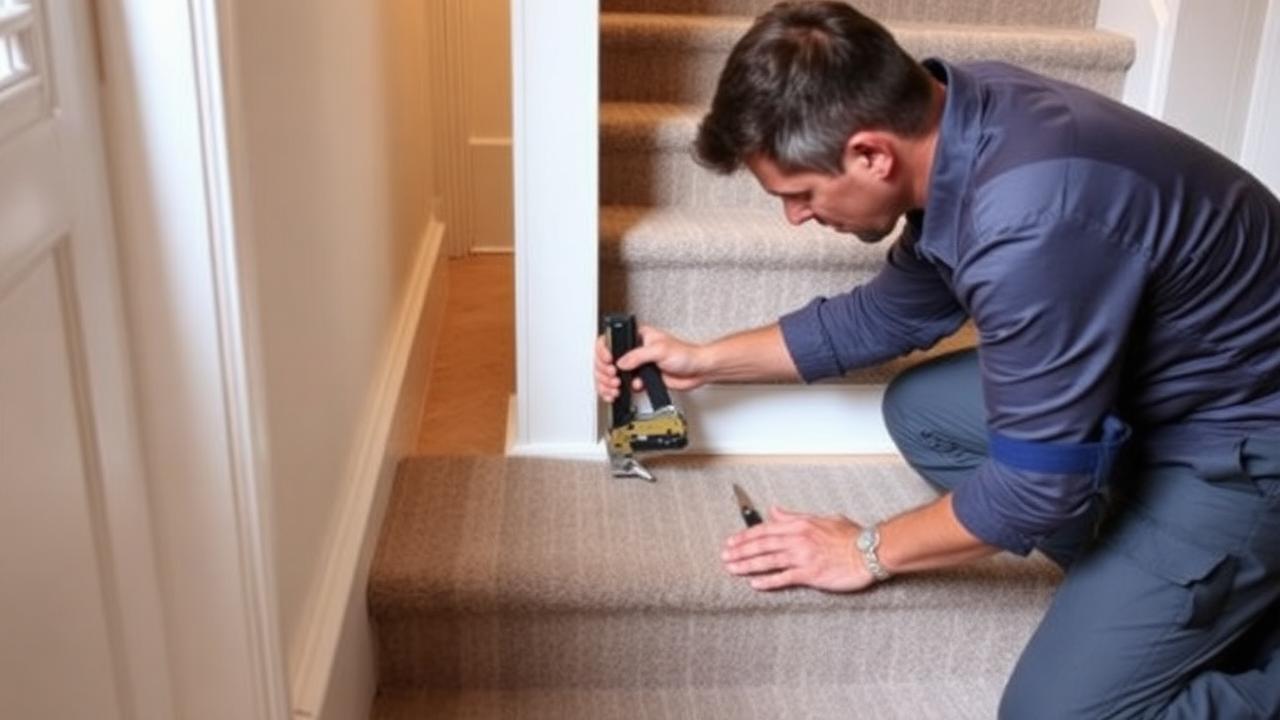
The no-drill toolkit
Four methods make up almost every genuinely no-drill stair runner installation, and they're designed to be combined rather than chosen individually. Tension rods spring outward against the strings at each tread crease and hold the runner by friction and downward pressure. Clamping clips grip the runner and the tread edge mechanically without piercing either. Grip pads are high-friction adhesive pads bonded to the tread under the runner. Light-duty double-sided tape supplements any of the above at the nosing, where movement concentrates.
| Method | Leaves marks? | Works on cut-string stairs? | Hold quality alone |
|---|---|---|---|
| Tension rods | No | No — needs parallel closed strings | Good |
| Clamping clips | No | Yes, if tread edge allows clamping | Fair to good |
| Grip pads | Minimal residue, usually removable | Yes | Fair |
| Double-sided tape | Minimal residue on sealed surfaces | Yes | Fair, weakens under flex |
Check your staircase shape first
Tension rods are the strongest of the no-drill methods but only work where the clear width between the strings is genuinely consistent from top to bottom — a straight, closed-string flight. On a cut-string staircase (where the ends of the treads are visible, without a continuous string alongside), or on a flight that tapers even slightly, a tension rod has nothing consistent to press against and will not hold reliably. In that case, build the fix around clips and grip pads instead.
The best-performing combination
Grip pads under the runner across the tread, plus a tension rod or clamping clips at every crease, consistently outperforms any single method used alone in real-world reports. The grip pads control the flat, low-load area of the tread, while the rods or clips take the higher-load flex right at the nosing and crease where a runner is most likely to lift or creep.
- Clean and dry every tread thoroughly before fitting anything adhesive.
- Lay the runner and mark the crease position at every step before fixing.
- Fit grip pads first, centred under the runner, then lay the runner over them.
- Add tension rods or clips at every crease, working from the bottom of the flight upward.
- Recheck every fixing after the first week, then monthly — friction-based systems settle and need re-tensioning.
Check your tenancy agreement before adhesive of any kind
Even 'residue-free' tapes and pads can mark some paint finishes, and some tenancy agreements explicitly prohibit adhesives on stair surfaces regardless of how they're marketed. Test any adhesive product on a hidden spot for 48 hours, and get informal confirmation from your landlord in writing before covering a whole flight.
What to expect for durability
No-drill systems are not a permanent fix and shouldn't be marketed or budgeted as one. Expect to re-tension rods and clips every one to three months, and to occasionally replace a grip pad that's lost adhesion, particularly in the first six months while you find the right combination for your specific stairs. This is a normal, expected maintenance cycle for a no-drill install, not a sign it's failing — see the temporary stair runner guide for the equivalent maintenance rhythm.
Cost breakdown
| Component | 13-step flight, approx. |
|---|---|
| Tension rods (13) | £195-455 / $260-610 |
| Clamping clips (26) | £90-160 / $120-215 |
| Grip pads (13-26) | £25-80 / $35-105 |
| Runner itself (budget-mid) | £150-400 / $200-540 |
| Full no-drill setup, all-in | £360-830 / $480-1,120 |
Know your numbers in 30 seconds
Enter your step count, tread depth and riser height — the stair runner calculator gives you the exact length to order, in metres and feet, with waste included.
Open the stair runner calculatorChoosing a runner width and length for a rental
Because no-drill methods can't rely on gripper strip to hold a tightly stretched edge, err very slightly narrower than you might for a permanent fit, leaving a touch more exposed stair on each side — this reduces the chance of an edge lifting where it isn't under any tension. Use the stair runner width calculator to check proportions before ordering, and buy pre-bound rather than raw-edge carpet, since you won't have a professional fitter finishing the edges on site.

Worked example: sizing a no-drill runner for a 13-step rental flight
Take a typical rental staircase: 13 steps, a 10in (25cm) going and a 7.5in (19cm) rise, with a clear width of 33in (84cm) between the strings. The running length before allowances is 13 x 17.5in = 227.5in, or about 19ft (13 x 44cm = 572cm, about 5.7m). Because a no-drill fit is repositioned more often than a stapled one, add a slightly larger waste allowance than usual — 10% rather than the 5-7% a fitter would use — which takes you to roughly 250in (21ft, or about 6.3m). For width, take the 33in clear span, subtract about 8in (20cm) total so you leave a 4in (10cm) reveal each side, and you land on a 25-27in (64-70cm) runner, which sits neatly inside the most widely stocked stair runner carpet widths. Run those figures through the stair runner calculator on the homepage before you order, because on a rental you generally cannot go back for a second cut from the same dye lot months later.
| Clear width between strings | Suggested runner width | Reveal each side |
|---|---|---|
| 30in / 76cm | 22-24in / 56-61cm | 3-4in / 8-10cm |
| 33in / 84cm | 25-27in / 64-70cm | 4in / 10cm |
| 36in / 91cm | 27-30in / 70-76cm | 4-5in / 10-12cm |
| 40in / 102cm | 30-32in / 76-81cm | 5in / 12cm |
Documenting the staircase before you fit anything
The five minutes that most often saves a deposit is spent before any product touches the treads. Photograph every tread and riser in daylight, including the string edges and any existing scuffs, and keep the images with your check-in inventory rather than only on your phone. If a landlord or letting agent later queries a mark, a dated photograph of the bare staircase settles the point far faster than an argument about how the runner was fitted. The same logic applies at the end of the tenancy: photograph the stairs again immediately after removing rods, clips and pads, before you clean, so the comparison is like-for-like.
- Photograph each tread, riser and string edge in daylight before fitting, and store the images with your tenancy paperwork.
- Test any adhesive pad or tape on a hidden step for 48 hours and photograph the test area before and after removal.
- Keep the product listings for anything adhesive, so you can show the residue-free rating if it is ever questioned.
- Ask for written (even email) confirmation from the landlord before covering a full flight, describing the exact fixing method.
- Re-photograph the bare stairs immediately after removal, before cleaning, so the comparison matches the check-in images.
Which no-drill method suits which tenancy length
Tenancy length changes the sensible choice more than most buying guides admit. For a six-month let, clamping clips plus grip pads keep the upfront spend near the bottom of the ranges above and come up in under an hour at the end. For a two- or three-year tenancy, tension rods are worth the higher outlay because they need no adhesive at all, survive repeated re-tensioning, and can be unscrewed from their brackets and taken with you to the next property. Either way, keep the runner itself slightly generous in length rather than cut exactly to the calculated figure, because a no-drill fit is far more likely to be lifted and repositioned once or twice in its life than a permanently stapled one.
Whatever you decide, get the numbers first: the stair runner calculator doubles as a stair runner length calculator, adding nosing wrap, landings, winders, pattern repeat and waste so you order the right length the first time.
Still deciding on material, width or pattern? Our hub on stair runners compares weaves, widths, backings and fitting styles side by side, then hands the numbers straight to the calculator.
Frequently asked questions
Can you fit a stair runner without drilling?
Yes, on most straight closed-string staircases, using tension rods, clamping clips and grip pads in combination. It won't hold quite as securely as gripper and staples but is genuinely workable for daily use.
Do tension rods work on all staircases?
No — they need a consistent clear width between two parallel strings. They don't work reliably on cut-string or tapering staircases; use clips and grip pads instead in that case.
Will a no-drill stair runner damage a rental property?
Not if fitted correctly. Tension rods and clips leave no marks. Adhesive tapes and grip pads can leave minor residue on some paint finishes, so test a hidden spot first and check your tenancy agreement.
How much does a renter-friendly stair runner cost?
A full no-drill kit — rods or clips plus grip pads — runs roughly £120-350 or $160-470 on a 13-step flight, before the runner itself.
How often do no-drill stair runner fixings need attention?
Expect to re-tension rods or clips every one to three months and occasionally replace a grip pad, especially in the first six months. This is normal maintenance, not a sign of failure.
What's the strongest no-drill method?
Grip pads under the runner combined with tension rods or clamping clips at every crease outperforms any single method used alone, because it addresses both the flat tread and the high-flex nosing.
Can I use double-sided tape alone on a rental staircase?
You can, but tape alone is the weakest option and tends to lift within months under daily traffic. It works better as a supplement to rods, clips or pads than as the sole fixing.
What size runner should I buy for a no-drill fit?
Slightly narrower than you'd choose for a permanent fit, leaving a touch more exposed stair either side, since the edges aren't held under gripper tension. Check proportions with the width calculator first.
Know your numbers in 30 seconds
Enter your step count, tread depth and riser height — the stair runner calculator gives you the exact length to order, in metres and feet, with waste included.
Size my no-drill runnerReady for real prices?
Get quotes from vetted stair runner suppliers and fitters near you. Free, no account, no obligation.
Every guide is written from hands-on measuring and fitting experience, checked against the calculator’s own maths, and re-reviewed whenever prices or methods change. Read our editorial standards.