
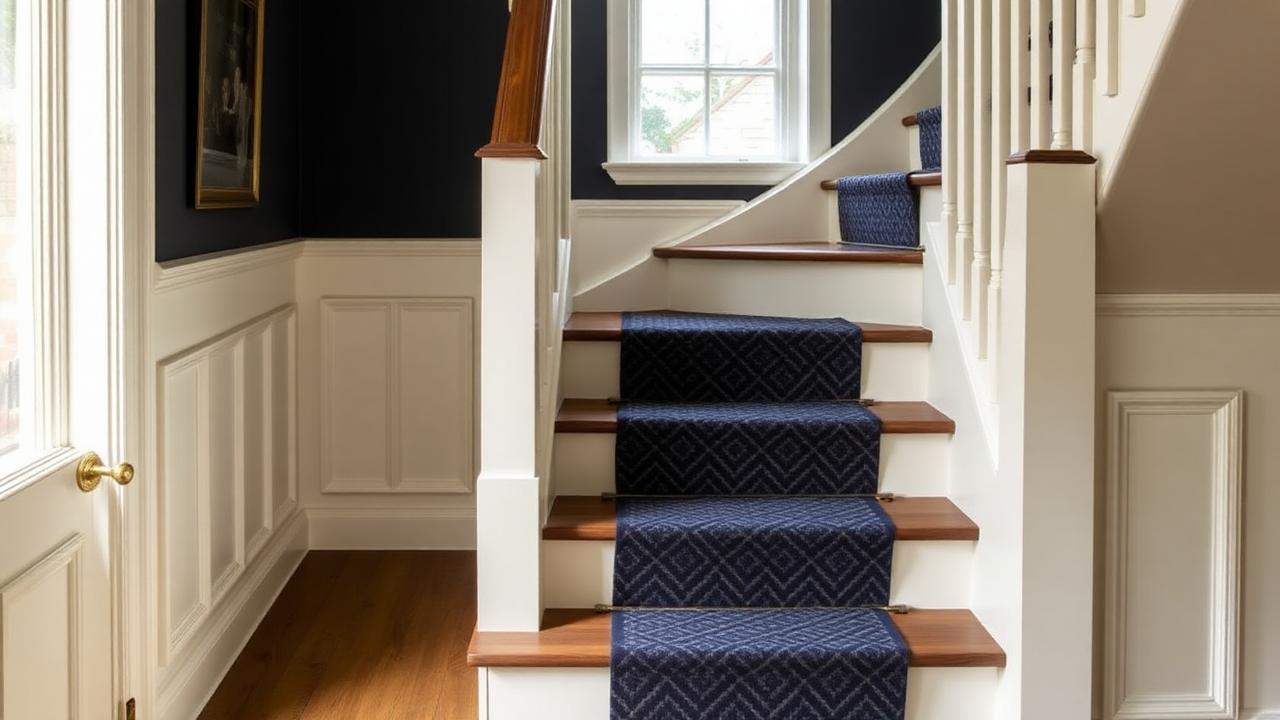
What is a rug stair runner
A rug stair runner is any staircase carpet that borrows its pattern language, colour palette or construction from area rugs rather than from traditional broadloom stair carpet ranges. In practice this covers two quite different products: an actual rug — a finished, bound piece bought in a stock length like 8ft or 10ft — fitted directly to the stairs, or a cut-and-bound runner woven to rug-style patterns (Persian, kilim, Moroccan, vintage-wash) but supplied on a roll and cut to the exact length of the flight like any other stair runner. The visual result can look almost identical; the sizing, joining and cost implications are very different.
People search for stair carpet runner ideas in this rug-inspired style because rug ranges carry far more pattern variety than mainstream broadloom stair ranges — kilim flatweaves, distressed vintage-wash Turkish designs, and bold Moroccan Beni Ourain-style geometrics are widely available as rugs but comparatively rare as dedicated stair broadloom.
Popular rug-style patterns for stairs
| Style | Colour palette | Best staircase type |
|---|---|---|
| Persian medallion | Deep reds, blues, gold accents | Formal, traditional staircases |
| Kilim geometric | Rust, mustard, indigo, cream | Eclectic, bohemian interiors |
| Vintage-wash Turkish | Faded pastels, muted terracotta | Relaxed, lived-in interiors |
| Moroccan Beni Ourain | Ivory with black or brown line motifs | Minimal, Scandinavian-boho crossover |
| Tribal / Aztec geometric | High-contrast black, white, rust | Modern-eclectic staircases |
Stock rug vs cut-and-bound rug-style runner
| Stock rug fitted to stairs | Cut-and-bound rug-style runner | |
|---|---|---|
| Lead time | Days, in stock | 2-4 weeks typically |
| Length | Fixed sizes, joins usually needed | Exact to your flight, no joins |
| Cost per step | Lower, especially machine-woven | Higher but no join waste |
| Pattern range | Very wide, full rug market | Narrower, depends on supplier |
| Winders and turns | Very difficult to shape | Can be cut and bound to shape |
If the staircase is short and straight, a stock rug is usually the simpler and cheaper route. If the flight has a turn, winders or a landing, a cut-and-bound rug-style runner from a roll almost always works out better, because it can be shaped exactly where a fixed-size rug cannot.
Sizing a rug stair runner
As a rule of thumb, each stair step consumes about 18in (46cm) of runner length once tread depth, riser height and the nosing curve are accounted for. This lets you convert directly between a stock rug length and the number of steps it will cover.
| Rug length | Steps covered | Notes |
|---|---|---|
| 6 ft (1.83m) | 4 steps | Short flight only |
| 8 ft (2.44m) | 5 steps | Half flight to a landing |
| 10 ft (3.05m) | 6-7 steps | Common single-rug size |
| 12 ft (3.66m) | 8 steps | Two rugs cover 13-16 steps |
Joining rug patterns across a flight
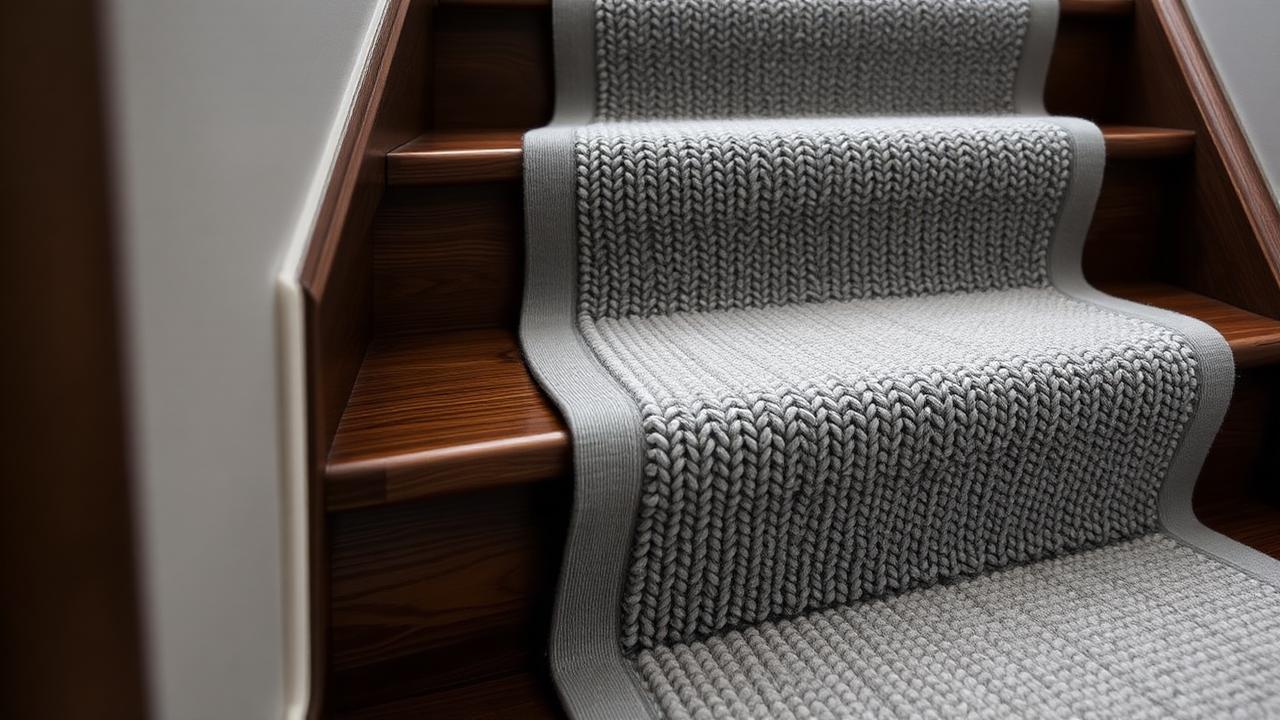
Where a full staircase needs more length than one rug or one roll section provides, the join has to land at the base of a riser so it is hidden in the shadow line, exactly as with a plain rug runner. Bold geometric and kilim patterns make mismatched joins far more visible than a plain colour would, so buy all pieces from a single production run and check that the pattern repeat aligns at the join point before fitting, not after.
- Confirm total flight length with the stair runner calculator.
- Choose whether to buy stock rug lengths or order a cut-and-bound roll length.
- Mark exactly which riser each join or cut will fall on.
- For patterned rugs, buy from the same dye lot and check the pattern lines up across the join.
- Fit the lower section first, then align the upper section's pattern before fixing.
Know your numbers in 30 seconds
Enter your step count, tread depth and riser height — the stair runner calculator gives you the exact length to order, in metres and feet, with waste included.
Open the stair runner calculatorFitting a rug-style runner
Fixing methods are the same as for any stair runner: staples, gripper strip, or stair rods, with underlay recommended in every case. Bold patterns generally suit a waterfall fit, since the pattern already provides visual interest and does not need the added structure of a Hollywood fit and rods — though rods in an antique brass or bronze finish do complement kilim and Persian palettes particularly well if a more finished, decorative look is wanted.
| Fixing method | Works well with | Notes |
|---|---|---|
| Staples with underlay | Waterfall fit, bold pattern | Cleanest, most affordable option |
| Gripper strip | Any rug-style pattern | Professional standard, removable |
| Antique brass or bronze rods | Persian, kilim, vintage-wash | Adds a decorative, finished layer |
What a rug stair runner costs
| Item | Typical range (US) | Typical range (UK) |
|---|---|---|
| Machine-woven kilim-style, 13 steps | $235-470 | £190-380 |
| Hand-knotted or vintage-wash, 13 steps | $700-1,800 | £560-1,440 |
| Cut-and-bound rug-pattern roll, 13 steps | $390-850 | £315-680 |
| Underlay pad, 13 steps | $50-90 | £40-75 |
| Professional fitting | $235-455 | £195-365 |
Run the exact figures through the stair runner cost calculator before comparing a stock-rug route against a cut-and-bound route, since the two can differ substantially once joins, waste and winders are factored in.
Living with a bold rug-style runner
Busy, high-contrast rug patterns hide daily wear and light soiling far better than a plain colour, which is one of their practical advantages on a staircase. Vacuum weekly with the beater bar off on lower-pile designs, and if the pattern is genuinely one-off or vintage, keep any leftover material from the same batch for future repairs, since a mismatched replacement patch is far more visible on a bold rug pattern than on a plain runner.
Whatever you decide, get the numbers first: the stair runner calculator doubles as a stair runner length calculator, adding nosing wrap, landings, winders, pattern repeat and waste so you order the right length the first time.
Still deciding on material, width or pattern? Our hub on stair runners compares weaves, widths, backings and fitting styles side by side, then hands the numbers straight to the calculator.
Frequently asked questions
What is a rug stair runner?
A stair runner styled after rug patterns — Persian, kilim, vintage-wash or Moroccan geometric designs — either as an actual stock rug fitted to the stairs, or as a cut-and-bound broadloom runner woven in a rug-inspired pattern.
Should I use a stock rug or a cut-and-bound runner for a rug-style stair look?
A stock rug suits a short, straight flight. A cut-and-bound runner from a roll is better for staircases with turns, winders or landings, since it can be shaped where a fixed-size rug cannot.
How do you size a rug for a staircase?
Allow about 18in (46cm) of runner per step. A 10ft rug covers roughly 6-7 steps, so a standard 13-16 step staircase typically needs two rugs or a bespoke cut-and-bound length.
Do bold rug patterns need to be joined carefully on stairs?
Yes. Joins must land at the base of a riser, and pattern pieces should come from the same production batch so the design lines up cleanly across the join.
What fitting method suits a rug stair runner?
Waterfall fitting with staples or gripper strip suits most bold patterns well, since the pattern already carries visual interest. Antique brass or bronze rods complement Persian and kilim palettes if a more decorative finish is wanted.
How much does a rug stair runner cost?
Machine-woven kilim-style runners for a 13-step staircase typically cost $235-470, while hand-knotted or vintage-wash options run $700-1,800 or more.
Can a rug stair runner handle winders?
Not easily if it is a fixed-size stock rug. A cut-and-bound roll version can be shaped to fit winder treads, making it the better choice for a turning staircase.
Do bold patterns show wear less than plain stair carpet?
Yes, generally. High-contrast, busy patterns hide light soiling and daily wear better than a solid colour, which is one practical reason they suit high-traffic staircases.
Know your numbers in 30 seconds
Enter your step count, tread depth and riser height — the stair runner calculator gives you the exact length to order, in metres and feet, with waste included.
Measure my stairsReady for real prices?
Get quotes from vetted stair runner suppliers and fitters near you. Free, no account, no obligation.
Every guide is written from hands-on measuring and fitting experience, checked against the calculator’s own maths, and re-reviewed whenever prices or methods change. Read our editorial standards.