
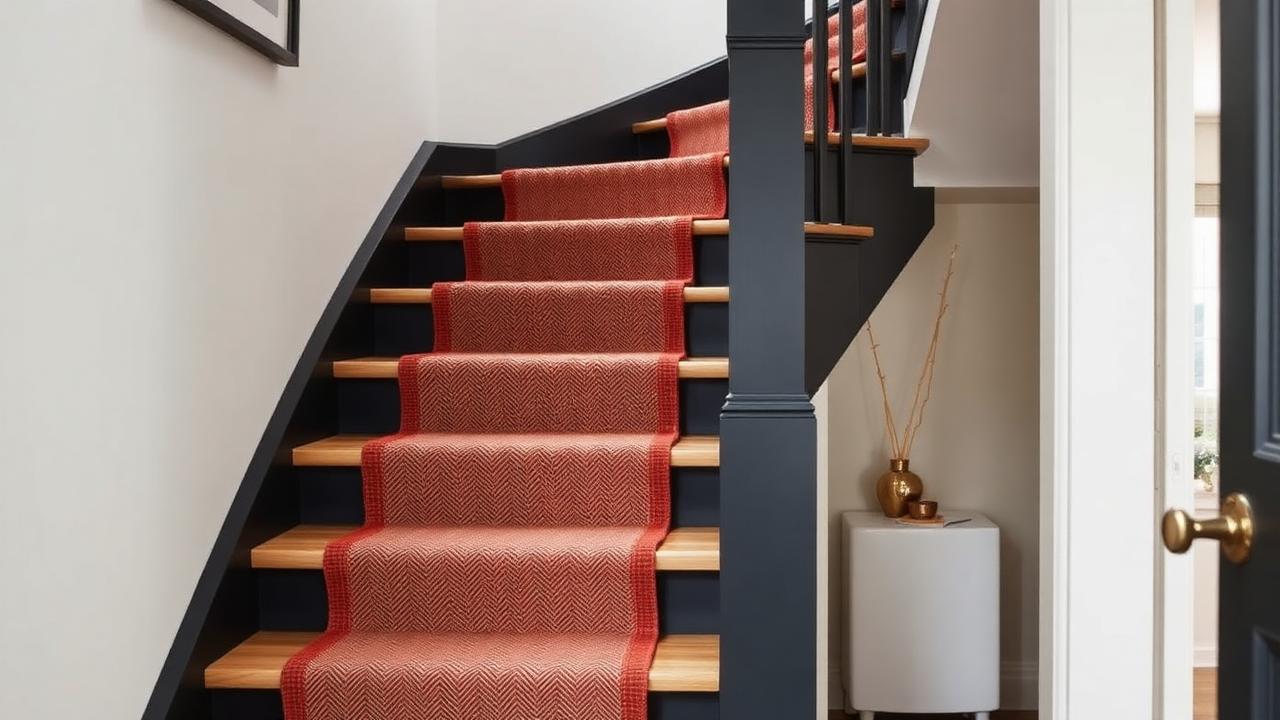
Rug runner vs fitted broadloom runner
A stair rug runner is manufactured and finished as a complete product — bound or serged on all edges, sold at a fixed length (commonly 6ft, 9ft, 12ft or custom lengths up to 24ft+) — and can, in principle, be lifted off the stairs and reused elsewhere or taken to a new home. A fitted broadloom runner, by contrast, is cut to the exact length of a specific staircase from a roll and bound to that flight's precise measurements, with no expectation of reuse elsewhere. Rug runners suit renters and anyone who values flexibility; fitted runners suit anyone who wants a perfect, seamless match to one specific flight and plans to stay long-term.
| Factor | Stair rug runner | Fitted broadloom runner |
|---|---|---|
| Sizing | Fixed stock lengths, may need trimming or a gap | Custom-cut to the exact flight |
| Reusability | Can be lifted and reused elsewhere | Cut to one staircase, not reusable |
| Typical fixing | Rug grippers, double-sided tape, or stair rods | Staples, tackless strip, or rods |
| Best for | Renters, DIY, short-term homes | Long-term owners wanting a precise fit |
Fixed sizes to check before buying
Most rug-style stair runners are sold in these common lengths: 6ft (covers roughly 5-6 steps), 9ft (8-9 steps), 12ft (10-11 steps), 15ft (13-14 steps), and made-to-order lengths beyond that from some retailers. If your flight falls between two stock sizes, most suppliers will custom-cut a rug runner to length for an added fee, effectively converting it into a semi-fitted product — worth asking about directly rather than assuming only fixed sizes are available.
- Measure total flight length including any landing run using the stair runner length calculator.
- Round up to the next available stock length rather than down, and plan to trim any excess at the bottom step.
- Check the rug's finished width against your desired reveal — rug runners commonly come in 26in, 27in, 30in and 36in widths.
- Ask whether the supplier offers custom-length cutting with rebinding if your flight falls between standard sizes.
Securing a rug runner safely
Because a rug runner is not tacked into gripper strip the way a fitted runner usually is, securing it properly matters even more for safety. The most common methods are double-sided carpet tape at each tread (renter-friendly, no marks on removal), narrow adhesive stair rug grippers sold specifically for this purpose, or decorative stair rods, which both secure the rug and add a finished look without any adhesive or stapling at all.
| Fixing method | Damage to stairs | Security level | Typical cost (13 steps) |
|---|---|---|---|
| Double-sided carpet tape | None to minimal | Moderate, needs periodic reapplication | $15-35 |
| Adhesive rug grippers | Minimal | Good | $25-50 |
| Stair rods | Small screw holes if not clip-on | Excellent | $260-650 |
| Staples into gripper strip | Permanent holes | Excellent | $50-90 (materials) |
Rug runners need underlay too
Even a finished rug runner benefits from a thin non-slip pad beneath it, both to cushion the tread edge and to stop the rug shifting between fixing points. Skipping underlay on a rug-style runner is one of the most common reasons they work loose within the first year.
Know your numbers in 30 seconds
Enter your step count, tread depth and riser height — the stair runner calculator gives you the exact length to order, in metres and feet, with waste included.
Open the stair runner calculatorCost comparison
A stock-size rug runner is usually the cheaper starting point for a small budget, since it avoids custom cutting and binding fees, but the gap narrows once you compare against similar-quality fitted broadloom. In the US, a 9ft wool-blend rug runner typically costs $180-380; the UK equivalent (roughly 2.7m) runs £150-320. Add a rug pad and your chosen fixing method to reach the full installed cost.

How much runner length to actually order
Because rug runners come in fixed stock lengths, the goal is not to calculate an exact figure but to work out the minimum length that clears your flight so you round up to the nearest available size rather than under-ordering. On a 13-step US flight with a 10in going and 7.5in rise, the total run works out to 13 x (10+7.5)/12 = 19ft before any waste allowance, meaning a 15ft stock rug runner would fall well short and you would need to step up to a 21-24ft custom-cut length. In metric terms, the same 13-step flight with 25cm going and 19cm rise needs 13 x (25+19)/100 = 5.7m, so a 6m stock length is the minimum realistic choice, with 6.5-7m safer once a small trim allowance at the bottom step is included. Always confirm the figure for your own flight using the stair runner calculator, since even a one-inch difference in going per step adds over a foot of extra length across a 13-step run.
| Flight length | Minimum US length needed | Minimum UK length needed | Recommended stock size |
|---|---|---|---|
| 9 steps | ~13.75ft | ~4.2m | 15ft / 4.5m |
| 13 steps | ~19ft | ~5.7m | 21-24ft / 6-6.5m |
| 17 steps | ~25ft | ~7.5m | custom cut to length |
When a rug runner beats fitted stair runner carpet
Renters and anyone in a short-term let are the clearest case for a rug-style runner over fitted stair runner carpet, since a rug runner can be lifted, rolled and taken to the next home without a single mark left on the stairs when secured with tape or clip-on rods rather than staples. Homeowners planning a stair renovation within the next few years also lean toward rug runners, since replacing a rug is a same-day job while replacing fitted broadloom typically means a half-day fitter visit. Fitted broadloom stays the better choice once you are confident in the long-term stair layout and want a seamless, edge-to-edge look with no visible rug border at all.
Quick decision checklist
- Renting or planning to move within 2-3 years - choose a rug runner.
- Want zero visible border and a seamless fitted look - choose broadloom.
- Budget-limited but want a quality wool feel - choose a stock-size wool-blend rug runner.
- Flight has an unusual winder or turn - fitted broadloom handles irregular shapes better.
Storing and reusing a rug runner
One genuine advantage of a rug-style runner over fitted stair runner carpet is that it can be rolled, stored and reused after a move or a stair refit. Roll rather than fold a rug runner for storage, since a sharp fold crease in wool or wool-blend backing can leave a permanent line that is difficult to fully relax out later. Store it somewhere dry with a breathable cover rather than sealed plastic, which can trap moisture against wool fibres, and add a cedar block or lavender sachet nearby if long-term storage in a loft or garage is likely, since natural fibre backing can attract moth activity in storage far more than it does in daily use on a stair.
Whatever you decide, get the numbers first: the stair runner calculator doubles as a stair runner length calculator, adding nosing wrap, landings, winders, pattern repeat and waste so you order the right length the first time.
Frequently asked questions
What is a stair rug runner?
A finished, edge-bound rug sold in fixed lengths (commonly 6-15ft) rather than custom-cut broadloom, designed to be laid onto a staircase and, if needed, removed and reused elsewhere.
How do you secure a stair rug runner without stapling?
Double-sided carpet tape, adhesive stair rug grippers, or decorative stair rods are the three main non-permanent options, all of which avoid stapling into the treads.
What if my staircase doesn't match a standard rug runner length?
Round up to the next available stock size and trim the excess, or ask the supplier about custom-length cutting with rebinding, which many retailers offer for an added fee.
Does a stair rug runner need underlay?
Yes. A thin non-slip pad underneath cushions the tread edge and helps keep the rug from shifting between fixing points, even with tape or grippers holding it in place.
Is a stair rug runner good for renters?
Yes, it is one of the most rental-friendly options since it can be secured with tape or clip-on rods that leave no permanent marks and can be taken to a new home later.
How much does a stair rug runner cost?
A 9ft wool-blend rug runner typically costs $180-380 (£150-320) before pad and fixing costs, generally less than an equivalent fitted broadloom runner of the same quality.
Know your numbers in 30 seconds
Enter your step count, tread depth and riser height — the stair runner calculator gives you the exact length to order, in metres and feet, with waste included.
Measure my stairsReady for real prices?
Get quotes from vetted stair runner suppliers and fitters near you. Free, no account, no obligation.
Every guide is written from hands-on measuring and fitting experience, checked against the calculator’s own maths, and re-reviewed whenever prices or methods change. Read our editorial standards.