
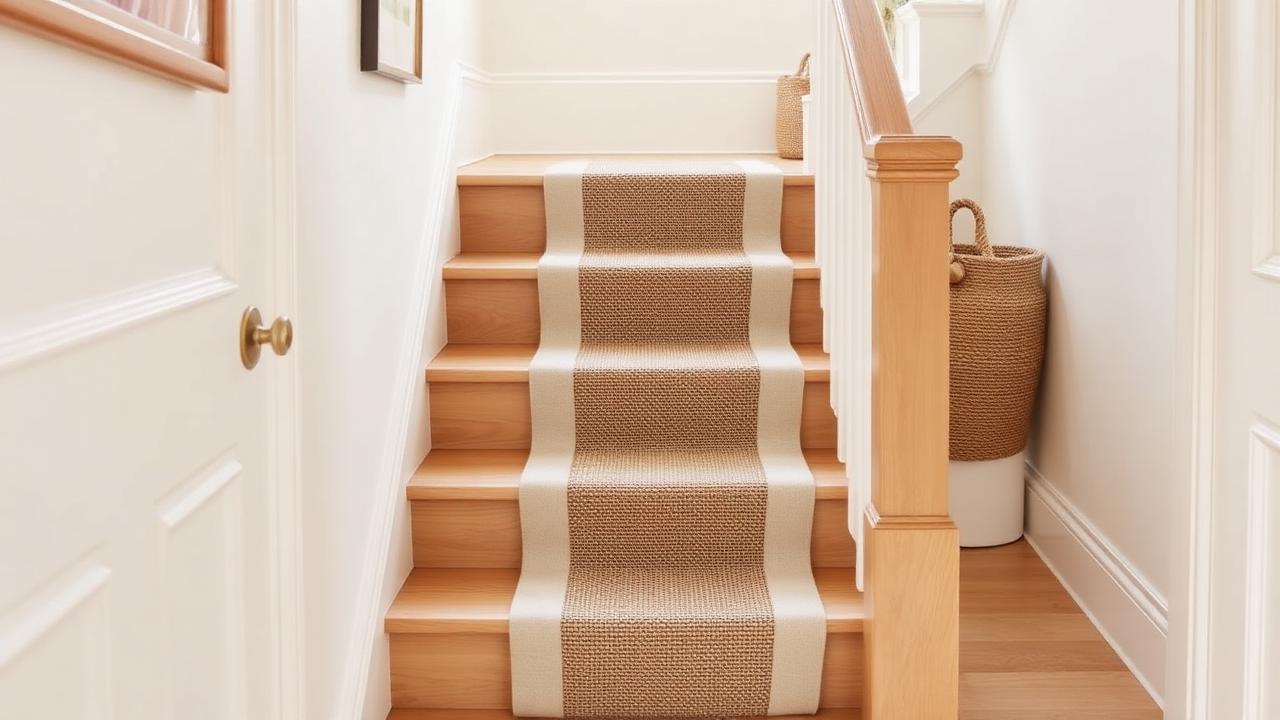
Full comparison table
| Fibre | Wear resistance | Stain resistance | Slip risk | Price per ft (US) |
|---|---|---|---|---|
| Sisal | Excellent | Poor | Low-moderate | $18–$45 |
| Jute | Fair | Poor | Low | $12–$30 |
| Seagrass | Moderate | Good | High | $14–$32 |
| Coir | Good | Poor | Moderate | $10–$25 |
| Wool (80/20 blend) | Very good | Good | Low | $25–$70 |
Ranking by best stair safety
For stair-specific slip safety, wool and sisal rank ahead of seagrass, thanks to their textured, non-glossy surface. Seagrass's smooth, waxy fibre is genuinely the riskiest natural option on a treaded staircase and is best reserved for flat flooring.
Ranking by stain resistance
- Wool: fair natural resistance, some time to blot spills before staining.
- Seagrass: naturally water-resistant surface, wipes clean well.
- Sisal: absorbs and stains permanently, avoid near spill-prone areas.
- Jute: absorbs quickly and can yellow, the weakest performer here.
- Coir: coarse and porous, stains and is hard to clean fully.
Know your numbers in 30 seconds
Enter your step count, tread depth and riser height — the stair runner calculator gives you the exact length to order, in metres and feet, with waste included.
Open the stair runner calculatorNo single natural fibre wins on every factor
If durability at the nosing is the priority, sisal or wool lead. If moisture resistance matters most, seagrass or synthetic sisal lead instead. Rank your own priorities before choosing.
When to choose a synthetic alternative instead
If your staircase sees children, pets, or a nearby entryway with wet shoes, a synthetic sisal or polypropylene alternative will usually outperform any genuine natural fibre on stain and moisture handling, while keeping the same textured aesthetic.
Wear rating and warranty comparison
Warranty length is one of the clearest signals of how a mill expects each natural fibre to perform on stairs specifically, since manufacturers set warranty terms based on real return-rate data across thousands of installations.
| Fibre | Typical wear warranty | Realistic stair lifespan |
|---|---|---|
| Sisal | 5-10 years | 10-15 years |
| Jute | 0-3 years (pure) | 4-8 years |
| Wool (100%) | 10-15 years | 10-15 years |
| Wool-nylon 80/20 | 20-25 years | 15-20 years |
| Seagrass | 0-5 years | 6-10 years (landings better than treads) |
Buying checklist with price bands
When comparing natural fibres head to head, price alone is misleading since sisal, jute and wool sit on overlapping but distinct price scales driven by different cost factors: harvesting and weaving labour for plant fibres, versus raw material and processing for wool.
| Fibre | Price per linear ft (US) | Price per linear m (UK) |
|---|---|---|
| Jute | $12-$30 | £18-£45 |
| Sisal | $18-$45 | £25-£65 |
| Seagrass | $15-$35 | £22-£50 |
| Wool (80/20 blend) | $25-$70 | £35-£100 |
- Match the fibre to the traffic level first, then to budget; a cheap fibre on a busy stair is rarely the cheapest option over ten years.
- Request wear-warranty documentation in writing, not just a verbal assurance from the sales team.
- Ask for a moisture-tolerance rating if the stair is near an entry, basement or bathroom.
Cost per year across the five fibres
| Fibre | Typical price/ft (US) | Realistic stair life | Approx cost per ft per year |
|---|---|---|---|
| Jute | $18 | 6 years | $3.00 |
| Seagrass | $22 | 7 years | $3.14 |
| Coir | $16 | 8 years | $2.00 |
| Sisal | $28 | 12 years | $2.33 |
| Wool 80/20 | $45 | 18 years | $2.50 |
Trade tip: mixing fibres in one scheme
It is common and often sensible to use a tougher fibre like sisal or wool on the main flight and a softer, cheaper fibre like jute or cotton on a landing or a rarely used secondary stair, provided the colours are chosen to coordinate rather than match exactly. Ask a single supplier to quote both so binding colour and edge finish are consistent across the whole job.
Environmental and sustainability considerations
Natural fibres like sisal, jute and seagrass are biodegradable and typically require less energy to produce than synthetic alternatives, making them a popular choice for buyers prioritising sustainability. Wool sits between the two: it is a renewable, biodegradable natural fibre but often blended with a small percentage of nylon for stair durability, which slightly reduces its end-of-life biodegradability compared with 100% wool or pure plant fibres.
| Fibre | Biodegradable | Typical production footprint |
|---|---|---|
| Sisal | Yes | Low, minimal processing |
| Jute | Yes | Low, minimal processing |
| Seagrass | Yes | Low, harvested rather than farmed |
| Wool (100%) | Yes | Moderate, farming footprint |
| Wool-nylon blend | Partial | Moderate to higher |
Choosing between natural fibres by household type
- Young family with children and pets: wool-nylon blend or synthetic sisal, avoiding pure sisal, jute or seagrass on the main stair.
- Adult-only household, low spill risk: pure sisal or wool both perform excellently.
- Rental or short-term ownership: jute or a budget synthetic keeps upfront cost low given the shorter expected tenure.
- Period or heritage home wanting an authentic natural look: sisal or wool in a herringbone or boucle weave suits the aesthetic while still performing well.
Testing samples before a full order
Every natural fibre in this comparison looks meaningfully different under real stairwell lighting than under a showroom spotlight, so always request a large physical sample, at least A4 size, and view it on the actual staircase at different times of day before committing to a full flight order across any of these fibres.
Worked example: sizing a natural fibre order for a 13-step staircase
Natural fibres are usually sold in fixed widths and cut from finite rolls, so getting the yardage right before ordering matters more than with a broadloom synthetic. Take a straight 13-step flight with a 10in going and 7.5in rise in US units, or 25cm going and 19cm rise in UK units. The pitch-line run is 13 x 17.5in = 227.5in (13 x 44cm = 572cm). Sisal and jute both need slightly more nosing wrap than a low-pile synthetic, typically 1.5-2in (4-5cm) per tread because the weave is stiffer and does not compress as tightly around the nosing radius, bringing the figure to roughly 247-253in (626-638cm). Add an 8-10% waste allowance for natural fibres specifically, since off-cuts from a woven natural cannot always be reused elsewhere on the job the way a synthetic remnant can, and you land at approximately 270-280in (686-711cm) of running length. Enter these exact tread-by-tread numbers into a stair runner calculator before placing a natural fibre order, since natural fibre suppliers often have longer lead times and will not thank you for a follow-up top-up order on a dye lot that has already sold out.
Natural fibre width and roll format comparison
| Fibre | Common roll widths | Typical minimum order |
|---|---|---|
| Sisal | 66cm, 70cm, 80cm, 4m broadloom | 1 linear metre |
| Jute | 68cm, 70cm, 4m broadloom | 1 linear metre |
| Seagrass | 70cm, 80cm | 1 linear metre |
| Coir | 70cm, 90cm | 1-2 linear metres |
- Natural fibre rolls are typically narrower than synthetic broadloom, so check the runner width you want fits a standard roll before falling in love with a specific weave.
- A stair runner calculator will convert your tread measurements straight into linear yardage, but you still need to confirm the roll width matches your chosen runner width.
- Order at least one spare linear foot beyond the calculated figure for natural fibres, since dye lots vary batch to batch and a repair years later will rarely match exactly.
- Ask the supplier for the true face width after any selvedge or binding allowance, since natural fibre binding can take up more edge width than a bound synthetic.
Why natural fibre stair runners need more careful planning than synthetics
Stiffness in the weave of sisal, jute and coir means these fibres crease rather than roll smoothly at a tight winder or a half-landing turn, which is the single biggest planning trap in a natural fibre installation. On stair runners fitted around winders, a fitter working in sisal will typically need to piece the fibre with a seam at the turn rather than wrapping it continuously the way a softer wool or synthetic pile can be coaxed around the same corner. Factor this into your budget and yardage before ordering, since a seamed winder section uses noticeably more fibre than a continuous wrap and the seam itself needs to be accounted for in both material and labour cost.
Whatever you decide, get the numbers first: the stair runner calculator doubles as a stair runner length calculator, adding nosing wrap, landings, winders, pattern repeat and waste so you order the right length the first time.
Frequently asked questions
Which natural fibre is most environmentally friendly for stairs?
Sisal, jute and seagrass are all biodegradable and generally require less energy to produce than synthetic fibres, making them strong choices for sustainability-focused buyers, though wool remains a renewable natural option too, especially in 100% wool form.
How do I choose between natural fibres for my specific household?
Match the fibre to your traffic and spill risk first: wool or synthetic sisal for families and pets, pure sisal or wool for dry adult households, and jute or budget synthetics for rentals or short-term ownership.
Is there a natural fibre that beats wool on every factor?
No single natural plant fibre beats an 80/20 wool-nylon blend across durability, stain resistance and safety together. Sisal comes closest on raw wear resistance, but wool still wins on stain resistance, crush recovery and warranty length overall.
Which natural fibre stair runner is most durable?
Sisal offers the best raw abrasion resistance among natural fibres, closely followed by wool, which also recovers from crushing better than sisal over time.
Which natural fibre is safest on stairs?
Wool and sisal have more textured, grippier surfaces than seagrass, which is notably smooth and slippery and best avoided on a treaded staircase.
Are natural fibre stair runners good with pets?
Wool with a tight loop performs best; sisal, jute and coir all stain permanently from pet accidents and are harder to recommend in busy pet households.
Is coir a good stair runner material?
Coir is coarse, stiff and cheap, with decent wear resistance but poor stain resistance and a rough feel; it suits doormats and entry areas more than a main staircase.
Which natural fibre is best for a busy family staircase?
An 80/20 wool-nylon blend is the strongest all-round choice for a busy main stair among natural fibres, offering the best crush recovery, longest warranty and most stain resistance. Sisal is a good second choice where a firmer, more textural look is wanted and spills are rare.
Know your numbers in 30 seconds
Enter your step count, tread depth and riser height — the stair runner calculator gives you the exact length to order, in metres and feet, with waste included.
Compare natural fibre costReady for real prices?
Get quotes from vetted stair runner suppliers and fitters near you. Free, no account, no obligation.
Every guide is written from hands-on measuring and fitting experience, checked against the calculator’s own maths, and re-reviewed whenever prices or methods change. Read our editorial standards.