
Fibre and construction
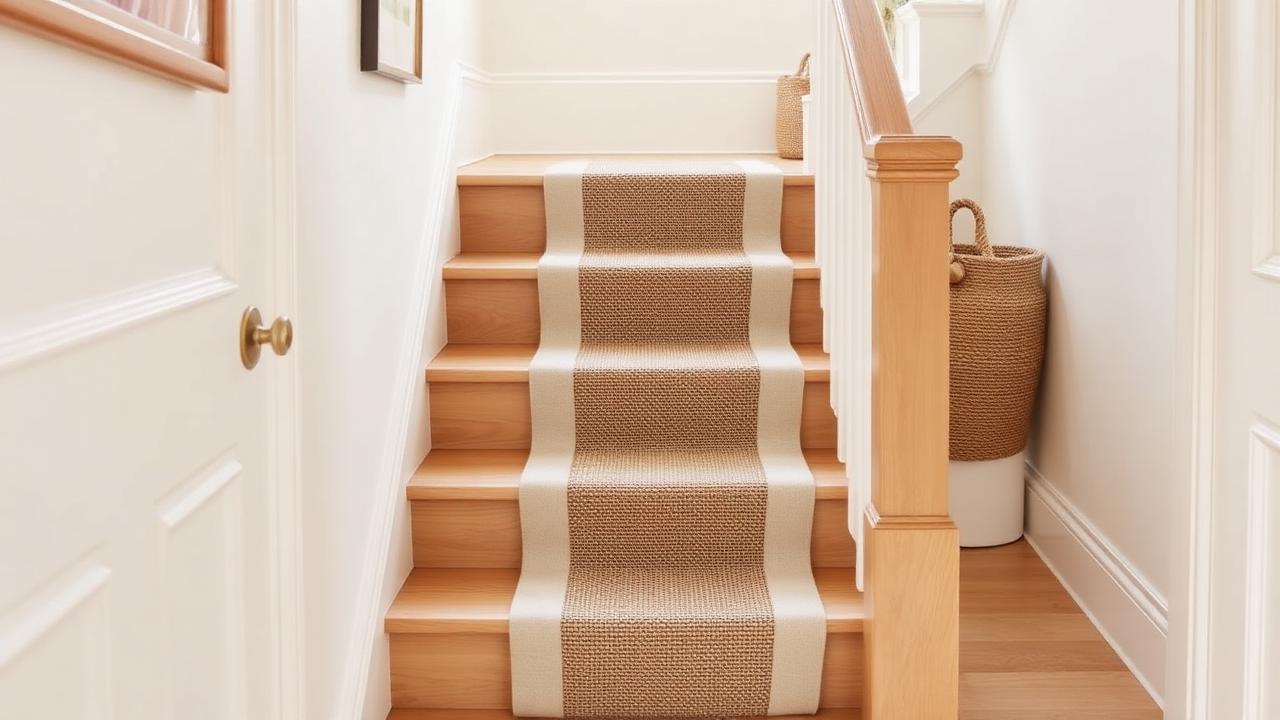
Jute comes from the stem of the jute plant, spun into a soft, low-lustre yarn and woven into flat or boucle constructions similar to sisal. The fibre itself is finer and less rigid than sisal, so jute runners feel noticeably softer underfoot but wear through faster at pressure points.
Spec sheet
| Property | Typical value |
|---|---|
| Fibre origin | Corchorus (jute plant) stem |
| Construction | Flatweave, boucle, often wool-blended |
| Face weight | 1,400–2,000 g/m² |
| Abrasion rating | Fair, weaker than sisal |
| Roll widths | 66cm, 68cm, some 4m broadloom |
| Price per linear ft (US) | $12–$30 |
| Price per linear m (UK) | £18–£45 |
Durability and where it fails first
Jute's weak point on a staircase is the nosing edge, where the fibre flattens and can start to fray within a few years of daily traffic. It is a poor choice for a family's only staircase in a busy household, but a good choice for a spare-room stair, a rarely used formal staircase, or a landing rather than a treaded run.
- Low resistance to abrasion compared with sisal, wool or nylon.
- Poor moisture tolerance, similar to sisal, and prone to yellowing if it stays damp.
- Very low static and no shedding.
- Often blended with wool at 50/50 or 80/20 to boost durability while keeping cost down.
Know your numbers in 30 seconds
Enter your step count, tread depth and riser height — the stair runner calculator gives you the exact length to order, in metres and feet, with waste included.
Open the stair runner calculatorBlend it if the stairs get real use
A jute-wool blend costs less than pure wool but wears dramatically better than pure jute. On any staircase used daily, treat pure jute as a landing or accent material rather than the full run.
Buying tips
Ask suppliers directly for the wear rating or Martindale-equivalent figure, since jute quality varies widely between mills. A denser, tighter weave with a heavier face weight will noticeably outlast a loose, lightweight jute at a similar price point.
Wear rating and warranty comparison
Jute rarely carries a manufacturer wear warranty at all when sold as a pure fibre, and where one exists it is usually 2 to 5 years, reflecting the fibre's genuinely lower abrasion resistance compared with sisal or wool. Wool-jute blends close this gap considerably because the wool content carries most of the mechanical load while jute contributes bulk and softness, so blended ranges can offer 8 to 12 year warranties at a price still well under pure wool.
| Product type | Typical warranty | Realistic stair lifespan |
|---|---|---|
| Pure jute | 0-3 years | 4-8 years |
| Wool-jute blend (50/50) | 8-10 years | 10-14 years |
| Wool-jute blend (80/20 wool) | 10-12 years | 14-18 years |
Care and cleaning specifics
Jute must be kept dry above almost every other care priority; even a damp mop bucket carried past an open jute-topped landing can wick moisture into the fibre and cause yellowing that does not reverse. Vacuum jute stairs weekly using suction only, never a rotating beater bar, since the brush roll snags and pulls jute fibres loose from the weave faster than it would with wool or synthetic pile.

- Blot spills immediately with a dry cloth; never rub, and avoid water-based spot cleaners.
- Use a dry foam or dry-compound carpet cleaning method only, never a steam or wet extraction cleaner.
- Keep jute stairs away from direct exterior doors where wet shoes or umbrellas are common.
- Rotate or replace a jute runner sooner than wool if you notice fibre breakage starting at tread edges.
Cost ranges in context
Pure jute sits at the bottom of the natural-fibre price ladder, which makes it tempting for a full staircase on a budget, but the true cost comparison should include how soon it will need replacing. At $15/ft with a realistic 6 year stair life, jute costs roughly $2.50 per foot per year, close to sisal despite the lower sticker price, because sisal simply lasts twice as long.
Where a jute-look synthetic makes more sense
| Situation | Better option than pure jute |
|---|---|
| Main staircase, daily use | Wool-jute blend or wool berber |
| Budget entry or basement stair | Polypropylene or synthetic sisal |
| Formal, rarely used staircase | Pure jute is fine here |
| Household with pets | Wool blend, not pure jute |
Jute versus cotton for a secondary staircase
Jute and cotton are often shortlisted together for a secondary or guest staircase because both are soft, natural and relatively inexpensive, but they fail differently. Jute wears through at the nosing fold from repeated flexing, while cotton flatweave thins and loses colour at the same point without the same fraying. If washability matters more than texture, cotton edges ahead; if a warmer, more textured natural look matters more, jute wins.
| Factor | Jute | Cotton |
|---|---|---|
| Softness underfoot | Soft, slightly coarse | Very soft |
| Washability | Poor, water damages fibre | Good, some machine washable |
| Typical lifespan on stairs | 4-8 years | 2-5 years |
| Price per linear ft (US) | $12-$30 | $8-$25 |
Humidity and climate considerations
Jute performs noticeably worse in humid climates or homes without air conditioning, since ambient moisture in the air alone, not just spills, can cause slow fibre degradation and a musty smell over time. In coastal or high-humidity regions, a wool-jute blend or a fully synthetic alternative is generally a safer long-term choice than pure jute, even on a low-traffic secondary staircase.
Refreshing a worn jute runner without full replacement
Because jute wears unevenly, fraying first at the nosing while the flat field between treads stays intact for years longer, some households have a fitter shift the runner down a step or two to move fresh weave into the nosing position, extending usable life by a year or two before full replacement. This only works on a plain, non-patterned jute where the shift is not visually obvious, and it requires enough spare length at the bottom landing to allow the move.
Whatever you decide, get the numbers first: the stair runner calculator doubles as a stair runner length calculator, adding nosing wrap, landings, winders, pattern repeat and waste so you order the right length the first time.
Still deciding on material, width or pattern? Our hub on stair runners compares weaves, widths, backings and fitting styles side by side, then hands the numbers straight to the calculator.
Frequently asked questions
Does jute smell if it gets damp?
Yes, jute can develop a musty odour if it stays damp for any length of time, since the fibre absorbs moisture readily and is slow to dry out fully once wet.
Is jute a good choice in a humid climate?
Not ideally. Ambient humidity alone, not just spills, can degrade jute fibre over time in consistently damp or coastal climates, so a wool-jute blend or synthetic alternative is generally safer there.
Is jute cheaper than sisal overall?
Only on the initial purchase price. Because pure jute wears out roughly twice as fast as sisal on a busy staircase, the true cost per year of use is often similar once refitting and labour are counted, so budget accordingly rather than choosing on sticker price alone.
Is jute good for stair runners?
It is soft and attractive but wears faster than sisal or wool. It suits low-traffic or secondary staircases better than a busy family main flight.
How long does a jute stair runner last?
Typically 4 to 8 years on a well-used staircase, shorter than sisal or wool, though a wool-jute blend can extend this significantly.
Is jute softer than sisal?
Yes, noticeably. Jute fibre is finer and less rigid, giving a softer underfoot feel, but that same softness is why it wears faster.
Can jute stair runners get wet?
No, jute absorbs moisture and can yellow or mildew when damp, so avoid it near entries, basements or bathrooms.
Can you steam clean a jute stair runner?
No. Steam and wet extraction cleaning soak the fibre, causing swelling, yellowing and possible mildew. Jute should only be cleaned with dry foam, dry compound methods, or light vacuuming, and spills must be blotted, never scrubbed with water.
Know your numbers in 30 seconds
Enter your step count, tread depth and riser height — the stair runner calculator gives you the exact length to order, in metres and feet, with waste included.
Cost my jute runnerReady for real prices?
Get quotes from vetted stair runner suppliers and fitters near you. Free, no account, no obligation.
Every guide is written from hands-on measuring and fitting experience, checked against the calculator’s own maths, and re-reviewed whenever prices or methods change. Read our editorial standards.