

What a stair cost calculator actually estimates
A staircase build has several distinct cost layers: the structural stringers, the treads and risers, the railing and balusters, and finally the finish, which might be paint, stain, carpet, or a stair runner. A stair cost calculator adds these layers together based on the number of steps, the materials chosen, and whether the work is DIY or professionally installed. Understanding each layer separately lets you find savings without cutting corners on safety.
Stringers: the structural backbone
Stringers are the diagonal boards that carry the load of every step. For a standard interior staircase, builders typically use three 2x12 stringers spaced roughly 16 in apart, cut to follow the rise and run of each step. Material cost for stringers on a 14-step flight is usually modest, in the $150-300 range in the US or GBP 100-220 in the UK, but labor to lay out and cut stringers accurately is where a carpenter earns their fee, since an incorrectly cut stringer throws off every riser above it.
Treads and risers
Treads and risers make up the visible walking surface. Basic pine treads might run $25-40 each in the US, while hardwood oak or maple treads can run $60-120 each. Multiply by 14 steps and you can see how tread material alone swings a budget by $500-1,000. In the UK, expect GBP 20-30 per softwood tread or GBP 45-90 per hardwood tread. Risers are typically cheaper since they carry no load and are often left as thinner plywood or MDF panels if the stair will be carpeted.
| Component | US cost range | UK cost range |
|---|---|---|
| Stringers (3, 14-step) | $150-300 | GBP 100-220 |
| Softwood treads/risers (14 steps) | $500-900 | GBP 380-650 |
| Hardwood treads/risers (14 steps) | $1,200-2,200 | GBP 900-1,700 |
| Railing and balusters | $400-1,500 | GBP 300-1,100 |
| Professional labor | $1,000-2,500 | GBP 800-1,900 |
| Stair runner (14 steps) | $400-900 | GBP 300-700 |
Know your numbers in 30 seconds
Enter your step count, tread depth and riser height — the stair runner calculator gives you the exact length to order, in metres and feet, with waste included.
Open the stair runner calculatorWorked budget example
Take a 14-step straight interior staircase with softwood treads, a simple railing, and a mid-range wool-blend stair runner. Stringers at $220, treads and risers at $700, railing at $600, and professional installation labor at $1,800 brings the structural build to $3,320. Adding a stair runner at roughly $22 per linear foot for a 26 ft requirement (14 steps at 10 in tread, 7.5 in riser, 1 in nosing wrap, plus finishing and waste) brings the runner cost to about $570, for a project total near $3,890. In the UK, the equivalent build might total GBP 2,400 for structure and labor, plus GBP 420 for an 8 m wool-blend runner, for roughly GBP 2,820 overall.
Get three quotes before committing
Stair carpentry pricing varies enormously by region and by the complexity of your layout, especially if winders or a landing are involved. Always get at least three itemized quotes so you can compare labor and material costs separately, not just the bottom line.
Where a stair runner changes the budget
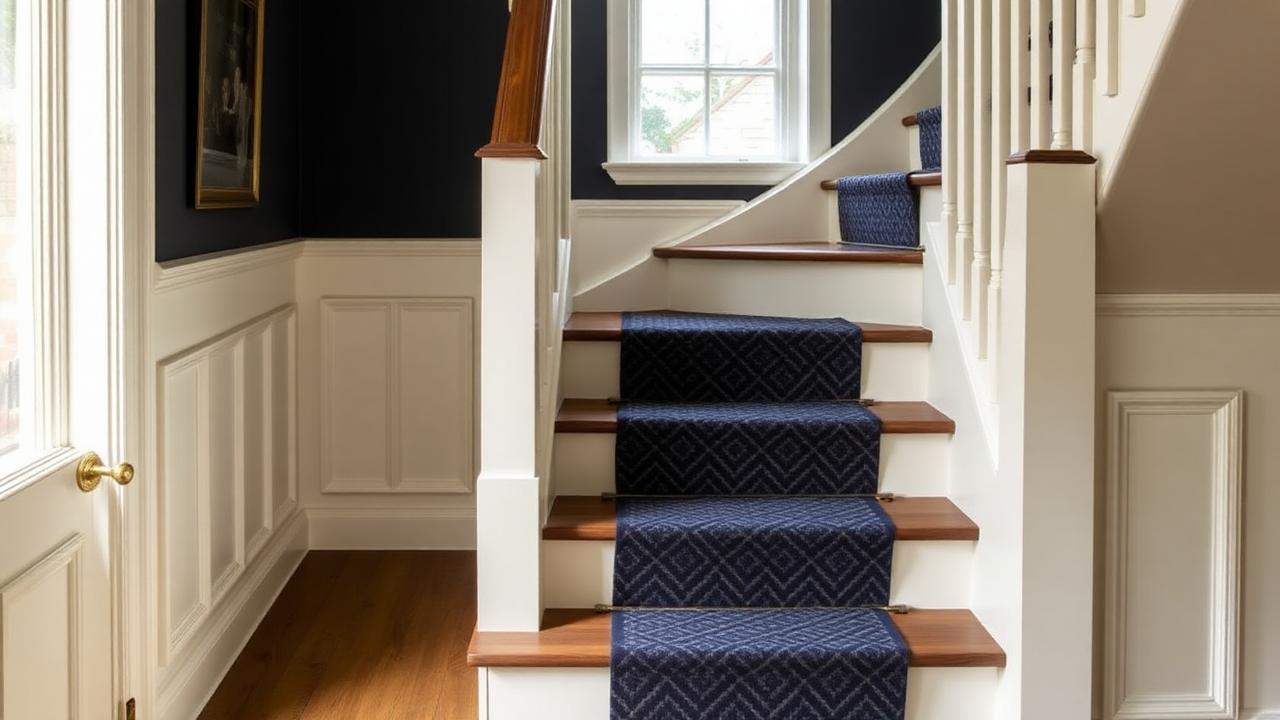
Many homeowners choose to leave treads exposed and add a stair runner rather than fully carpeting the staircase, which is both a design choice and a cost-saving one. A runner covers only the central portion of each tread, leaving painted or stained wood exposed on either side, which means you can use a cheaper tread material since it will be partially hidden. Runner cost itself scales with fibre: a polypropylene or synthetic blend might run $12-18 per linear foot, while a pure wool Axminster or Wilton weave can reach $40-70 per linear foot. Running our stair runner calculator with your exact tread, riser, and step count gives you the linear footage needed to get an accurate quote from a supplier before you commit to a fibre.
- Get stringer, tread, and railing quotes itemized separately.
- Decide early whether treads will be exposed (runner) or fully carpeted (broadloom).
- Use a stair runner calculator to size runner length before shopping for fibre.
- Factor in underlay and installation labor, which are often quoted separately from the runner material.
- Budget an extra 10-15% contingency for unexpected structural repairs on older staircases.
Labor versus material split
On most staircase projects, labor represents 40-55% of total cost, higher than many other home improvement projects because stair carpentry demands precision that is difficult to DIY safely. If you are trying to cut costs, focus on material choices (softwood versus hardwood, synthetic versus wool runner) rather than cutting corners on labor, since a poorly built stringer or improperly fitted runner creates a safety hazard that costs far more to fix later.
Regional and seasonal cost factors
Carpenter and flooring installer rates vary significantly by region, and demand spikes around spring and early autumn renovation seasons in both the US and UK. If your project timeline is flexible, booking work in winter months can sometimes secure better rates as contractors have more availability. Material costs for hardwood also fluctuate with lumber markets, so locking in a quote with your supplier before starting demolition can protect your budget from mid-project price increases.
Timber sizing costs baked into a stringer budget
Stringer lumber choice is a small line item but a real one. A standard 2x12 construction-grade stringer board for a 14-step, 130 in run flight runs roughly $18-28 per board in the US, or GBP 14-22 in the UK, and you need three for a 36 in wide stair, bringing stringer material to $55-85 or GBP 42-66 before waste. If your span exceeds about 10-12 ft unsupported, an engineered LVL stringer at $60-110 each becomes worth pricing against adding a mid-span support wall, since the labor to build a support wall can easily exceed the LVL upgrade cost. Always get stringer material priced separately from cut-and-install labor, since a contractor's day rate for laying out and cutting three stringers accurately is usually a bigger number than the lumber itself.
Formula for a quick self-estimate
You can sanity-check any contractor quote with a rough formula: (number of steps x average tread+riser material cost) + stringer cost + railing allowance + (labor rate x estimated hours) = total structural cost. For our 14-step example with softwood at $50 per step installed (tread, riser, and fixings), that is 14 x $50 = $700, plus $220 stringers, plus $600 railing, plus 24 labor hours at $75/hr = $1,800, totaling $3,320, which matches our worked example almost exactly. Swap in hardwood at $90 per step installed and the same formula pushes the total to roughly $3,880, a useful gut-check before you accept or reject a quote.
| Stringer option | Material cost (3 boards) | Best for |
|---|---|---|
| 2x12 construction grade | $55-85 / GBP 42-66 | Spans under 10-12 ft |
| 2x12 select structural | $90-140 / GBP 70-110 | Heavier loads, wider stairs |
| LVL engineered stringer | $180-330 / GBP 140-260 | Longer spans, no mid-support wall |
| Precut stringer (retail) | $40-70 each / GBP 32-55 | Standard 7-7.5 in riser, DIY jobs |
- Price stringer lumber separately from cut-and-install labor on any quote.
- Use (steps x cost per step) + stringers + railing + (labor rate x hours) as a rough cross-check.
- Compare LVL stringer cost against the cost of adding a mid-span support wall.
- Confirm whether a quote includes a stair runner or only bare treads and risers.
- Re-price hardwood versus softwood using the same per-step formula to compare quickly.
Whatever you decide, get the numbers first: the stair runner calculator doubles as a stair runner length calculator, adding nosing wrap, landings, winders, pattern repeat and waste so you order the right length the first time.
Still deciding on material, width or pattern? Our hub on stair runners compares weaves, widths, backings and fitting styles side by side, then hands the numbers straight to the calculator.
Frequently asked questions
How much does a basic staircase cost to build?
A basic 14-step interior wood staircase typically runs $2,500-5,500 in the US or GBP 1,800-4,000 in the UK, before floor covering.
What is the biggest cost driver in a staircase build?
Labor typically accounts for 40-55% of total cost, followed by tread and riser material, especially if hardwood is chosen.
Does a stair runner cost less than full carpeting?
Usually yes, since a runner covers only the central portion of each tread and uses less material overall than wall-to-wall stair carpet.
How much does a stair runner typically add to the budget?
Expect $400-900 in the US or GBP 300-700 in the UK for a 14-step flight, depending on fibre choice.
Should I get multiple quotes for staircase work?
Yes, always get at least three itemized quotes, since pricing and quality can vary widely between contractors.
Can I save money by leaving treads exposed?
Yes, exposed treads with a runner down the centre allow you to use a less expensive tread material since it's partially covered.
How do I estimate runner cost accurately?
Use a stair runner calculator to get the exact linear footage needed, then multiply by your chosen fibre's per-foot or per-meter price.
Is winter a cheaper time to book stair carpentry?
Often, yes. Contractor demand typically dips in winter months, which can translate to better rates and faster scheduling.
Know your numbers in 30 seconds
Enter your step count, tread depth and riser height — the stair runner calculator gives you the exact length to order, in metres and feet, with waste included.
Estimate runner length with the stair runner calculatorReady for real prices?
Get quotes from vetted stair runner suppliers and fitters near you. Free, no account, no obligation.
Every guide is written from hands-on measuring and fitting experience, checked against the calculator’s own maths, and re-reviewed whenever prices or methods change. Read our editorial standards.