

What counts as a landing and when you need one
A landing is a flat, level platform interrupting a flight of stairs, used either to break up a long straight run or to allow the stair to change direction, and most codes require one wherever a flight climbs beyond a set maximum vertical rise without a break. The US IRC generally caps a continuous flight at 12 ft (3.66 m) of vertical rise before a landing is required, while UK Approved Document K sets a maximum of 2 m (about 6 ft 6 in) rise between landings on a private stair, with tighter limits on stairs serving the public.
Beyond the vertical rise trigger, a landing is also mandatory anywhere a staircase changes direction by more than a small amount, and at both the top and bottom of every flight, which is why even a short single-storey staircase always has at least two landings, the floor at the bottom and the floor (or upper landing) at the top, even though nobody thinks of those as 'landings' in casual conversation.
Minimum landing dimensions under US and UK code
US IRC R311.7.6 sets a minimum landing dimension of 36 in (91 cm) measured in the direction of travel, and the landing must also be at least as wide as the stairway itself. A door swinging onto a landing is allowed to reduce the clear space by up to half its swing when fully open, provided at least 36 in of clear depth remains, which catches out a lot of DIY basement or loft conversions where a door was added onto a landing without rechecking this clearance.
UK Approved Document K doesn't set one single fixed number the way the IRC does, but requires the landing to be at least as wide and as deep as the flight it serves, and clear of any door swing (with allowances for door swing similar in principle to the US rule). In practice this means most UK domestic landings end up somewhere between 800 mm and 1 m deep, matching the stair width, though a wider stair naturally needs a correspondingly deeper landing to satisfy the rule.
Winders are not a substitute for a required landing
Some designs try to use a run of winder treads instead of a flat landing to save space where code requires a break. Check your local jurisdiction carefully, since many codes only accept winders as a turn method, not as a substitute for a mandatory rest landing on long flights.
How much runner do I need?
A landing adds a flat section to your runner run that's measured by its own depth rather than by the tread-and-riser formula used on sloped steps. Take a US example: an L-shaped stair with 7 steps up to a 36 in x 42 in landing, then 6 more steps continuing to the upper floor, all steps at 10 in going and 7.5 in rise. The lower flight is 7 x 18.25 in (10 + 7.5 + 0.75 nosing) = 127.75 in, or 10.65 ft. The landing itself, measured along the direction of travel, adds 42 in, or 3.5 ft, of flat runner. The upper flight is 6 x 18.25 in = 109.5 in, or 9.125 ft. Total before waste is 23.27 ft; add a 24 in top/bottom finishing allowance (2 ft) for 25.27 ft, then a 7% waste margin brings it to roughly 27 ft.
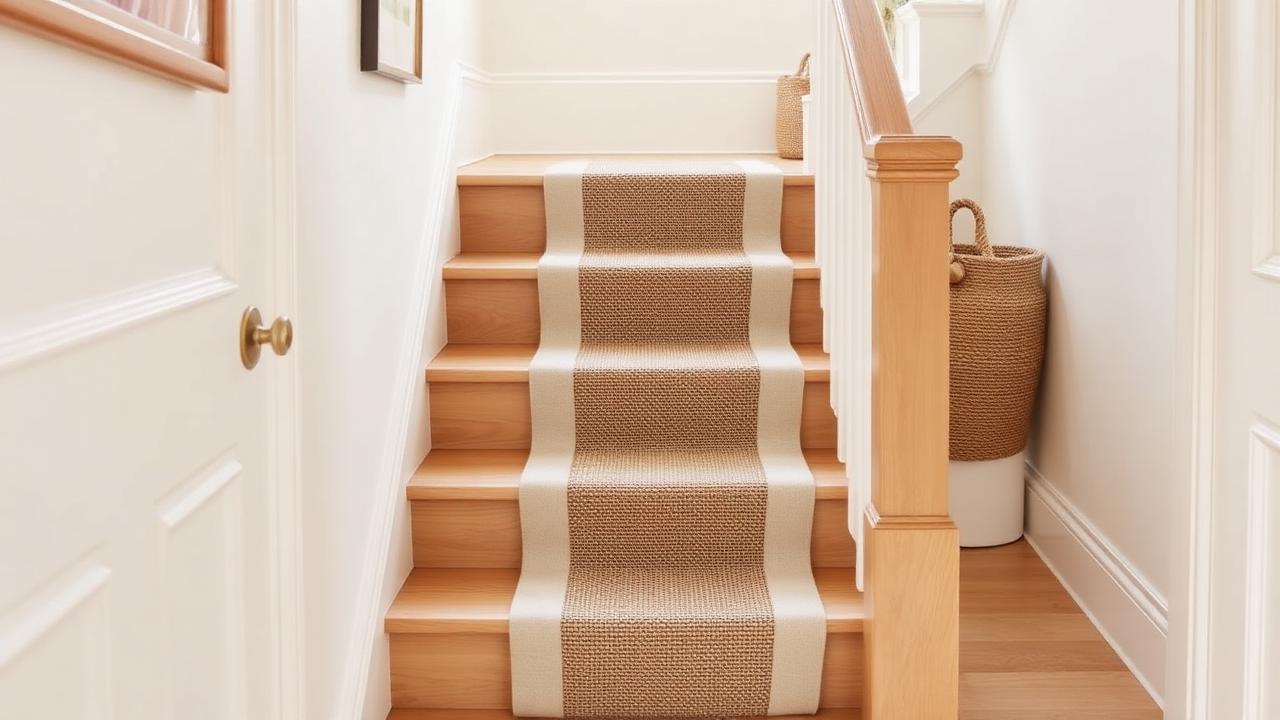
In UK metric terms, the same layout is 7 steps at 45.9 cm (25 cm going, 19 cm rise, 1.9 cm nosing) = 321.3 cm, a landing depth of 1 m (100 cm) of flat runner, then 6 more steps at 45.9 cm = 275.4 cm. Total before waste is 696.7 cm, plus a 60 cm finishing allowance for 756.7 cm, then a 7% waste margin brings it to roughly 8.1 m. Landings always add length in a simple, direct way, since it's just the flat landing depth added once, unlike sloped treads which each carry their own going, rise and nosing.
| Section | US (in/ft) | UK (cm/m) |
|---|---|---|
| Lower flight (7 steps) | 10.65 ft | 3.21 m |
| Landing (flat) | 3.5 ft | 1.0 m |
| Upper flight (6 steps) | 9.13 ft | 2.75 m |
| With finishing allowance + 7% waste | 27 ft | 8.1 m |
Know your numbers in 30 seconds
Enter your step count, tread depth and riser height — the stair runner calculator gives you the exact length to order, in metres and feet, with waste included.
Open the stair runner calculatorFitting a runner across a landing
Runner across a flat landing is generally easier to fit than around a winder turn, since there's no pleating needed, but the transition point where the sloped run meets the flat landing needs a clean, neat fold or a proper transition bar, otherwise the runner can bunch or lift at exactly the point most feet land heaviest during a direction change. If the landing turns the stair by 90 or 180 degrees, decide early whether the runner continues in one continuous piece across the turn or is seamed at the landing, since a seam here is far less visible than one mid-flight and is often the more practical choice for a fitter working with a fixed roll width.
- Measure landing depth along the actual direction of travel, not diagonally across it.
- Check door swing clearance on any landing with a door opening onto it.
- Treat the landing as a flat length addition, separate from the tread-and-riser formula.
- Consider seaming the runner at the landing rather than mid-flight if a join is unavoidable.
- Recheck landing minimum dimensions against your specific stair width, not a generic figure.
When an undersized landing needs redesigning
If your existing landing falls short of the minimum, usually discovered during a renovation survey or a loft conversion structural check, the options are broadly the same as fixing a headroom shortfall: enlarge the opening or floor area around the landing, reconfigure the stair to change direction earlier or later in the run, or in some cases convert a small landing plus adjoining winder treads into a slightly larger combined turning space that satisfies both requirements at once. This is squarely a job for a structural engineer or building control surveyor rather than a DIY decision, since landing size interacts with load-bearing walls and floor joist direction more often than people expect.
Once any structural redesign is settled, run your finalised step counts, going, rise and landing depth through a stair runner calculator rather than relying on the numbers from the original, now-superseded design, since even a modest landing resize changes your total runner length and where any seams should sit. Getting this right before ordering avoids the common and costly mistake of a runner cut for a landing that no longer matches what was actually built.
Whatever you decide, get the numbers first: the stair runner calculator doubles as a stair runner length calculator, adding nosing wrap, landings, winders, pattern repeat and waste so you order the right length the first time.
Still deciding on material, width or pattern? Our hub on stair runners compares weaves, widths, backings and fitting styles side by side, then hands the numbers straight to the calculator.
Frequently asked questions
What is the minimum stair landing size under US code?
The IRC requires a landing at least 36 in (91 cm) deep in the direction of travel, and at least as wide as the staircase itself. A door opening onto the landing can reduce clear space by up to half its swing, provided 36 in of clear depth remains.
What is the minimum stair landing size under UK code?
UK Approved Document K requires the landing to be at least as wide and as deep as the stair flight it serves, which in practice usually means somewhere between 800 mm and 1 m for a typical domestic staircase, with no single fixed universal minimum figure.
How much vertical rise can a staircase have before it needs a landing?
The US IRC generally requires a landing after 12 ft (3.66 m) of continuous vertical rise, while UK Approved Document K sets a tighter limit of around 2 m (6 ft 6 in) for a private domestic stair.
Can a door open directly onto a stair landing?
Yes, within limits. Most codes allow a door to encroach on a landing by up to half its swing when fully open, provided the required minimum clear landing depth still remains once the door is open.
Does a stair runner need a special transition at a landing?
Yes, ideally. The point where a sloped run meets a flat landing benefits from a clean fold or a proper transition strip, since that's where feet land heaviest during a direction change and a poorly finished join is more likely to lift or bunch.
Can winder treads replace a required landing?
Not usually. Most codes treat winders as a method for turning a stair, not as a substitute for a mandatory rest landing on a long flight, though rules vary by jurisdiction, so check locally before relying on winders to avoid a landing.
How do I measure how much extra runner a landing adds?
Measure the landing depth along the actual direction of travel and add that figure once as a flat length, separate from the tread-and-riser calculation used for the sloped sections either side of it.
What happens if my existing landing is undersized?
It typically needs a structural review, since fixing it may involve enlarging the landing area, repositioning the stair's turn, or adjusting adjoining floor framing. This is a job for a structural engineer or building control surveyor, not a DIY fix.
Know your numbers in 30 seconds
Enter your step count, tread depth and riser height — the stair runner calculator gives you the exact length to order, in metres and feet, with waste included.
Include your landing in the stair runner calculatorReady for real prices?
Get quotes from vetted stair runner suppliers and fitters near you. Free, no account, no obligation.
Every guide is written from hands-on measuring and fitting experience, checked against the calculator’s own maths, and re-reviewed whenever prices or methods change. Read our editorial standards.