
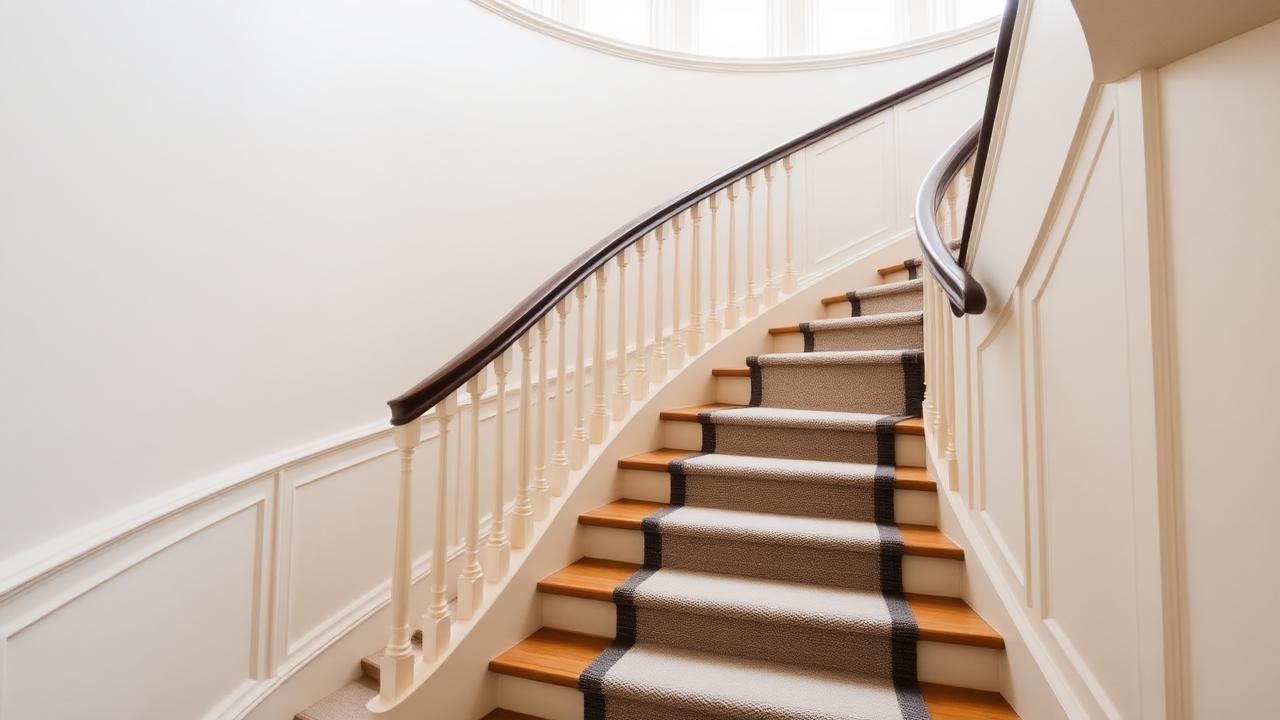
What a half landing is
A half landing is a flat platform, typically the same width as the staircase, where a flight turns back on itself, most commonly through 180 degrees. Unlike winder treads, it involves no pie-shaped steps, just a flat section that the runner has to cross before the second flight begins.
Continuous run or seam at the landing
| Approach | Extra length allowance | Look | Difficulty |
|---|---|---|---|
| Runner continues flat across landing | Landing depth + 5% waste | Seamless, most premium look | Moderate |
| Runner turns a corner on the landing itself | Landing depth x 2 (both directions) + 10% | Neat, needs careful mitred corner | Hard |
| Runner seamed at each edge of landing, different piece fills the landing | Landing area + 10% waste, separate piece | Practical, visible seams | Moderate |
Measuring the landing itself
- Measure the landing's depth in the direction of travel, from the top of the lower flight to the start of the upper flight.
- Measure the landing's width to confirm it matches the runner width, since half landings are sometimes wider than the stair width.
- If the runner turns a corner on the landing, measure both legs of the L-shape it will need to cover.
- Note whether a mitred corner or a simple straight seam will be used, since this changes the cutting layout.
A 180-degree turn usually means two 90-degree corners
Most half landings involve the runner turning twice, once entering and once leaving the landing, each of which needs its own mitred corner or seam allowance, not a single turn allowance.
Know your numbers in 30 seconds
Enter your step count, tread depth and riser height — the stair runner calculator gives you the exact length to order, in metres and feet, with waste included.
Open the stair runner calculatorTypical extra material
| Landing size | Extra length allowance | Difficulty | DIY-able |
|---|---|---|---|
| Small half landing (under 1 m deep) | 0.3–0.5 m extra | Moderate | Yes |
| Standard half landing (1–1.5 m deep) | 0.6–1.0 m extra | Hard | Experienced DIY only |
| Large half landing (over 1.5 m deep) | 1.0 m+ extra | Hard | Fitter recommended |
When to call a professional instead
Plenty of homeowners handle stair runner for half-landing stairs themselves on a straightforward straight flight, but certain conditions tip the balance firmly towards hiring a fitter. Getting a second opinion before committing materials often costs nothing and can save an expensive mistake on a job that cannot easily be undone.
- The staircase has a turn, winders, a curve or a split level rather than one straight run.
- The existing substrate is damaged, damp, or its condition is genuinely unclear.
- The runner is an expensive natural fibre or bespoke pattern where a cutting mistake is costly.
- You have no experience with a staple gun, knee kicker or carpet seaming on stairs.
- The staircase is the main one in the home and downtime or an unfinished look is not acceptable.
Worked example with real numbers
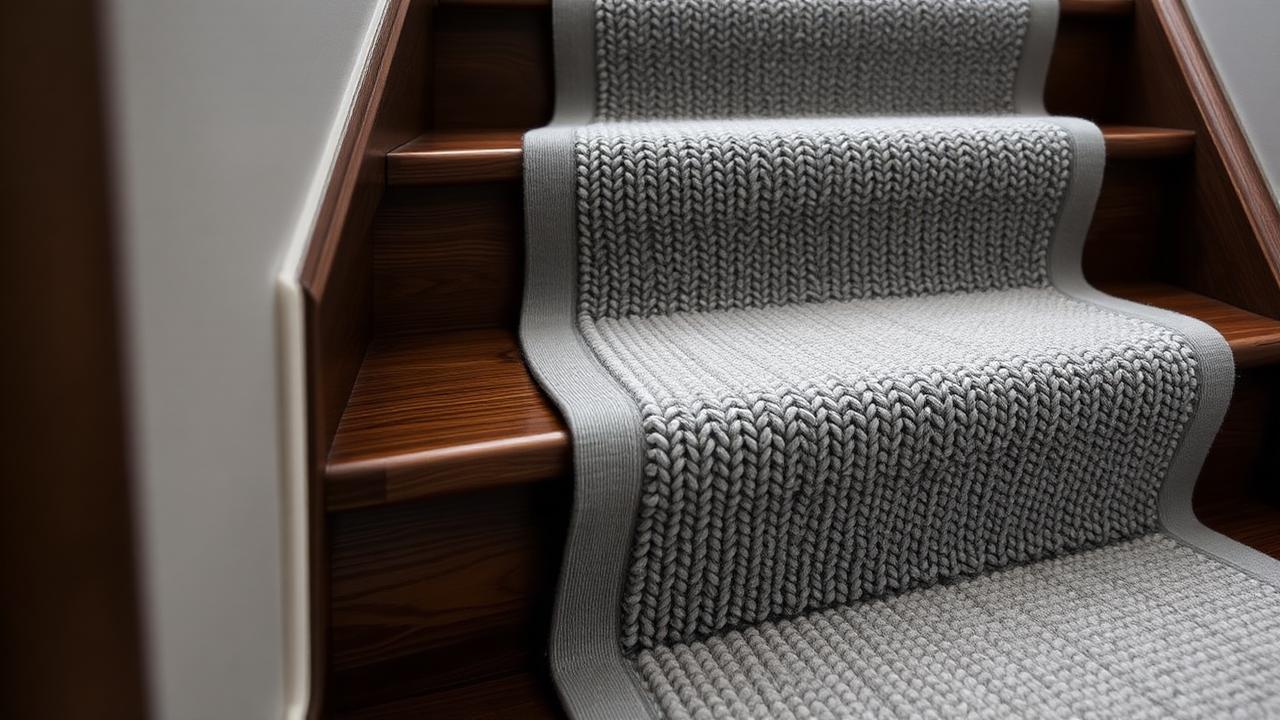
To see how stair runner for half-landing stairs plays out on an actual staircase, take a common 13-step flight with a 10 in (25 cm) tread depth and a 7.5 in (19 cm) riser height. That gives 17.5 in (44 cm) per step, or 227.5 in (5.78 m) of raw length before any waste allowance is added, a figure worth keeping in mind whenever this topic is discussed in isolation from the rest of the job.
| Measurement | Imperial | Metric |
|---|---|---|
| Tread depth | 10 in | 25 cm |
| Riser height | 7.5 in | 19 cm |
| Per step total | 17.5 in | 44 cm |
| 13 steps, raw length | 227.5 in | 5.78 m |
| With 8% waste allowance | 245.7 in | 6.24 m |
Common mistakes on half landings
- Measuring the landing as part of the tread-plus-riser run instead of as its own flat area.
- Forgetting that most half landings need two corner allowances, not one.
- Choosing a mitred corner detail without checking the fitter has done one before.
- Not confirming landing width matches the runner width, since landings are sometimes wider than the stairs.
- Skipping a template on a landing that turns, leading to a crooked or gapped seam.
How a half landing differs from a full landing
A half landing sits partway up a flight, splitting it into two shorter runs, and is usually smaller than a top or full landing, sometimes barely wider than the staircase itself. Because it is compact, a half landing is a good candidate for continuing the runner across it without a seam, provided the direction of travel does not turn sharply, in which case the same turn allowances used for winders or a quarter landing apply.
Turning direction on a half landing
Half landings can turn the stair 90 degrees, 180 degrees, or continue straight, and each changes how the runner is planned. A 180-degree half landing, where the stair doubles back on itself, needs the runner to pivot fully across the landing width, which is usually easiest handled by measuring the landing as a small flat floor and either seaming there or continuing the runner in a single mitred or L-shaped piece cut specifically to the landing's shape.
| Half landing type | Extra length allowance | Complexity |
|---|---|---|
| Straight-through, no turn | 0.2-0.3 m (8-12 in) | Low |
| 90-degree turn | 0.4-0.6 m (16-24 in) | Moderate |
| 180-degree turn (doubles back) | 0.6-0.9 m (24-35 in) | Moderate-high |
Visual impact of a half landing on runner design
A half landing breaks up a long flight visually as well as physically, and some homeowners use this natural pause point to introduce a border, a change of colour, or a decorative rug-style medallion on the landing itself before the runner continues on the next flight. This works particularly well when the two flights above and below are similar lengths, since the landing then reads as a deliberate midpoint rather than an interruption.
Runner direction across a half landing
On a half landing the runner typically turns 180 degrees, so the pile direction and any directional pattern will run one way going up and the opposite way coming back down on the return flight. Solid colours and non-directional patterns hide this completely, while a clear stripe or chevron will visibly reverse at the landing, which is worth previewing with a sample before ordering a long directional pattern for a half-landing staircase.
Whatever you decide, get the numbers first: the stair runner calculator doubles as a stair runner length calculator, adding nosing wrap, landings, winders, pattern repeat and waste so you order the right length the first time.
Still deciding on material, width or pattern? Our hub on stair runners compares weaves, widths, backings and fitting styles side by side, then hands the numbers straight to the calculator.
Frequently asked questions
How is a half landing measured for a stair runner?
As a flat rectangle, measuring its depth in the direction of travel and its width, separately from the tread-plus-riser calculation used for the sloped flights on either side.
Does a stair runner need to be seamed at a half landing?
Not necessarily. It can run continuously across the landing for a seamless look, or be seamed at each edge with the landing covered by a separate piece, which is simpler to fit.
How much extra runner does a half landing need?
Roughly 0.3 to 1.0 metres or more depending on the landing's depth, plus additional allowance if the runner turns a corner on the landing itself.
Can a half landing be a DIY stair runner project?
A small, simple half landing is manageable for an experienced DIYer, but a larger landing with mitred corners or a continuous turning run is best left to a professional fitter.
What is the biggest mistake people make with this?
Rushing the measuring or prep stage. Most poor outcomes with stair runner for half-landing stairs trace back to a single measurement taken at the wrong point, or a substrate check skipped to save a few minutes, both far cheaper to fix before the runner is cut than after.
Does a half landing need a seam in the runner?
Not necessarily. Small half landings, especially on a straight-through or gentle turn, can often carry the runner across without a seam, though a 90 or 180-degree turn usually needs the turn allowances used for winders or a quarter landing.
Can I use a different design on a half landing than the rest of the runner?
Yes, a half landing is a natural pause point and some owners add a border, colour change or medallion there, especially when the flights above and below are similar lengths.
Know your numbers in 30 seconds
Enter your step count, tread depth and riser height — the stair runner calculator gives you the exact length to order, in metres and feet, with waste included.
Measure my half-landing stairsReady for real prices?
Get quotes from vetted stair runner suppliers and fitters near you. Free, no account, no obligation.
Every guide is written from hands-on measuring and fitting experience, checked against the calculator’s own maths, and re-reviewed whenever prices or methods change. Read our editorial standards.