

What a stair build actually consumes
A stair material calculator breaks a flight down into its structural and finish components separately, because they scale slightly differently. Structurally, you need stringers - the sawtooth-cut side supports that carry the load - typically three for a residential stair up to about 36 in (91 cm) wide, with a fourth added on wider stairs or where the middle stringer needs extra support under a heavy tread material like stone-look composite. Finish-wise, you need one tread board per step, one riser board per step if the risers are closed rather than open, plus glue blocks or angle brackets at each tread-to-riser joint, screws or nails throughout, and typically a skirt board running along any wall-side edge of the flight to finish the join between stairs and wall neatly.
Getting the riser count right first matters because every other quantity in the list is derived from it - stringers are cut once but marked with a repeat pattern equal to the riser count, tread and riser boards are needed one per step, and even fixings scale linearly with steps. A stair rise calculator or general stair measurements calculator will confirm your exact riser count from total rise and target riser height before you price anything, since ordering material against a guessed riser count is one of the most common causes of a mid-project material shortage.
Stringer material and sizing
Stringers are typically cut from 2x12 (nominal 2 in x 12 in, actual roughly 1.5 in x 11.25 in / 38 mm x 286 mm) lumber for most residential stairs, since the sawtooth cutting removes a lot of material and a narrower board risks being too weak at the thinnest remaining point behind the notch. Length is calculated from the total run and total rise using the Pythagorean relationship - the stringer is effectively the hypotenuse of a right triangle formed by total rise and total run - so a flight with a 76 in (1.93 m) total rise and 108 in (2.74 m) total run needs a stringer roughly 132 in (3.35 m) long before trimming the ends, calculated as the square root of (76² + 108²). Always round up to the next standard lumber length and buy stringer stock slightly longer than the raw calculation to allow for end trimming and any layout error.
Worked material list for a 13-step straight flight
Take a straight indoor flight with 13 risers at 7.5 in (19 cm) each and 12 treads at 10 in (25 cm) run each, 36 in (91 cm) wide, with closed risers and one open (wall-free) side. The structural list is 3 stringers cut from 2x12 stock at around 168 in (4.27 m) raw length each given the total rise and run involved, plus a supporting ledger or newel post connection at top and bottom. The finish list is 13 tread boards and 13 riser boards cut to 36 in (91 cm) width (or ganged from narrower stock if using a hardwood tread board), 26 glue blocks (2 per step) or equivalent angle brackets, roughly 120-150 screws across stringers, treads, risers and blocking, and a skirt board roughly 14-15 ft (4.3-4.6 m) long for the wall side.
| Component | Quantity (13-step flight) | Typical material |
|---|---|---|
| Stringers | 3 (4 if >42 in / 107 cm wide) | 2x12 (38 x 286 mm) lumber |
| Tread boards | 13 | 1x12 or 5/4 hardwood/softwood |
| Riser boards | 13 (0 if open riser) | 3/4 in (19 mm) plywood or hardwood |
| Glue blocks / brackets | ~26 | Wood blocks or steel angle brackets |
| Screws/fixings | 120-150 | 2.5-3 in (65-75 mm) deck or wood screws |
| Skirt board | 1 run, ~14-15 ft (4.3-4.6 m) | 1x8 or 1x10 finish board |
Add a waste allowance
Add 10-15% to lumber lengths for stringers and skirt boards, and round tread/riser board counts up to the next full sheet or board length available from your supplier, since offcuts from stringer cutting are rarely reusable elsewhere.
Cost ranges by material grade
Material cost varies hugely by tread finish more than by structural lumber, since stringers are a small share of total cost regardless of grade. As a typical range rather than a fixed quote: a basic pressure-treated or paint-grade softwood stair (structure plus treads and risers, excluding installation labour) for a 13-step flight typically runs $400-800 (£320-650) in materials; a mid-range hardwood tread with painted riser setup runs $900-1,800 (£720-1,450); and a premium solid oak or engineered stair with matching skirt and stringer covers can run $2,000-4,000+ (£1,600-3,200+) in materials alone. These are general ranges for planning, not quotes from any specific supplier or brand, and will shift with local lumber pricing and species availability.
Ordering checklist
- Confirm exact riser count and riser height using a stair rise calculator before ordering anything.
- Calculate stringer length from total rise and run, then round up to the next standard board length.
- Order 3 stringers for stairs up to about 36 in (91 cm) wide, 4 for wider or heavier-loaded flights.
- Count tread and riser boards at one per step, plus 10-15% extra for cutting waste and mistakes.
- Add glue blocks or brackets at two per tread-to-riser joint minimum.
- Measure the wall-side run separately for skirt board length, adding an allowance for mitred corners.
How much runner do I need?
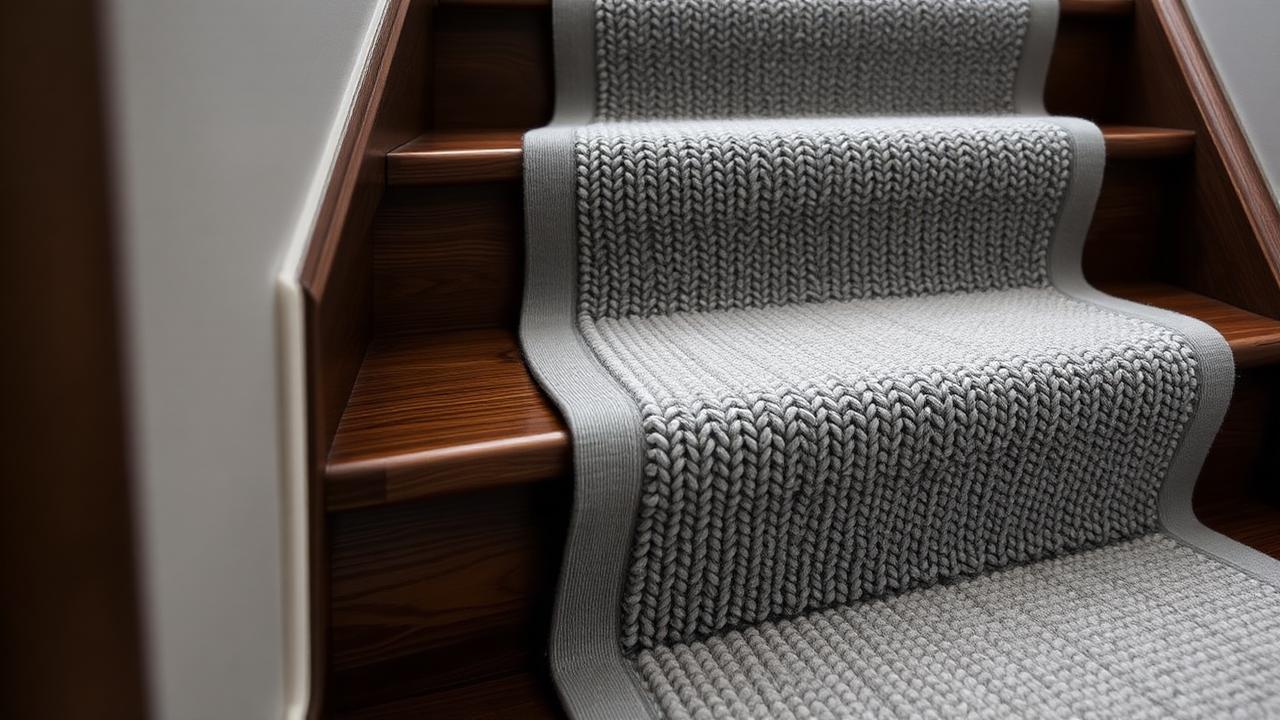
Once the structural material list is settled, many stair builds finish with a fitted runner rather than bare or painted treads. For the same 13-step flight at 10 in (25 cm) going and 7.5 in (19 cm) rise, each step needs about 17.5 in (44.5 cm) of runner to wrap tread, riser and nosing, giving roughly 19 ft (5.8 m) for the full flight. In metric that's 25 cm going and 19 cm rise, using 44.5 cm per step and about 5.8 m across 13 steps. Add a 5-10% waste allowance for pattern registration, trims and any adjustment around the skirt board, bringing the practical order to about 20-21 ft (6.1-6.4 m). A stair runner calculator will run these numbers precisely against your own finished tread and riser measurements once the carpentry is complete.
Know your numbers in 30 seconds
Enter your step count, tread depth and riser height — the stair runner calculator gives you the exact length to order, in metres and feet, with waste included.
Open the stair runner calculatorWhere budgets commonly go wrong
The most frequent overspend on a stair material list is buying stringer stock at exactly the calculated raw length rather than a full standard length with margin, forcing a second, wasteful purchase when a cutting error uses up the trim allowance. The second common issue is underestimating fixings - screws, brackets and glue blocks are cheap individually but easy to under-order by counting only the obvious joints and forgetting blocking, toe-kicks, or a mid-span brace on a wide stair. Buying 10-15% over the calculated fixing count is inexpensive insurance against a delayed second trip to the supplier mid-build.
Whatever you decide, get the numbers first: the stair runner calculator doubles as a stair runner length calculator, adding nosing wrap, landings, winders, pattern repeat and waste so you order the right length the first time.
Still deciding on material, width or pattern? Our hub on stair runners compares weaves, widths, backings and fitting styles side by side, then hands the numbers straight to the calculator.
Frequently asked questions
How many stringers does a residential stair need?
Most stairs up to about 36 in (91 cm) wide use three stringers - one on each side and one down the middle for extra support. Wider stairs, over roughly 42 in (107 cm), or stairs carrying a heavier tread material, typically need four stringers to prevent flex underfoot.
What size lumber is used for stair stringers?
2x12 (nominal, actual roughly 1.5 x 11.25 in / 38 x 286 mm) is the standard stringer stock for most residential stairs, since the sawtooth cutting removes significant material and a narrower board risks weakness behind the notch. Engineered stringers are also available as a stronger alternative.
How do I calculate stringer length?
Stringer length follows the Pythagorean relationship between total rise and total run: length equals the square root of (rise squared plus run squared). Always round the result up to the next standard lumber length and add a trimming allowance for the top and bottom cuts.
How many tread and riser boards do I need for a 13-step stair?
One tread board and one riser board per step, so 13 of each for a 13-riser flight with closed risers. If the risers are left open, you only need the 13 tread boards, but check your local code's maximum open-riser gap first.
What's a realistic material budget for a straight staircase?
As a general planning range, a basic paint-grade softwood 13-step stair typically runs $400-800 (£320-650) in materials, mid-range hardwood treads run $900-1,800 (£720-1,450), and premium solid hardwood setups can run $2,000-4,000+ (£1,600-3,200+), excluding installation labour.
How much waste allowance should I add to a stair material order?
Add roughly 10-15% to lumber lengths for stringers and skirt boards to cover cutting errors and offcuts that can't be reused elsewhere, and round board counts up to the nearest full board or sheet length your supplier sells rather than ordering the exact calculated quantity.
Do I need glue blocks as well as screws on stair treads?
Glue blocks or angle brackets at each tread-to-riser joint add rigidity and reduce squeaking over time, which screws alone don't fully prevent since wood movement can work fixings loose. Budget roughly two blocks or brackets per step as a minimum.
Does riser count affect how much skirt board I need?
Yes, skirt board length is driven by the wall-side run of the stair, which is directly tied to riser and tread count via the total run calculation. Measure the actual wall-side length once stringers are laid out, and add extra for any mitred corner cuts at the top or bottom.
Know your numbers in 30 seconds
Enter your step count, tread depth and riser height — the stair runner calculator gives you the exact length to order, in metres and feet, with waste included.
Confirm your riser and tread count before ordering materialReady for real prices?
Get quotes from vetted stair runner suppliers and fitters near you. Free, no account, no obligation.
Every guide is written from hands-on measuring and fitting experience, checked against the calculator’s own maths, and re-reviewed whenever prices or methods change. Read our editorial standards.