

Understanding nosing geometry
The nosing is the most stressed part of the stair tread. Every time someone steps on the stair, the leading edge of the runner experiences the highest amount of pressure and abrasion, especially as the foot pivots slightly on the descent. If you don't calculate the nosing wrap accurately, you end up with one of two problems: either the runner is pulled too tight and leaves an air pocket under the nosing, which will fail the first time someone kicks it, or it is left too loose and will sag over time. When I am fitting, I look for a firm contact along the entire profile of the nosing.
How much runner do I need?
To calculate runner requirements for a 13-step flight in US units: 10 in tread + 7.5 in riser + 1 in nosing wrap = 18.5 in per step. Across 13 steps that is 240.5 in (20.04 ft). Add 24 in total for landing turns = 264.5 in (22.04 ft). With a 10% waste for pattern matching, you need roughly 24.2 ft.
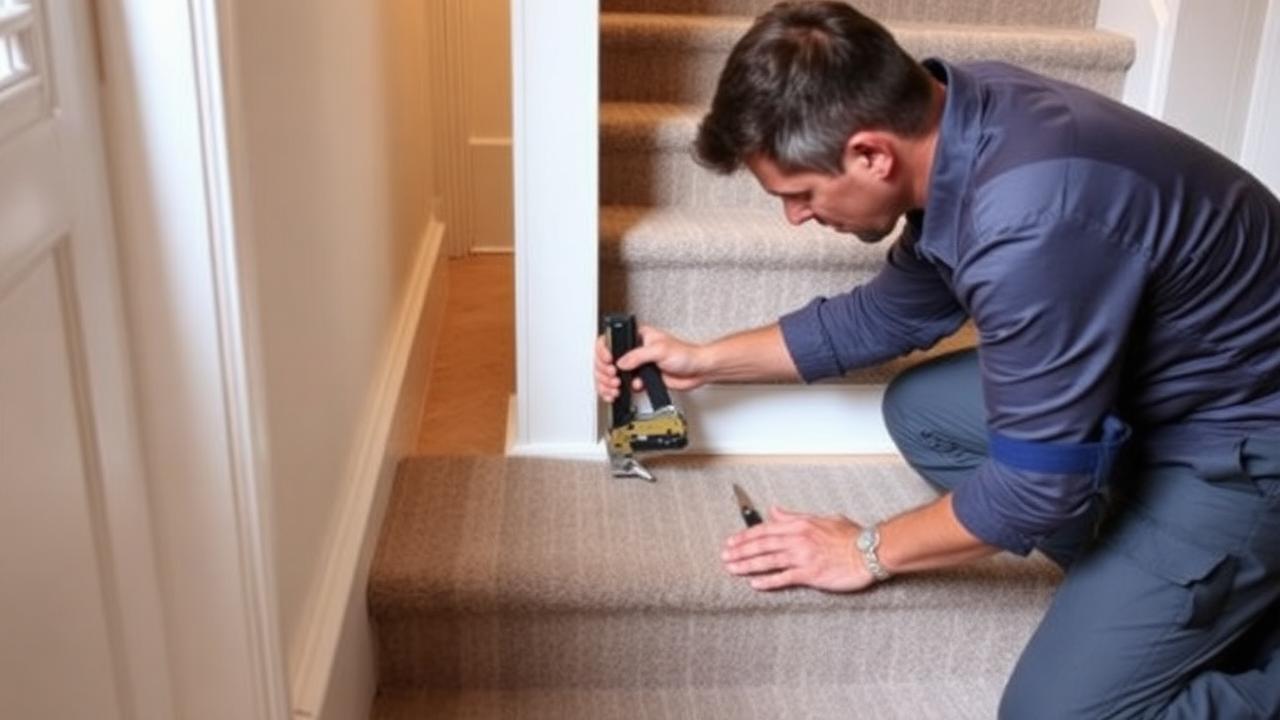
In UK metric, that is 25 cm tread + 19 cm riser + 2.5 cm nosing = 46.5 cm per step. Across 13 steps that is 604.5 cm. Add 60 cm for finishing, totalling 664.5 cm (6.65 m). With 10% waste, you need about 7.3 m.
| Measurement | US (in/ft) | UK (cm/m) |
|---|---|---|
| Tread | 10 in | 25 cm |
| Riser | 7.5 in | 19 cm |
| Nosing Wrap | 1 in | 2.5 cm |
| Per step | 18.5 in | 46.5 cm |
| 13 steps | 20 ft | 6.05 m |
| Plus finishing | 22 ft | 6.65 m |
| Total with 10% waste | 24.2 ft | 7.3 m |
Know your numbers in 30 seconds
Enter your step count, tread depth and riser height — the stair runner calculator gives you the exact length to order, in metres and feet, with waste included.
Open the stair runner calculatorSafety Tip
Always check the nosing projection. UK building regulations often specify a minimum overlap, but too much projection can create a catch point for shoes, especially on descending stairs.
- Use a steel tape measure to check the nosing profile.
- Check for consistent nosing projection across the entire flight.
- If the nosing is rounded, a stiffer runner backing is essential.
- Avoid creating a 'bridge' where the runner hangs across the nosing edge.
- Ensure the carpet runner is stapled firmly under the nosing for stability.
Whatever you decide, get the numbers first: the stair runner calculator doubles as a stair runner length calculator, adding nosing wrap, landings, winders, pattern repeat and waste so you order the right length the first time.
Still deciding on material, width or pattern? Our hub on stair runners compares weaves, widths, backings and fitting styles side by side, then hands the numbers straight to the calculator.
Frequently asked questions
What is stair nosing?
Stair nosing is the edge of the stair tread that projects out beyond the riser below it, designed to provide a safer foothold.
Why is nosing measurement important?
Accurate nosing measurement ensures your runner fits snugly against the tread and riser, preventing pockets and premature wear.
Do I need to calculate nosing for all runners?
Yes, even thin runners need to account for the extra length needed to wrap around the nosing edge, or they will pull tight and gap.
What if my stairs have no nosing?
These are often called open riser stairs or modern floating stairs. They don't require nosing wrap, but they often need a different fitting method.
Is there a standard nosing projection?
Building codes often suggest 16mm to 25mm in the UK, but vary by region and stair design.
How do I measure a rounded nosing?
Use a contour gauge or wrap a flexible tape measure over the profile to get the exact length.
Does nosing wrap affect carpet wear?
Yes, if the runner isn't supported properly under the nosing, the fibre is more likely to wear down due to friction.
Can I use the stair runner calculator for this?
Yes, use the stair runner calculator to enter your specific tread/riser/nosing specs for a custom fit.
Know your numbers in 30 seconds
Enter your step count, tread depth and riser height — the stair runner calculator gives you the exact length to order, in metres and feet, with waste included.
Measure your stair runner length with our calculatorReady for real prices?
Get quotes from vetted stair runner suppliers and fitters near you. Free, no account, no obligation.
Every guide is written from hands-on measuring and fitting experience, checked against the calculator’s own maths, and re-reviewed whenever prices or methods change. Read our editorial standards.