
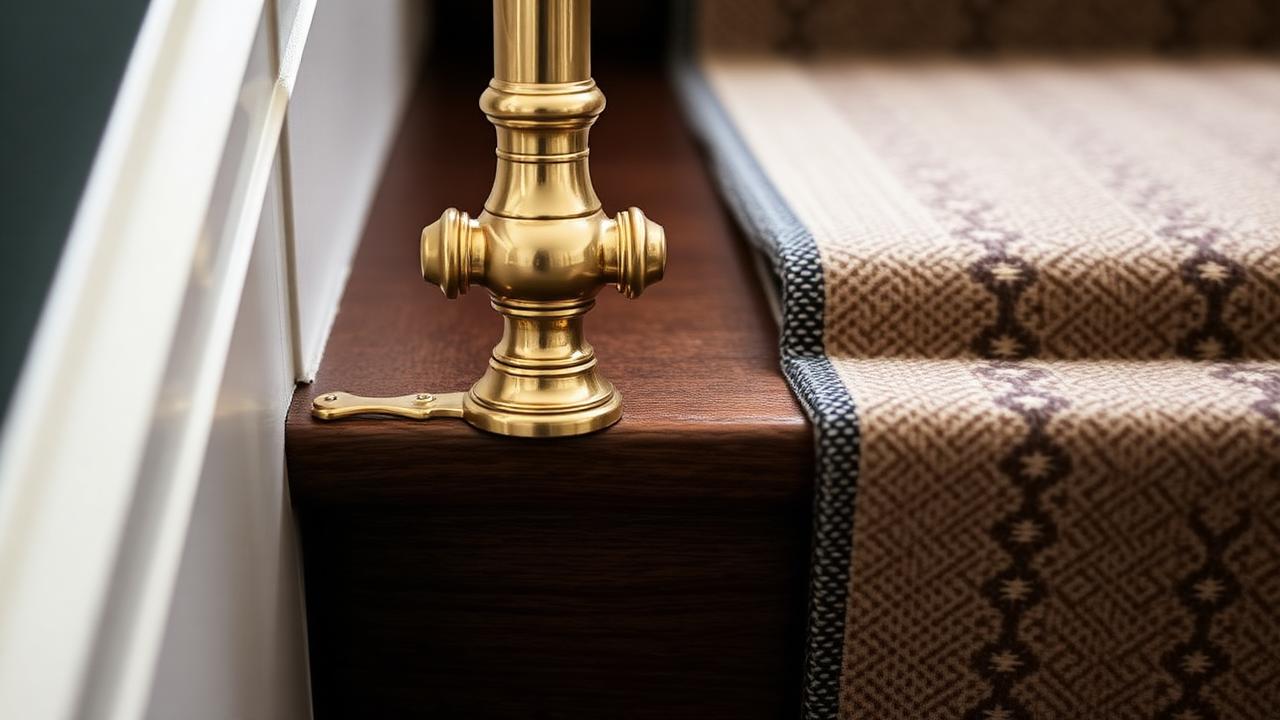
What stair runner bars do
Stair runner bars sit in the crevice where the tread meets the riser, pinning the runner down at exactly the point where foot traffic is heaviest and the carpet is most likely to lift or shift. Functionally, they reinforce the fitting, especially on runners that are laid rather than fully fixed with tackless strip along the entire length. Decoratively, they add a visible, tactile detail that can elevate an otherwise simple runner into a genuinely finished, high-end look.
Not every stair runner needs bars. Runners that are professionally fitted with gripper rods and glued underlay along the whole flight can hold perfectly well without them. Bars are most valuable either as a style statement, or as extra security on runners that are held with a lighter fixing method, such as hook-and-eye brackets rather than continuous gripper.
Material and finish options
Stair rods are commonly available in solid brass, brushed nickel, matte black, antique bronze, and stainless steel, in both round and hollow tube profiles. Brass suits period homes with warm wood tones, while matte black and brushed nickel pair well with contemporary hardware and painted staircases. Hollow tube rods are lighter and generally more affordable; solid rods have more heft and a premium feel but cost more, particularly in wider widths.
| Finish | Best paired with |
|---|---|
| Polished brass | Period homes, wood banisters |
| Antique bronze | Traditional, warm interiors |
| Brushed nickel | Transitional, mixed-metal schemes |
| Matte black | Contemporary, painted staircases |
| Stainless steel | Modern, minimalist interiors |
Sizing and spacing
Stair rods are sold by length and should match your runner's width plus roughly 2-4 in (5-10 cm) extra on each side, so the decorative finials extend beyond the carpet edge rather than sitting flush with it. For a 30 in (76 cm) wide runner, a common bar length is 36 in (91 cm) total, giving 3 in (7.5 cm) of overhang on each side. You need one bar per step, so a 13-step flight requires 13 bars — plan for this when budgeting, since bars are typically sold individually or in small sets rather than as a full flight pack.
| Runner width | Recommended bar length |
|---|---|
| 24 in (61 cm) | 30 in (76 cm) |
| 27 in (68 cm) | 33 in (84 cm) |
| 30 in (76 cm) | 36 in (91 cm) |
| 32 in (81 cm) | 38 in (96 cm) |
Know your numbers in 30 seconds
Enter your step count, tread depth and riser height — the stair runner calculator gives you the exact length to order, in metres and feet, with waste included.
Open the stair runner calculatorOrder one extra bar
Fittings can occasionally be damaged or lost during installation. Order one spare bar beyond your step count so a replacement is on hand if needed.
How much runner do I need underneath?
Bars don't change your yardage calculation, but it's worth sizing the runner correctly at the same time. For a 13-step flight with 10 in tread + 7.5 in riser + 0.75 in nosing wrap, that's 18.25 in per step, 237.25 in across 13 steps, plus 24 in finishing for 261.25 in (21.77 ft), plus 8-10% waste for roughly 23.5-24 ft. Metric: 45.9 cm per step, 596.7 cm across 13 steps, plus 60 cm finishing is 656.7 cm, plus waste is around 7.1-7.3 m.

- One bar per step, plus one spare for a 13-step flight (14 total).
- Bar length should exceed runner width by 2-4 in (5-10 cm) each side.
- Match the finish to your existing stair hardware and handrail.
- Bars add a decorative and functional layer but don't replace proper underlay and fixing.
Stair runner bars are a relatively small investment that makes a disproportionately large visual difference — they're often the detail visitors notice first on a well-dressed staircase.
Fitting steps for stair runner bars
Bars are fitted after the runner itself is laid and tensioned. Brackets are screwed into the tread at the base of the riser, on either side of the runner width, then the bar is dropped into the brackets and any decorative finials are screwed on last. For a 13-step flight, fitting bars typically adds 1-1.5 hours to a standard install, since each of the 13 positions needs to be measured, drilled, and levelled individually.
Getting bracket spacing right
Brackets should sit close enough to the runner edge to hold it flat without visible gapping, but not so tight that the fabric puckers around the fixing. Measure from the centre of the runner outward on each side so the bar sits perfectly level rather than skewed, which is especially noticeable on a light or neutral runner where any asymmetry catches the eye.
Cost bands for stair rods
Pricing for stair rods depends heavily on material and finish. Hollow tube rods in a basic finish are the most affordable option for a full flight of 13-14 bars, while solid brass or hand-finished antique bronze sits at the premium end, particularly in wider profiles.
| Finish/type | Cost band | Weight/feel |
|---|---|---|
| Hollow tube, plated | Budget | Light |
| Hollow tube, brushed nickel/black | Mid-range | Light to medium |
| Solid brass or bronze | Premium | Heavy, substantial feel |
- Measure runner width accurately before ordering bar length.
- Choose a finish that matches existing door and stair hardware, not just the handrail.
- Order one spare bar and bracket set beyond your step count.
- Ask your fitter to level each bar with a spirit level, not just by eye.
Maintenance for stair runner bars
Metal finishes need different care: brass and bronze benefit from an occasional wipe with a suitable metal polish to prevent tarnishing, while matte black and brushed nickel generally just need dusting. Check bracket screws every few months, since the constant flex of foot traffic on the runner can gradually loosen fixings over a year or two of use.
Whatever you decide, get the numbers first: the stair runner calculator doubles as a stair runner length calculator, adding nosing wrap, landings, winders, pattern repeat and waste so you order the right length the first time.
Still deciding on material, width or pattern? Our hub on stair runners compares weaves, widths, backings and fitting styles side by side, then hands the numbers straight to the calculator.
Frequently asked questions
How many stair runner bars do I need for 13 steps?
One bar per step, so 13 in total, plus a spare is recommended, bringing it to 14.
Are stair runner bars purely decorative?
They're partly decorative but also help pin the runner down at the tread-riser crevice, reinforcing the fitting.
What length bar do I need for a 30 in runner?
Around 36 in (91 cm) total, giving roughly 3 in (7.5 cm) of overhang on each side.
Do all stair runners need bars?
No, runners fully fitted with gripper and glued underlay can hold securely without them.
What finish suits a period home?
Polished brass or antique bronze typically suits period homes with warm wood tones best.
Can I fit stair runner bars myself?
Yes, with the correct brackets it's a straightforward DIY job, though professional fitting ensures secure alignment.
Do bars work with any runner width?
Yes, as long as the bar length is sized to extend 2-4 in (5-10 cm) beyond the runner on each side.
How much runner do I need alongside the bars?
For a 13-step flight, around 23.5-24 ft (7.1-7.3 m), calculated the same way regardless of whether bars are used.
Know your numbers in 30 seconds
Enter your step count, tread depth and riser height — the stair runner calculator gives you the exact length to order, in metres and feet, with waste included.
Calculate your runner length with the stair runner calculatorReady for real prices?
Get quotes from vetted stair runner suppliers and fitters near you. Free, no account, no obligation.
Every guide is written from hands-on measuring and fitting experience, checked against the calculator’s own maths, and re-reviewed whenever prices or methods change. Read our editorial standards.