

Buying carpeting vs buying a finished runner
A finished, made-to-measure stair runner arrives already cut to length and width, bound or serged at the edges, and sometimes with a pattern centred and matched for your specific flight. Buying raw stair runner carpeting means purchasing broadloom carpet by the metre or yard and having it cut, bound and fitted, either by the same supplier or a separate fitter. This route can be more cost-effective for a plain carpet and gives you more control over width, but it puts more responsibility on you or your fitter to get quantities, pattern matching and binding right.
Fibre types compared for stair use
| Fibre | Durability on stairs | Feel | Typical price per m2 |
|---|---|---|---|
| Wool | Excellent, resists crushing and soiling well | Soft, warm, natural sheen | £35-70 / $48-95 |
| Wool-blend (80/20) | Very good, slightly more stain resistant than pure wool | Similar to wool, slightly firmer | £28-55 / $38-75 |
| Nylon (solution-dyed) | Very good, strong stain and fade resistance | Can feel slightly less soft than wool | £20-45 / $28-60 |
| Polypropylene | Good for moderate traffic, less resilient long-term | Firmer, less springy underfoot | £12-30 / $16-40 |
| Sisal / natural fibre | Good, but abrasive and less forgiving underfoot | Coarse, textured | £18-40 / $25-55 |
Pile construction and what it means for stairs
- Cut pile: individual tufts sheared level; comfortable and shows footprints/vacuum marks more than loop.
- Loop pile (Berber): uncut loops, very durable and resists crushing, a strong choice for busy stairs.
- Cut-and-loop / sculptured: mixed texture, decorative but check the manufacturer's stair suitability rating specifically.
- Twist pile: tightly twisted cut fibres that resist pile lay-over and footprint marking better than a plain cut pile.
Check for an explicit 'suitable for stairs' rating
Not every domestic carpet is rated for stair use even if it is a heavy-duty floor carpet — stairs flex and fold the carpet at the nosing in a way flat floors do not. Look for a specific stair suitability rating on the spec sheet, not just a general traffic grade.
Reading a spec sheet
| Spec term | What it tells you |
|---|---|
| Pile weight (oz/yd2 or g/m2) | Higher generally means denser, more durable pile |
| Density / pile density | How tightly tufts are packed; higher resists crushing better |
| Wear/traffic rating (e.g. AC1-5 or Heavy Domestic) | Manufacturer's suitability for footfall level |
| Stair rating (yes/no) | Whether the specific product is approved for stair fitting |
| Twist level / pile retention | How well the pile resists flattening and footprint marks over time |
| Backing type | Affects gripper compatibility and dimensional stability |
Width options when buying by the roll
Broadloom carpet is typically supplied in standard widths (commonly 4m/13ft, sometimes 3.66m/12ft or narrower runner-specific rolls), and your runner width is then cut from that roll and bound to size. Confirm with your fitter how much waste this generates for your chosen runner width, since cutting a narrow runner from a wide roll can leave a lot of unused carpet, which affects overall cost per finished metre.
Typical costs when buying carpeting separately
| Element | Typical cost |
|---|---|
| Carpet material (per linear metre, 30in cut width) | £15-90 / $20-120 depending on fibre and quality |
| Binding/serging both edges | £4-10 / $5-14 per linear metre |
| Underlay | £8-15 / $11-20 per linear metre |
| Fitting labour (13-step flight) | £150-350 / $200-470 |
Know your numbers in 30 seconds
Enter your step count, tread depth and riser height — the stair runner calculator gives you the exact length to order, in metres and feet, with waste included.
Open the stair runner calculatorA short buying checklist
- Confirm the product has an explicit stair suitability rating, not just a general domestic traffic grade.
- Compare pile weight and density figures across shortlisted products, not just price.
- Ask your fitter how much waste your chosen width generates from the roll width they use.
- Get binding, underlay and fitting quoted alongside the carpet, since carpet price alone understates the total.
- Price the full package with the cost calculator before ordering the roll.
Styling considerations when buying raw carpeting
Choosing stair runner carpeting by the roll rather than a finished product gives you control over colour and fibre, but it puts the styling decisions – border fabric, binding colour, final width – onto you or your fitter rather than a supplier's finished design. Before ordering, decide on the binding colour against an actual sample of the carpet, not a screen image, since a binding that looks like a good match on a monitor can read noticeably warmer or cooler once sat against the real fibre in daylight.
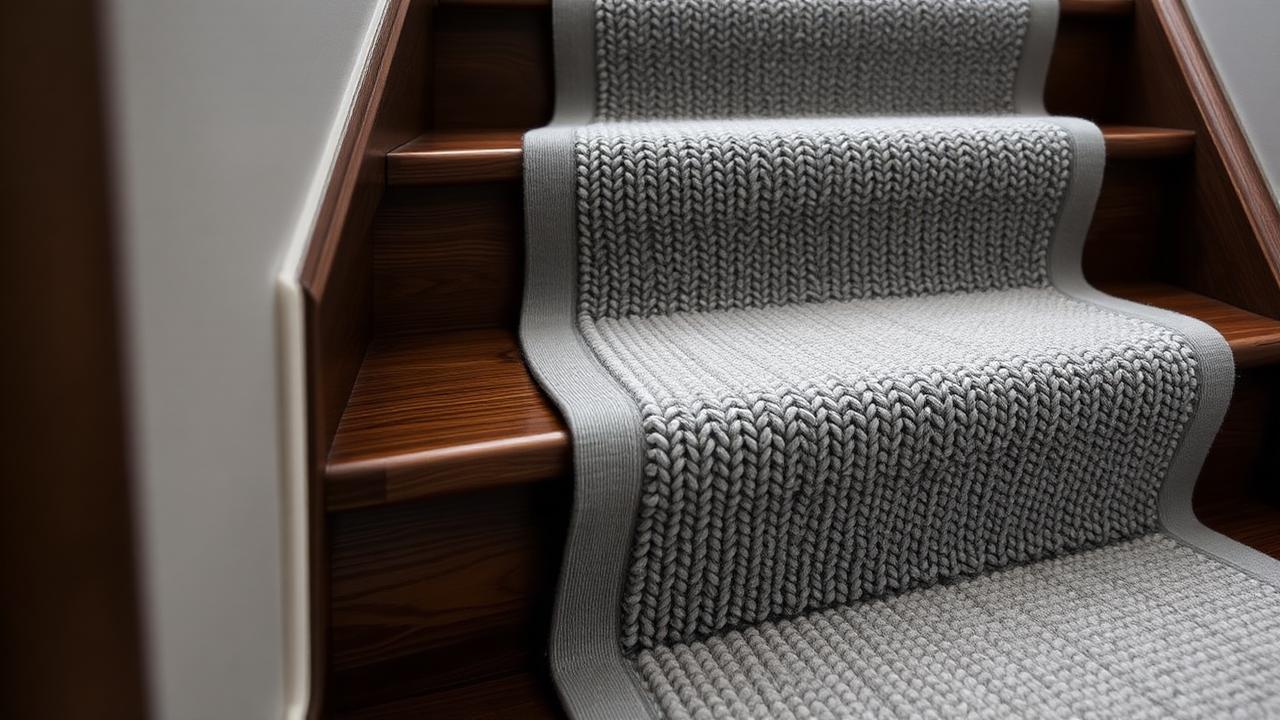
Pairing carpeting choices with the rest of the stair runner carpet in your home
If you already have carpet elsewhere in the house, matching the fibre type – not just the colour – of your new stair runner carpeting makes the whole scheme feel considered rather than pieced together. A wool-blend stair runner paired with a polypropylene hallway carpet can look subtly mismatched in sheen and texture even if the colours are identical, so ask your carpeting supplier for the closest fibre match to what is already fitted elsewhere, not just a colour match.
Pattern repeat maths when cutting from broadloom
When you buy plain carpeting with no pattern, repeat maths is not a concern, but many buyers choose a subtle woven texture or self-pattern, and this still needs checking. On a 13-step flight with a 10in (25cm) going and 7.5in (19cm) rise, the running length needed before waste is roughly 13ft 6in (4.1m); add 5-8% for a plain or subtly textured carpet, rising to 10-14% if the carpeting has any visible woven repeat that needs centring on the treads.
Wear ratings and what they actually mean on stairs
A carpet's stated wear or traffic rating is measured on flat flooring, not on the folded, flexed surface of a stair nosing, which is why a specific stair-suitability rating matters more than a general heavy-domestic grade when buying raw carpeting. A carpet rated Heavy Domestic for a living room floor can still wear prematurely at a stair nosing if it was never tested or rated for stair use, since the folding action at each nosing edge stresses the backing and pile in a way flat flooring never experiences.
Underlay choice affects wear as much as the carpet itself
A firm, dense underlay in the 9-10mm range extends the life of stair runner carpeting noticeably compared with a soft, thick pad, because it stops the pile from over-compressing at the nosing on every footstep. Ask your fitter to spec a stair-specific underlay rather than reusing whatever pad they have for flat flooring jobs, since the two applications have genuinely different requirements.
| Carpeting choice | Extra yardage to allow | Notes |
|---|---|---|
| Plain, no pattern | 5-8% | Waste only, no pattern matching needed |
| Subtle woven self-pattern | 10-14% | Needs centring on treads |
| Bold woven or printed pattern | 12-18% | Needs full repeat matching and turn planning |
Whatever you decide, get the numbers first: the stair runner calculator doubles as a stair runner length calculator, adding nosing wrap, landings, winders, pattern repeat and waste so you order the right length the first time.
Frequently asked questions
What is the difference between buying stair runner carpeting and a finished runner?
Carpeting is raw broadloom carpet cut to size and bound separately, giving more control over width and often better value for plain carpets; a finished runner arrives already cut, bound and sometimes pattern-matched.
What carpet fibre is best for stair runner carpeting?
Wool and wool-blend generally offer the best combination of durability and feel for stairs, with solution-dyed nylon a strong, often lower-cost alternative for stain resistance.
What does a stair suitability rating mean on a spec sheet?
It means the manufacturer has tested and approved that specific carpet for the extra flexing and folding stairs put on carpet at the nosing, which not all domestic carpets are rated for.
What pile construction is most durable on stairs?
Loop pile (Berber) and twist pile constructions generally resist crushing and footprint marking better on stairs than a plain cut pile.
How much carpet waste is there when cutting a narrow runner from a wide roll?
It depends on your chosen runner width against the roll width used, and can be significant for a narrow runner cut from a wide roll — ask your fitter to quote the waste specifically.
How much does stair runner carpeting cost per metre?
Roughly £15-90 or $20-120 per linear metre at a common 30in cut width depending on fibre and quality, before binding, underlay and fitting.
Should I get binding done separately from the carpet purchase?
It can be done by the same supplier or a separate specialist; either way, get it quoted explicitly alongside the carpet price so you see the true total cost.
How is this different from a custom stair runner carpet?
Custom stair runner carpet usually refers to a made-to-measure finished product ordered to your exact dimensions and pattern; this guide covers buying and specifying the raw carpeting yourself.
Know your numbers in 30 seconds
Enter your step count, tread depth and riser height — the stair runner calculator gives you the exact length to order, in metres and feet, with waste included.
Price the carpeting I've chosenReady for real prices?
Get quotes from vetted stair runner suppliers and fitters near you. Free, no account, no obligation.
Every guide is written from hands-on measuring and fitting experience, checked against the calculator’s own maths, and re-reviewed whenever prices or methods change. Read our editorial standards.