

Why carpet type should come before colour
A runner idea is really three decisions stacked together: the carpet fibre and construction, the colour and pattern printed or woven into it, and the width and border treatment used to fit it to your stairs. Pinterest boards collapse all three into one image, which is fine for inspiration but misleading for planning, because a striped wool Axminster and a striped synthetic loop pile are not interchangeable — they wear differently, cost differently, and photograph differently once they are underfoot rather than on a sample card.
Starting with the carpet also protects your budget. Wool runners in bold multi-colour patterns can run two to three times the price of a plain synthetic loop pile at the same width, so deciding on fibre first tells you honestly which idea boards are realistic before you fall for a specific look.
Wool and wool-blend runner ideas
Wool and wool-rich blends (typically 80% wool, 20% synthetic) are the default for a traditional or transitional staircase because the fibre takes dye well, resists crushing, and has a natural sheen that reads as quality even in a plain colourway. Wool suits both solid colours and complex woven patterns — herringbone, Greek key, and multi-colour stripes all show their best detail in a dense wool pile.
- Solid deep colour (navy, bottle green, charcoal) with a contrast bound edge for a classic, formal hallway.
- Herringbone or houndstooth wool for texture without needing a bold colour commitment.
- Wide-repeat woven stripe in two tonal neutrals for a quieter transitional look.
- Wool berber loop in a mid neutral where a busy pattern would fight with existing joinery.
Synthetic runner ideas (nylon, polypropylene, PET)
Synthetic runners have closed the quality gap with wool considerably, and solution-dyed nylon or polypropylene is now a sensible first choice for stairs with children, pets, or heavy footfall, since it resists staining and fading better than untreated wool and costs less per metre. The trade-off is a slightly flatter hand-feel and less depth of colour in dark tones, which matters on a runner viewed at close range on a landing but is barely noticeable once fitted.
| Idea | Carpet type | Why it works |
|---|---|---|
| Bold geometric print | Printed polypropylene | Sharp print definition, budget-friendly, good for a feature stair |
| Plain mid-grey loop | Solution-dyed nylon | Hides everyday dirt, wipeable-adjacent stain resistance |
| Faux-natural weave look | Synthetic flatweave | Natural texture without sisal's abrasiveness on bare feet |
| High-traffic runner runner-plus-hallway set | Nylon Berber loop | Matches a hall carpet in the same fibre for continuity |
Natural fibre runner ideas
Sisal, jute and seagrass runners bring texture and a warm, organic look that pairs particularly well with painted staircases and pale timber. They are the least forgiving on stairs used in bare feet and the most likely to shed fibres when first fitted, but the visual payoff — a genuinely woven, tactile surface — is hard to replicate synthetically. A herringbone-weave sisal with a contrast fabric border is one of the most requested natural-fibre stair looks, and it works because the border does the colour work while the sisal supplies the texture.
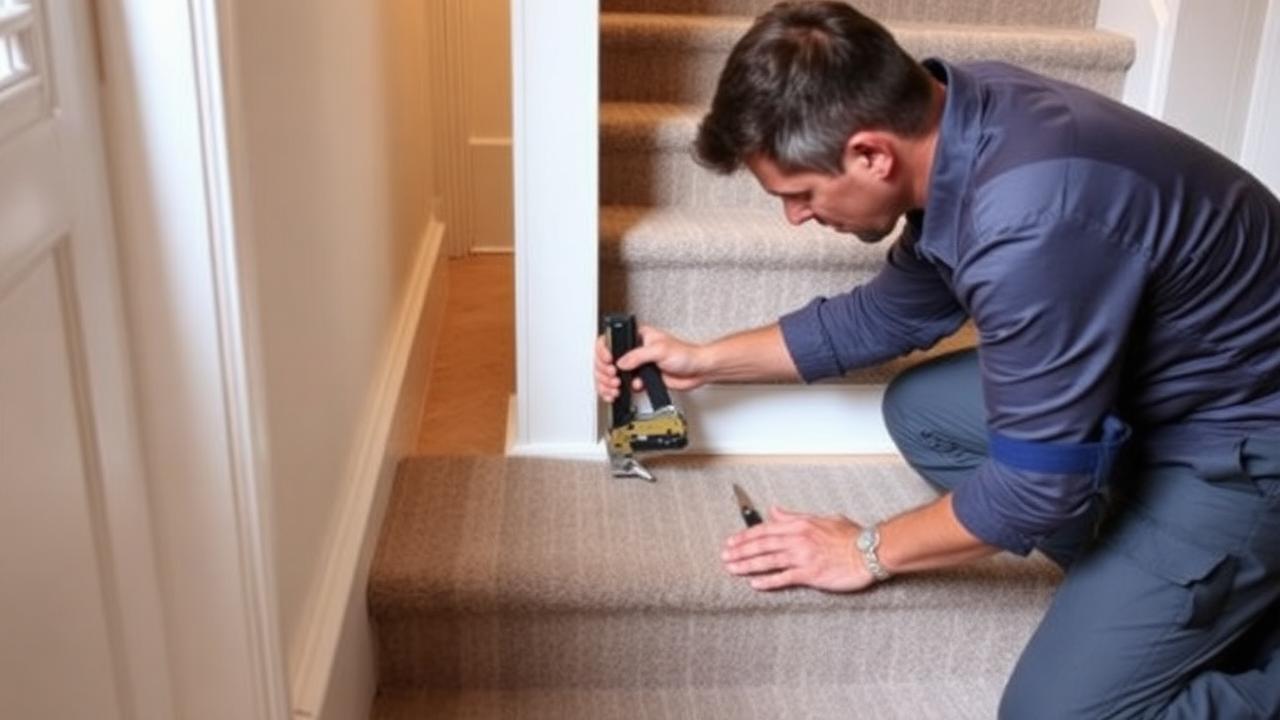
Natural fibre needs a plan for edges
Sisal and jute fray without a bound or serged edge, and the binding itself becomes part of the look. Choose the binding fabric before you commit to the base weave, not after.
Matching runner ideas to the staircase itself
The same carpet idea reads differently on a straight flight, a turned staircase, and a stair with winders. Bold pattern repeats look considered on a long straight run because you see the full repeat; on a stair with winders the pattern often has to be pieced or centred awkwardly around the pie-shaped treads, so a plain or subtly textured carpet is usually the safer idea there.
- Long straight flight: strong pattern or stripe reads best, since the repeat is uninterrupted.
- Turned or winder staircase: plain, tonal or small-scale texture avoids an awkward pattern break at the turn.
- Narrow stairs (under 32in): a lighter carpet colour and simpler pattern make the flight feel less enclosed.
- Stairs with a lot of natural light: check pattern and colour under both daylight and evening light before ordering.
Budgeting across carpet types
Prices below are indicative and vary by supplier, width and finishing; treat them as a starting point for comparison rather than a quote.
| Carpet type | Typical price per linear metre (30in wide) | Wear rating for stairs |
|---|---|---|
| Printed polypropylene | £25-45 / $35-60 | Good |
| Solution-dyed nylon | £35-65 / $48-88 | Very good |
| Wool-blend (80/20) | £45-85 / $60-115 | Excellent |
| Pure wool woven pattern | £70-140 / $95-190 | Excellent |
| Sisal / natural fibre | £40-90 / $55-120 | Good, needs bare-foot consideration |
Know your numbers in 30 seconds
Enter your step count, tread depth and riser height — the stair runner calculator gives you the exact length to order, in metres and feet, with waste included.
Open the stair runner calculatorA shortlist method that actually works
- Decide fibre first from footfall, pets and budget, not the photo you liked.
- Within that fibre, shortlist three colours against your actual flooring and paint, not a screen.
- Only then choose pattern or plain, based on whether your stair is straight or has winders.
- Confirm width and border against your measured stair width, not a standard size.
- Price the shortlist with the stair runner cost calculator before ordering samples.
Whatever you decide, get the numbers first: the stair runner calculator doubles as a stair runner length calculator, adding nosing wrap, landings, winders, pattern repeat and waste so you order the right length the first time.
Still deciding on material, width or pattern? Our hub on stair runners compares weaves, widths, backings and fitting styles side by side, then hands the numbers straight to the calculator.
Frequently asked questions
What is the most popular stair runner carpet?
Wool and wool-blend carpets remain the most requested for stair runners because they wear well and take colour and pattern richly, though solution-dyed nylon is increasingly chosen for busy households due to its stain resistance.
Should I choose colour or carpet type first?
Choose the carpet type first. It sets your realistic budget and pattern options, and prevents you falling for an idea in a fibre you were never going to buy.
Is sisal a good stair runner carpet idea?
Sisal looks striking, especially with a contrast bound edge, but it is firmer underfoot and less forgiving in bare feet than wool or synthetic, so it suits households who mostly wear socks or slippers on stairs.
Do bold patterns work on every staircase?
Bold repeating patterns generally look best on long straight flights. On staircases with winders or turns, a plain or subtly textured carpet avoids an awkward pattern break.
How much does a stair runner carpet cost per metre?
Roughly £25-45 for printed synthetic up to £70-140 for pure wool pattern, per linear metre at a common 30in width, though prices vary by supplier and finishing.
Can I match my stair runner to my hallway carpet?
Yes, ordering the runner and an adjoining hall carpet in the same fibre and colourway is common and gives a seamless look at the base of the stairs.
What carpet wears best on stairs with pets?
Solution-dyed nylon or a tight wool-blend loop generally wears and cleans best where pets are regularly on the stairs.
Where can I price my chosen carpet idea for my stairs?
Use the stair runner cost calculator with your measured stair width and step count to get an estimate for the carpet types you are considering.
Know your numbers in 30 seconds
Enter your step count, tread depth and riser height — the stair runner calculator gives you the exact length to order, in metres and feet, with waste included.
Price my stair runner carpetReady for real prices?
Get quotes from vetted stair runner suppliers and fitters near you. Free, no account, no obligation.
Every guide is written from hands-on measuring and fitting experience, checked against the calculator’s own maths, and re-reviewed whenever prices or methods change. Read our editorial standards.