
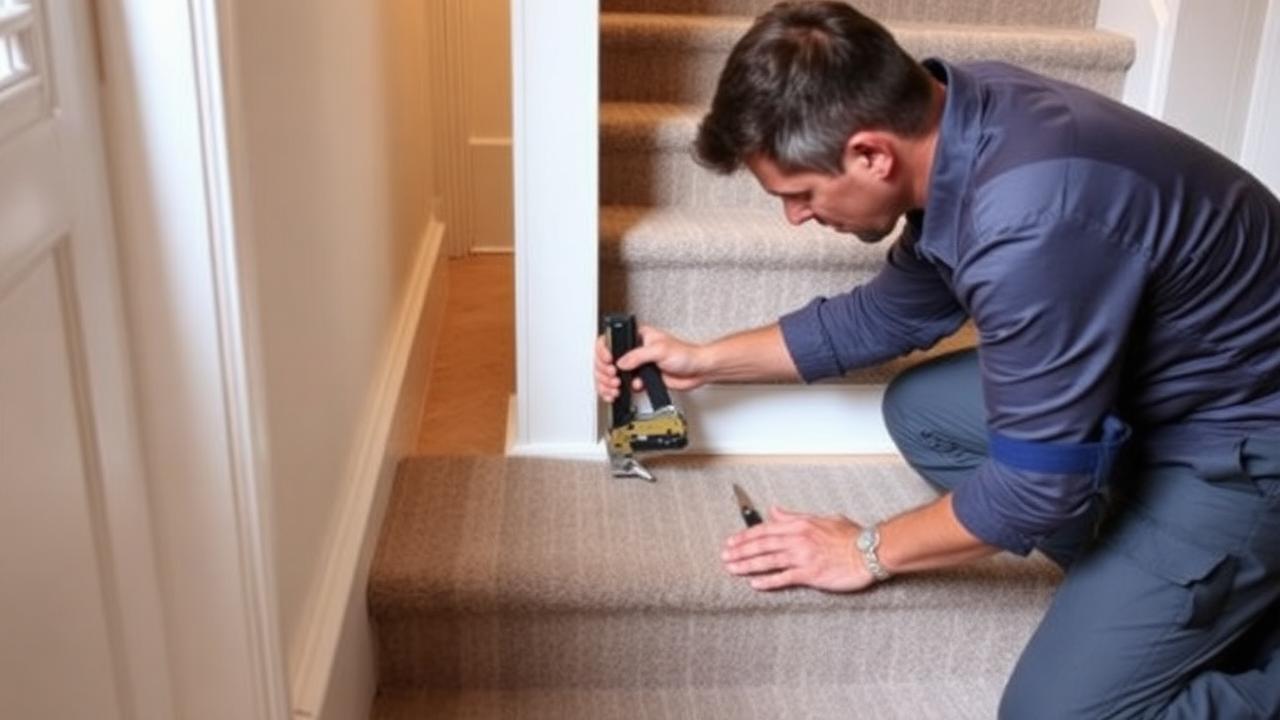
The anatomy of the fitting timeline
When you look at a finished stair runner, it's easy to underestimate the amount of time that went into each individual step. As a professional, I don't just 'throw down' the carpet; I treat every tread and riser as a mini-installation project. The 15 to 20 minutes per step isn't just spent stapling; it's the time taken to align the runner, tension it with the knee kicker, bolster it into the joins, and check the symmetry. For a DIYer, this time can easily double to 40 minutes per step as you navigate the learning curve. If you're planning a 13-step project, don't expect to be finished in two hours. A quality job requires patience, and rushing the process is the number one cause of alignment errors and loose carpet. Using a stair runner calculator to have all your measurements ready beforehand is the first way to save time.
The timeline is also heavily influenced by the complexity of the staircase. A straight flight with no turns is the fastest, but as soon as you add winders, bullnose steps, or landings, the time per step spikes. A winder step, for example, can take 45 to 60 minutes because it requires templating and individual cutting. A bottom bullnose (a step that wraps around the side) is another time-sink, often requiring an hour of careful 'dressing' to ensure the carpet follows the curve perfectly without any ripples. When you are calculating your total time, you must account for these 'speciality' steps separately from the standard ones. A 13-step flight with three winders and a bullnose at the bottom is a full day's work for even an experienced fitter.
Preparation: The invisible time-sink
Before you even touch the runner, there is the preparation phase, which often takes longer than people expect. Removing old carpet and, more importantly, old staples and gripper rods, can take an hour or more. Then there's the cleaning and potential sanding of the treads. If the stairs are squeaky, you’ll spend another 30 minutes driving screws into the treads to silence them. Once the stairs are prepped, installing the new gripper rods and underlay for a 13-step flight typically takes another 60 to 90 minutes. This foundation work is critical; if the grippers are slightly off, the rest of the job will take much longer as you fight to get the runner aligned. I always advise people to treat the preparation as a separate 'day zero' task if they are doing it themselves.
Then there's the marking out. Centring a runner and snapping chalk lines or setting up a laser level takes about 20 to 30 minutes. It feels like you’re not making progress, but this is the most important half-hour of the entire job. As the saying goes, 'measure twice, cut once.' If you skip the marking out to save time, you will almost certainly lose that time (and more) later when you have to pull the carpet up because it has drifted off-centre. A professional stair runner length calculator helps here by giving you a clear material plan, but the physical marking on the wood is what guides your hands. When you consider the total project time, the actual 'carpet fitting' is only about 50% of the effort.
Time-Saving Tip
Organize your tools in a bucket or belt so you aren't constantly climbing up and down the stairs to find your knife or stapler. Those small trips add up to 30 minutes of wasted time on a 13-step flight.
How much runner do I need?
Time and material go hand in hand. For a 13-step flight in the US (10 in tread, 7.5 in riser, 1 in wrap), you need 18.5 in per step. Total = 240.5 in (20.04 ft). Add 24 in for finishing and an 8% waste margin, total = 23.8 ft. If the stairs are complex, I add 5% to the waste margin because complex steps take more time and are more prone to cutting errors, bringing the total to about 25 ft.

In the UK, for a 13-step flight (25 cm tread, 19 cm riser, 2.5 cm wrap), you need 46.5 cm per step. Total = 6.05 m. Adding a 60 cm allowance and a 10% waste margin (essential for complex jobs), you need 7.32 metres. Always use a stair runner length calculator to ensure you don't run out of material when you're 80% through your fitting time.
| Task | Time (Professional) | Time (DIY) | Notes |
|---|---|---|---|
| Prep & Cleaning | 60 mins | 120 mins | Includes old carpet removal |
| Gripper & Underlay | 90 mins | 180 mins | Precision is key here |
| Marking & Centring | 30 mins | 60 mins | Don't skip this! |
| Fitting (13 Straight) | 200 mins | 400 mins | ~15-30 mins per step |
| Winders (x3) | 120 mins | 240 mins | Requires templating |
| Final Detailing | 30 mins | 60 mins | Stair rods, sealing, cleaning |
Know your numbers in 30 seconds
Enter your step count, tread depth and riser height — the stair runner calculator gives you the exact length to order, in metres and feet, with waste included.
Open the stair runner calculatorFactors that slow you down
Not all stair runners are created equal when it comes to fitting speed. A wool-blend runner with a flexible jute backing is the 'fastest' to fit because it responds well to the knee kicker and holds a crease easily. Conversely, a heavy loop-pile synthetic or a very stiff natural fibre like sisal can be a nightmare. These materials fight back, requiring more force to stretch and more staples to hold. You might find yourself spending 30 minutes per step just trying to get a stiff sisal runner to sit flat on the nosing. If you've chosen a particularly challenging material, adjust your expectations and your timeline accordingly. Also, patterned runners take longer because you have to spend time at each step ensuring the pattern aligns perfectly with the one below.
The physical environment also plays a role. Fitting in a narrow, dark hallway with no power outlets nearby will naturally slow you down. If you're working on very old, hard timber (like 100-year-old oak), your stapler will struggle, and you'll spend time clearing jammed staples or having to pre-drill for stair rod brackets. Even the weather can have an impact; in very cold conditions, carpet backings become stiffer and harder to work with. I always recommend bringing the stair runner carpet into the house 24 hours before fitting to let it acclimate and soften up, which can save you a significant amount of wrestling time on the stairs themselves.
- Wool runners are faster to fit than stiff synthetics or sisal.
- Winders and bullnose steps add significant time to the project.
- Preparation (removing staples, silencing squeaks) is often overlooked.
- Allow at least 24 hours for the carpet to acclimate to the home's temperature.
- Organizing tools before you start saves dozens of trips up and down the flight.
The importance of the 'final 5%'
The last part of the fitting process is the final detailing, and it's the one most people are tempted to rush because they're tired. This includes trimming any stray fibres, sealing any cut edges with seam sealer, and installing stair rods if you're using them. This 'final 5%' takes about 30 to 45 minutes but makes 50% of the visual difference. A runner that is perfectly fitted but has loose threads at the stringers will always look like a DIY job. Take the time to vacuum the stairs thoroughly and inspect every tuck. If you find a section that isn't quite as tight as the others, fix it now. It won't get better over time; it will only get worse.
In conclusion, fitting a stair runner is a marathon, not a sprint. For a professional, it's a 4-to-6-hour commitment; for a DIYer, it's a full weekend project. By understanding where the time goes—from the invisible prep work to the technical challenge of the winders—you can plan your project more effectively and avoid the frustration of a job that takes twice as long as you thought. Use a stair runner length calculator to get your foundation right, take your time with the marking out, and enjoy the satisfaction of a job well done. Your stairs are a high-traffic area that deserves the precision that only time and patience can provide.
In my two decades of fitting, I have never regretted taking an extra ten minutes on a step to get it perfect, but I have often regretted rushing. If you find yourself getting frustrated or tired, step away for a bit. The stairs will still be there, and a fresh pair of eyes can often see an alignment error that you missed. A well-fitted runner is a beautiful addition to any home, providing safety and style for years to come. Treat the process with respect, and the results will speak for themselves. Don't forget to double-check your material requirements one last time with a stair runner calculator before you make that first cut—it's the best time-saver there is.
Frequently asked questions
How long does it take to fit a stair runner on 13 steps?
A professional can typically complete a standard 13-step flight in 4 to 6 hours. For a DIYer, it is usually a full weekend project (10 to 12 hours) once you factor in the learning curve and preparation.
How much time should I allow per step?
Budget for 15 to 20 minutes per straight step for a professional finish. This includes aligning, tensioning, bolstering, and stapling. DIYers should allow 30 to 45 minutes per step.
Do winders take longer to fit?
Yes, significantly. A winder step can take 45 to 60 minutes because it requires individual templating, precise cutting, and complex tensioning to follow the curve of the stairs.
How long does preparation take?
Removing old carpet and staples, cleaning the stairs, and installing new grippers and underlay usually takes 2 to 3 hours before you even start fitting the runner itself.
Does the type of carpet affect fitting time?
Yes. Flexible wool runners are the fastest to fit. Stiff materials like sisal or seagrass, or very thick loop-pile synthetics, are much harder to manipulate and can double the fitting time per step.
How long does it take to install stair rods?
Installing a full set of 13 stair rods takes about 30 to 45 minutes. This involves measuring, pre-drilling pilot holes, and screwing in the brackets for each rod.
Can I fit a stair runner in a single day?
Yes, a professional can easily fit one or even two standard flights in a day. For a DIYer, it's better to split the job into prep (Day 1) and fitting (Day 2).
Why is my fitting taking so long?
Common delays include dull knife blades, inadequate tools (like manual staplers), and not marking out the centre line beforehand. Organization and preparation are key to efficiency.
Know your numbers in 30 seconds
Enter your step count, tread depth and riser height — the stair runner calculator gives you the exact length to order, in metres and feet, with waste included.
Plan your weekend project with the stair runner calculatorReady for real prices?
Get quotes from vetted stair runner suppliers and fitters near you. Free, no account, no obligation.
Every guide is written from hands-on measuring and fitting experience, checked against the calculator’s own maths, and re-reviewed whenever prices or methods change. Read our editorial standards.