
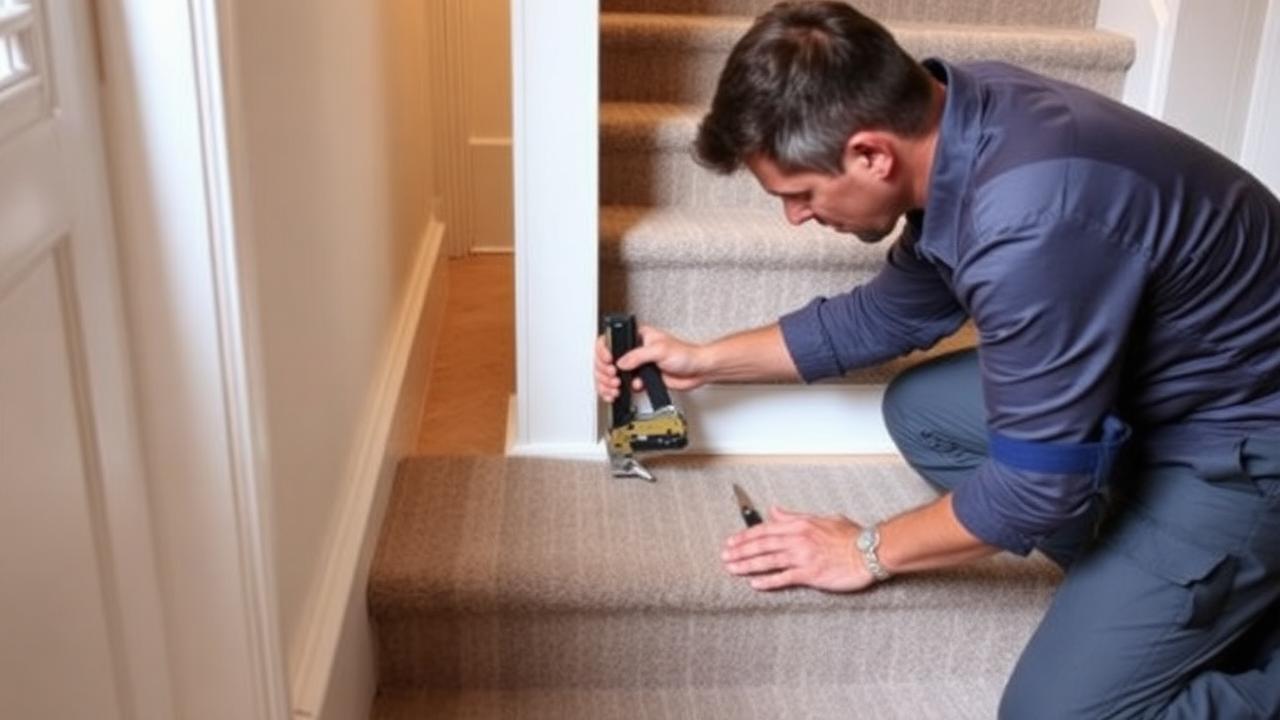
What are stair runner mats?
Unlike a continuous stair runner that flows down the whole flight in one piece, stair mats are individual rectangles or shaped pieces cut to fit a single tread, sometimes with a matching riser piece. They are popular in rental properties, for DIY installers, and anywhere a full carpet fitting isn't practical or affordable. Each mat is typically secured with double-sided adhesive strips, small gripper pads, or non-slip backing rather than the tackless strips and pad used for fitted runners.
Pros of individual mats
The biggest advantage is flexibility: if one mat wears out or gets stained, you replace just that piece rather than the entire runner. Installation is also far simpler and can usually be done without a professional fitter, since there is no continuous seam or nosing wrap to manage down the whole flight. Mats are also cheaper upfront in small quantities and easier to transport if you are moving.
Cons compared to a continuous runner
The trade-off is visual continuity and safety. A continuous runner reads as one elegant design element and, when properly fitted with pad and tackless strip, is significantly more secure underfoot. Individual mats can shift or curl at the edges over time, especially with lower-quality adhesive, creating a trip hazard. They also rarely achieve the same finished, tailored look as a fitted runner with bound edges and stair rods.
Sizing your mats
Each mat needs to cover the tread depth plus a small nosing wrap, similar to the calculation for a continuous runner but applied per step rather than cumulatively. For a 10 in (25 cm) tread, a mat around 8-9 in (20-23 cm) deep by your chosen width leaves a small unwrapped nosing lip, or you can buy mats pre-shaped to wrap the nosing fully. If you want the total material comparison, the stair runner calculator can still show you the equivalent continuous length so you can compare cost per square foot between mats and a full runner.
| Feature | Stair Mats | Continuous Runner |
|---|---|---|
| Installation | DIY-friendly | Usually professional |
| Replacement | Per mat | Whole runner |
| Visual effect | Segmented | Continuous, tailored |
| Security underfoot | Lower unless well fixed | Higher with pad and tackless strip |
| Typical cost per step | Lower per mat | Amortized across full length |
Know your numbers in 30 seconds
Enter your step count, tread depth and riser height — the stair runner calculator gives you the exact length to order, in metres and feet, with waste included.
Open the stair runner calculatorNon-slip backing is essential
If you choose individual mats, never use ones without a proper non-slip backing or secure adhesive. Loose mats on stairs are a genuine safety hazard, particularly for older household members or young children.
When mats make sense
Mats work well for short-term rentals, staircases where the wood itself is a feature you want mostly visible, or budget-conscious first installs where you want to test a color or pattern before committing to a full fitted runner. They are also useful on stairs that see uneven wear, such as a flight used constantly by pets, since you can rotate or replace individual mats as needed.

- Mats allow spot replacement instead of full runner replacement.
- Installation is generally DIY-friendly with adhesive strips.
- Continuous runners offer better security and a more tailored look.
- Always choose mats with proper non-slip backing.
- Mats suit rentals, budget projects, and pet-heavy households.
Cost comparison over time
While mats can be cheaper to buy initially, replacing worn mats one by one over several years can add up to a similar or higher total cost than a single quality continuous runner that lasts a decade or more. Factor in your household's traffic levels and how long you plan to stay in the home before choosing between mats and a full runner.
In short, stair runner mats are a practical, flexible option for many households, but for a long-term, polished result, a properly fitted continuous runner with pad and secure tackless strips remains the superior choice.
Measuring for a full mat set
To size a full set of mats for a 13-step flight with 10 in (25 cm) treads, measure each tread's depth and the riser height separately, since some mat manufacturers cut riser pieces to a fixed 7 in (18 cm) regardless of your actual riser height, which can leave a gap at the base. For a 10 in tread, look for a tread mat around 8.5-9.5 in (22-24 cm) deep, leaving a small unwrapped nosing lip of roughly half an inch (1.3 cm), or a nosing-wrap style that adds about 1 in (2.5 cm) to fully cover the front edge. Multiply the mat width by your chosen coverage, typically 27-30 in (68-76 cm), the same as a fitted runner.
| Item | US (in) | UK (cm) |
|---|---|---|
| Tread depth (typical) | 10 in | 25 cm |
| Mat depth (no nosing wrap) | 8.5-9.5 in | 22-24 cm |
| Mat depth (with nosing wrap) | 10-11 in | 25-28 cm |
| Riser piece height | 7-7.5 in | 18-19 cm |
Cost comparison in practice
A set of 13 decent-quality tread mats typically runs $150-350 in the US, or roughly £130-300 in the UK, depending on fibre and backing quality, compared with $550-1100 for a fitted 24 ft runner including pad and installation. The mat route is clearly cheaper at the outset, but if you replace three or four worn mats every couple of years over a decade, the running total can approach or exceed the cost of the fitted alternative, especially once you include your own time fitting replacements.
- Measure tread and riser separately; don't assume a standard riser height.
- Choose nosing-wrap mats if you want full front-edge coverage.
- Budget $150-350 (£130-300) for a full 13-mat set.
- Factor in replacement frequency when comparing long-term cost.
- Keep coverage width consistent with what a fitted runner would use.
Whatever you decide, get the numbers first: the stair runner calculator doubles as a stair runner length calculator, adding nosing wrap, landings, winders, pattern repeat and waste so you order the right length the first time.
Still deciding on material, width or pattern? Our hub on stair runners compares weaves, widths, backings and fitting styles side by side, then hands the numbers straight to the calculator.
Frequently asked questions
Are stair runner mats as safe as fitted runners?
Only if they have strong non-slip backing and are firmly adhered; poorly secured mats can shift and pose a trip hazard.
Can I install stair mats myself?
Yes, they are generally DIY-friendly and don't require the specialist tools needed for a fitted runner.
How many mats do I need for a 13-step staircase?
Typically 13, one per tread, though some designs also include separate riser pieces.
Do stair mats wear out faster than a fitted runner?
Individual mats can shift and wear at the edges faster, but you can replace single mats rather than the whole set.
Can mats be used on winders?
Yes, though you'll need custom-shaped mats or careful cutting to fit the tapered treads.
Are mats cheaper than a continuous runner?
Often cheaper upfront, but replacing them individually over years can approach the cost of one quality fitted runner.
What adhesive works best for stair mats?
Heavy-duty double-sided carpet tape or dedicated stair mat adhesive strips designed for foot traffic.
Do mats need underlay?
Some thicker mats have built-in cushioning, but a thin foam pad underneath improves comfort and grip.
Know your numbers in 30 seconds
Enter your step count, tread depth and riser height — the stair runner calculator gives you the exact length to order, in metres and feet, with waste included.
Compare lengths with the stair runner calculatorReady for real prices?
Get quotes from vetted stair runner suppliers and fitters near you. Free, no account, no obligation.
Every guide is written from hands-on measuring and fitting experience, checked against the calculator’s own maths, and re-reviewed whenever prices or methods change. Read our editorial standards.