

Treat every flight as its own project
Split-level homes often have three, four or more short flights linking staggered floor levels, each separated by a small landing. The most reliable approach is to measure each flight and each landing individually, rather than trying to estimate the whole house in one calculation, since flight lengths and landing sizes rarely match each other.
Step-by-step measuring process
- List every flight in the house separately and count the steps in each.
- Measure tread and riser depth for each flight, since older split-level homes sometimes vary flight to flight.
- Measure every landing as its own flat area, length by width.
- Decide whether each landing gets a seam or a continuous run, and add the relevant transition allowance from that decision.
- Total everything at the end, then add an overall waste margin.
Where the extra material goes
| Element | Extra length allowance | Difficulty | DIY-able |
|---|---|---|---|
| Each mid-level landing seam | 0.1–0.2 m per landing | Easy | Yes |
| Continuous run over a small landing | 0.4–0.6 m per landing | Moderate | Yes |
| Multiple flights of differing widths | Cut separately, minimal extra length, more waste | Moderate | Yes |
| Colour matching across many flights | 5–10% extra to allow reordering margin | Moderate | Yes |
Order all flights from one batch
Because a split-level staircase can involve several separate flight lengths, order enough runner for the entire project at once from a single dye lot rather than ordering flight by flight and risking a colour mismatch partway through.
Know your numbers in 30 seconds
Enter your step count, tread depth and riser height — the stair runner calculator gives you the exact length to order, in metres and feet, with waste included.
Open the stair runner calculatorKeeping a consistent look across levels
With several flights visible from common living areas at once, keep the runner width, binding and pile consistent throughout, even if the landings themselves use different transition details. A varied installation is far more noticeable in a split-level layout than in a single straight staircase.
Tools and materials, with typical prices
Before starting anything connected to fitting a stair runner on a split-level staircase, it helps to know what the job actually costs in tools and consumables, not just carpet. Most of this list is a one-off purchase that will be reused on future stair or rug projects, so it is worth buying reasonable quality rather than the cheapest option.
- Tape measure and chalk line: $15-30 (£12-24), for marking and checking dimensions.
- Utility knife and spare blades: $10-20 (£8-16), for clean cuts through backing.
- Staple gun or tackless strip and knee kicker: $40-150 (£30-120) depending on method.
- Underlay/pad, per step: $3-6 (£2.50-5), skip only where the fibre specifies no pad.
- Seam tape or adhesive for joins: $8-15 (£6-12) per roll or tube.
Safety and building-code notes
Stairs are one of the most common places for a fall in the home, so anything touching fitting a stair runner on a split-level staircase should be checked against basic safety practice as well as good looks. Codes vary by jurisdiction but the underlying principles are consistent everywhere carpet meets a staircase.
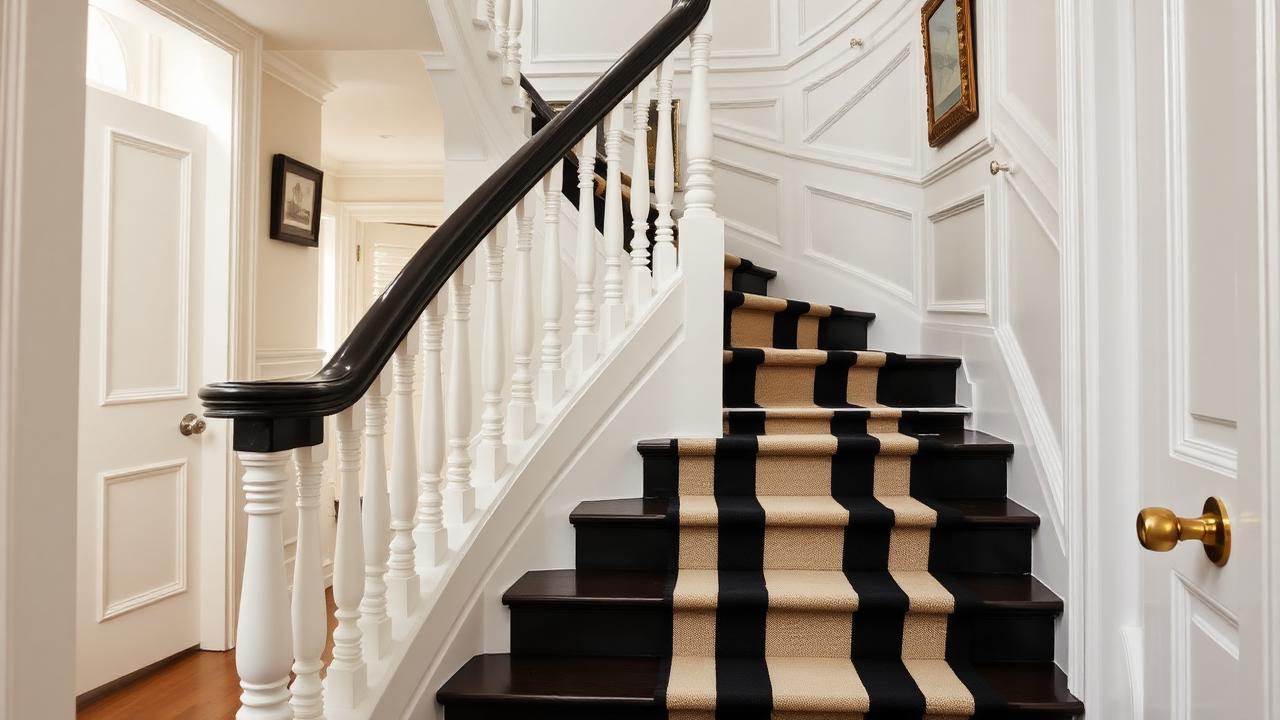
- Keep nosing build-up modest; a lip much over 3/8 in (10 mm) between the runner and a bare edge becomes a trip hazard.
- Use a slip-resistant backing or pad, particularly on the top and bottom steps where speed is highest.
- Secure every edge fully; a loose corner or lifted seam is the single most common cause of a stair fall on carpeted stairs.
- In rented or multi-occupancy buildings, check local fire and flooring regulations before installing natural fibre runners.
Identifying where each level's flight begins and ends
A split-level staircase typically breaks into two or more shorter flights connected by intermediate landings at different heights rather than one continuous run. Before measuring, walk the whole staircase and note exactly where each flight starts and stops, since it is easy to accidentally count a landing tread as part of a flight or vice versa, throwing off the whole calculation. Number each flight and landing on a simple sketch and measure them as separate sections, then total the results at the end.
Consistency of runner width across level changes
Where a split-level design changes staircase width between flights, which is common where one flight serves a wider hallway and another a narrower one, decide early whether the runner width will change to match each flight or stay constant throughout for visual consistency. A constant width usually looks better and is simpler to source, provided the narrowest flight can still accommodate it with an adequate margin; only drop to a narrower runner on one section if the width difference is significant.
| Section | Typical length range | Measuring approach |
|---|---|---|
| Each individual flight | 3-8 steps typically | Tread + riser per step, as standard |
| Intermediate landing | Varies, measure as floor | Length x width, wall to wall |
| Level change / half step | 1 step, often deeper | Measure individually, do not assume standard depth |
Ordering enough runner for multiple sections
Split-level staircases often need more separate cut pieces than a simple straight flight, which increases both waste and the risk of a dye-lot mismatch if sections are ordered at different times. Calculate every section's total before placing any order, add a combined waste allowance rather than a per-section one, and order the entire quantity from a single roll in one purchase wherever possible.
Handling the mid-level landing sightline
Split-level layouts also make it worth confirming how each short flight relates to natural light sources, since the staggered floor heights often place landing windows at unusual angles relative to a standard staircase. A light or mid-tone runner can help a shorter, dimmer split-level flight feel less enclosed, while a darker runner suits a flight that already gets strong daylight from a nearby window or skylight.
A split-level staircase usually has its landing visible from more than one room at once, since the short flights break sightlines differently than a single straight run. Consider how the runner and landing carpet will be seen from the entry hall, an adjoining room, and from above, before finalising colour and pattern, since a busy pattern that looks fine on a single flight can feel visually cluttered when three separate flight angles are visible from one seating position.
Whatever you decide, get the numbers first: the stair runner calculator doubles as a stair runner length calculator, adding nosing wrap, landings, winders, pattern repeat and waste so you order the right length the first time.
Still deciding on material, width or pattern? Our hub on stair runners compares weaves, widths, backings and fitting styles side by side, then hands the numbers straight to the calculator.
Frequently asked questions
How is a split-level staircase measured for a runner?
Each short flight and each mid-level landing is measured separately, since lengths rarely match between flights, and the totals are combined with an overall waste allowance at the end.
Should every flight in a split-level house use the same runner?
Yes, for visual consistency, especially where several flights are visible from the same living space. Order all the runner needed from one dye lot to avoid colour drift.
How much extra does each landing add on a split-level staircase?
Around 0.1 to 0.2 metres per landing if simply seamed at the top riser, or 0.4 to 0.6 metres per landing if the runner is run continuously across it.
Is a split-level staircase harder to fit a runner on than a normal staircase?
Not technically harder, but more time-consuming, since it involves measuring and fitting several separate flights and landings rather than one continuous run.
What is the biggest mistake people make with this?
Rushing the measuring or prep stage. Most poor outcomes with fitting a stair runner on a split-level staircase trace back to a single measurement taken at the wrong point, or a substrate check skipped to save a few minutes, both far cheaper to fix before the runner is cut than after.
How many separate sections does a split-level staircase usually have?
It varies by design, but most split-level staircases have two to four shorter flights connected by intermediate landings at different heights, each of which should be measured as its own section.
Should runner width stay the same across all flights on a split level?
Usually yes, for visual consistency, provided the narrowest flight can still fit it with an adequate margin. Only reduce the width on one section if the width difference between flights is substantial.
Is a split-level staircase more expensive to carpet?
Usually yes, since it has more individual sections, landings and potential seams than a single straight flight, which adds both labour time and a slightly higher material waste allowance.
Know your numbers in 30 seconds
Enter your step count, tread depth and riser height — the stair runner calculator gives you the exact length to order, in metres and feet, with waste included.
Measure my split-level stairsReady for real prices?
Get quotes from vetted stair runner suppliers and fitters near you. Free, no account, no obligation.
Every guide is written from hands-on measuring and fitting experience, checked against the calculator’s own maths, and re-reviewed whenever prices or methods change. Read our editorial standards.