

Pick a material that tolerates damp
| Material | Damp basement | Verdict |
|---|---|---|
| Polypropylene | Excellent | Best default for basements |
| Nylon | Good | Durable, dries reasonably |
| Wool | Poor | Absorbs moisture, risks mildew |
| Jute / sisal | Very poor | Stains and rots in damp air |
Open risers
With no riser to cover, the runner is fixed to the top of each tread only, wrapping the nosing and stopping underneath. This uses far less material — roughly tread depth plus 2 to 3 inches per step instead of tread plus riser.
Know your numbers in 30 seconds
Enter your step count, tread depth and riser height — the stair runner calculator gives you the exact length to order, in metres and feet, with waste included.
Open the stair runner calculatorSafety first on steep flights
- Choose a low, dense pile — deep pile hides the tread edge on steep stairs.
- Keep the nosing edge clearly defined; a contrasting binding helps.
- Fix at every step, never rely on tape alone.
- Make sure the runner does not reduce the effective tread depth.
Fix the damp before the runner
A runner over a damp concrete basement stair will smell within a year. Resolve moisture ingress and seal the substrate first.
Working out cost and material for a basement flight
Basement stairs are typically 12 to 15 steps. On a closed-riser flight at $30 to $55 per running yard for polypropylene, expect $200 to $450 in material for a typical basement run, plus fitting. Open-riser stairs cost less to cover because you are only wrapping treads, often 30 to 40% less material than a closed flight of the same length.
| Flight type | Material use | Typical material cost |
|---|---|---|
| Closed riser, 13 steps | Tread + riser + wrap per step | $260–$480 |
| Open riser, 13 steps | Tread + 2–3in wrap only | $150–$300 |
| Winders included | Add 15% waste allowance | +$40–$90 |
Ventilation matters as much as material
Basements often have limited air movement, which means moisture from cooking, laundry or simply humid summer air can linger longer around stair carpet than it would upstairs. A trickle vent, dehumidifier, or even just leaving the basement door cracked periodically helps any fibre — synthetic or natural — perform better over the years.
Lighting and colour underground
Basement stairwells are usually the darkest run in the house, often lit by a single bulkhead fixture. A pale or mid-tone runner reflects more of what light there is and makes the stairs read as an intentional space rather than an afterthought. Very dark charcoal or navy runners can disappear into the shadow at the bottom of the flight, which is a real safety issue if there is no separate step lighting.
- Add a step light or LED strip under the handrail if the flight has no natural light at all.
- A contrast edge binding helps define each tread when ambient light is poor.
- Avoid dense, dark patterns — in low light they read as a flat black void rather than a pattern.
Fitting method: concrete vs timber basement stairs
Many basements have poured concrete stairs rather than timber treads, which changes the fixing method entirely. Concrete needs a bonded or glued fit, or a track system screwed into masonry plugs, rather than the tackless-strip-and-pad method used on timber. If your basement stairs are concrete, read our guide on fitting a runner to concrete or tiled stairs before ordering underlay, since standard felt pads are not always the right spec for a hard substrate.
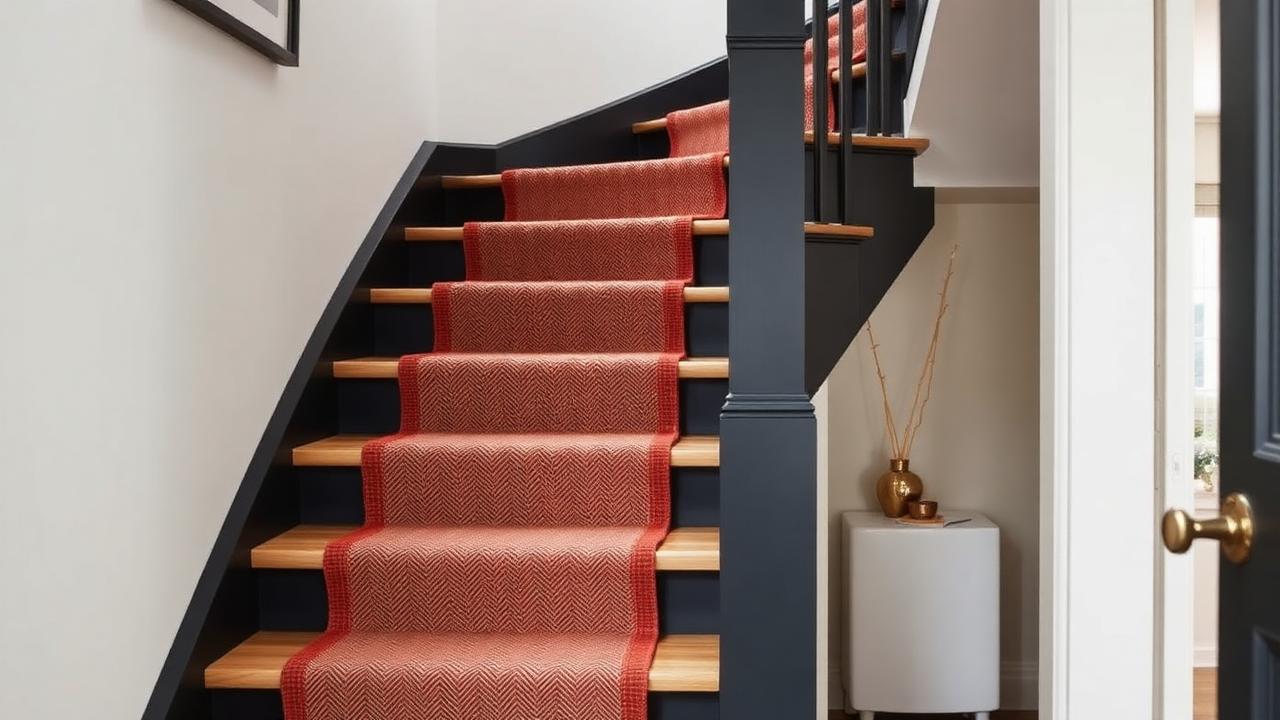
Test for damp before you buy anything
Tape a small square of plastic sheet to the concrete overnight. Condensation underneath means moisture is moving through the slab, and no runner fibre will survive long term until that is addressed.
Underlay choices for hard basement substrates
Standard felt or rubber-crumb underlay is designed for timber treads with some give in the structure. On solid concrete basement stairs, a thinner, denser underlay pad — sometimes called a hard-floor pad — performs better, since it resists compressing unevenly against a rigid surface and keeps the runner from feeling slippery underfoot near the nosing.
Common mistakes on basement flights
- Fitting wool or sisal because it was leftover from the main stairs — both fail quickly in basement humidity.
- Ignoring headroom: basement stairs often have lower headroom, so a thicker pile plus underlay can matter more than upstairs.
- Skipping a moisture test and finding mildew under the runner within a year.
- Using deep pile on a steep basement flight, which obscures the nosing edge exactly where visibility matters most.
DIY or hire a fitter?
A straight, closed-riser basement flight with no winders is one of the more DIY-friendly staircases in the house, since it is usually short and rarely has a landing to negotiate. Budget a full day for a first attempt. If the flight has open risers, stone treads, or any winders, hiring a fitter experienced with basement or utility stairs is worth the $150 to $300 it typically adds, because the fixing methods differ from a standard timber flight.
Insulating sound as well as damp
Basement stairs frequently sit against a utility room, garage or media room, and hard concrete treads bounce footfall noise straight through the structure. A stair runner with a proper cushioned underlay does double duty here — it is not only softer underfoot, it noticeably cuts the drum-like knock of feet on concrete that carries into adjoining rooms. If sound transfer is a real concern, choose the thicker end of the hard-floor underlay range rather than the thinnest option, since a few extra millimetres of felt or rubber-crumb pad absorbs meaningfully more impact noise.
Handrail and lighting upgrades worth doing at the same time
Because a basement runner install already means lifting tools and pulling up old flooring, it is a sensible moment to add anything else the flight needs. A continuous handrail on at least one side is worth adding if the stairs do not already have one — basement stairs are disproportionately involved in household falls, and a runner alone does not replace a rail. Similarly, a single extra step light wired in at this point is far cheaper than retrofitting it later once the new runner and rods are in place.
- Check the handrail height meets 34 to 38 inches from the nosing, the standard comfortable range.
- Add a motion-sensor step light if the basement switch is at the top or bottom only, not both.
- Repaint or reseal open stringers and risers before fitting — it is far harder once the runner is down.
Selling a house with basement stairs
Finished basements are a selling point in most markets, and a neatly runnered staircase reads as more finished and higher-value than bare or painted treads, even though the material cost is modest. Buyers and inspectors alike will also notice a musty smell or visible mildew under basement carpet immediately, so if you are preparing a home for sale, resolve any damp issue before fitting rather than masking it with a fresh runner.
Whatever you decide, get the numbers first: the stair runner calculator doubles as a stair runner length calculator, adding nosing wrap, landings, winders, pattern repeat and waste so you order the right length the first time.
Still deciding on material, width or pattern? Our hub on stair runners compares weaves, widths, backings and fitting styles side by side, then hands the numbers straight to the calculator.
Frequently asked questions
What is the best runner material for basement stairs?
Polypropylene or solution-dyed nylon. Both tolerate humidity and clean easily; avoid wool, jute and sisal in damp basements.
How much runner do open-riser basement stairs need?
Roughly tread depth plus 2 to 3 inches per step, since there is no riser to cover — considerably less than a closed staircase.
Can you fit a stair runner on concrete basement stairs?
Yes, but the fixing method changes — a bonded or glued fit, or a track system fixed with masonry plugs, rather than the tackless strip used on timber. Confirm your fitter has done concrete stairs before.
How do I stop a basement stair runner smelling musty?
Resolve any moisture ingress into the stairwell first, choose polypropylene or nylon over wool or natural fibre, and make sure the space has some ventilation. A runner fitted over a damp substrate will smell within a year regardless of fibre.
Do basement stairs need a lighter colour runner?
It helps. Basement stairwells are often the darkest run in a house, and a pale or mid-tone runner reflects more available light and stays visible at the bottom of the flight, which matters for safety.
What underlay works on concrete basement stairs?
A thin, dense hard-floor pad rather than a thick felt cushion. Thick, soft underlay can feel unstable on a rigid concrete substrate and compress unevenly around the nosing.
Does a basement stair runner reduce noise?
Yes, noticeably. Concrete or timber basement stairs without covering transmit footfall noise strongly into adjoining rooms, and a runner with a cushioned underlay absorbs much of that impact sound.
Should I add a handrail when fitting a basement stair runner?
If the flight does not already have one, it is worth doing at the same time. Basement stairs are steeper and darker than average and are disproportionately involved in household falls, so a handrail alongside the runner meaningfully improves safety.
Know your numbers in 30 seconds
Enter your step count, tread depth and riser height — the stair runner calculator gives you the exact length to order, in metres and feet, with waste included.
Measure my basement stairsReady for real prices?
Get quotes from vetted stair runner suppliers and fitters near you. Free, no account, no obligation.
Every guide is written from hands-on measuring and fitting experience, checked against the calculator’s own maths, and re-reviewed whenever prices or methods change. Read our editorial standards.