
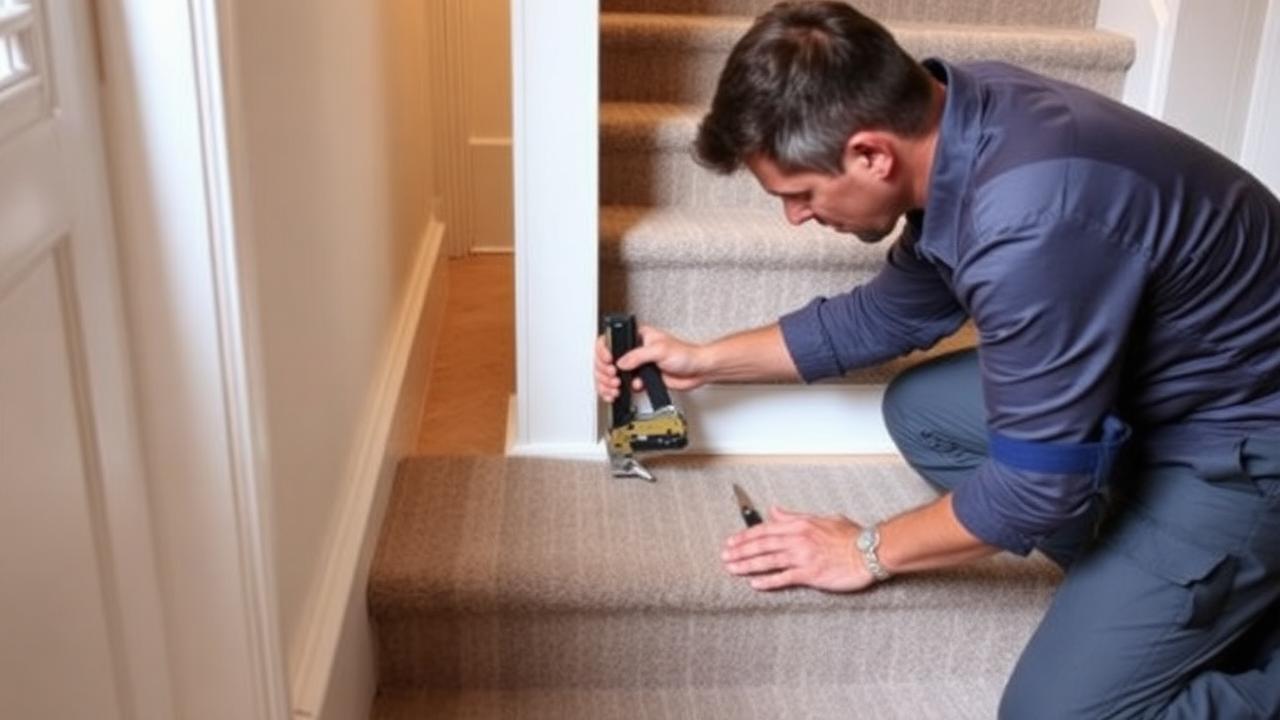
What tackless strip actually is
Tackless strip is a thin lath, usually about 1 in (2.5 cm) wide and 4 ft (1.2 m) long as sold, made from plywood or a rigid plastic composite, with two or three staggered rows of angled steel pins pressed through it at roughly 1/2 in (13 mm) intervals. It comes pre-cut into short 4 in (10 cm) or longer pieces specifically packaged for stair use, since a full flight needs many short lengths rather than one continuous run per tread the way a room carpet installation would use it along a skirting board. Some suppliers sell it as a dedicated 'stair gripper pack', bundled with enough pieces for a set number of steps, typically 13 or 15, which saves cutting down full-length strip yourself.
The angled pins are the whole point of the design. They're punched through at roughly a 60-degree angle so that when the strip is fixed down and the carpet backing pressed onto it, the pins grip the backing and resist being pulled straight back out, while still allowing the installer to press the carpet down onto them in one motion rather than having to hook each pin individually. This is why direction matters when you fit strip - point the pins the wrong way and the carpet will lift straight back off with normal foot traffic within days.
Correct placement on treads and risers
On the tread, fit one strip running the full width of the stair, set back 3/8-1/2 in (10-13 mm) from the riser-tread junction, with the pins angled toward the riser. This pulls the runner tight into the internal corner as you stretch it down, closing the gap that otherwise shows as a dark shadow line at the back of every step. On the riser itself, some fitting methods (particularly waterfall style, where the runner drops straight down each riser without gripping the underside of the nosing above) use a second short strip near the base of the riser, pins angled downward, to anchor the bottom edge of that riser section before it turns onto the next tread.
Setback distance is not optional
3/8-1/2 in (10-13 mm) back from the riser-tread corner is the standard setback for a reason - too close and the pins interfere with the nosing wrap, too far back and you leave a loose, unsupported gap of carpet at the rear of the tread that will crush flat within weeks and show wear faster than the rest of the run.
How much runner do I need?
Before ordering strip, confirm your total runner length so you know exactly how many treads and risers you're fixing gripper to. On a US 13-step flight with a 10 in tread run, 7.5 in riser height and 0.75 in nosing wrap allowance, the per-step total is 18.25 in, giving 237.25 in (19.77 ft) across the flight, plus a 24 in top-and-bottom finishing allowance for 261.25 in (21.77 ft), and with a 7% waste margin you'd order around 23-24 ft of runner and correspondingly 13 tread strips plus, if using waterfall style, 13 riser strips.
In UK measurements that's a 25 cm tread run, 19 cm riser and 1.9 cm nosing wrap, giving 45.9 cm per step and 596.7 cm across 13 steps, plus 60 cm finishing allowance for 656.7 cm, then a 7% waste margin brings you to roughly 7.0-7.2 m of runner. A single 1.2 m length of tackless strip cuts into roughly four 30 cm tread-width pieces on a standard 30 in (76 cm) wide runner, so for 13 treads you need about 3.5 full-length strips, and double that if you're fixing risers too. Running the numbers through a stair runner calculator first avoids the classic mistake of buying gripper for 13 steps and then discovering the flight actually has 14.
| Item | US measurement | UK measurement |
|---|---|---|
| Strip setback from riser-tread corner | 3/8-1/2 in | 10-13 mm |
| Pin spacing | approx 1/2 in | approx 13 mm |
| Standard strip length as sold | 48 in | 1.2 m |
| Strip pieces per tread (30 in / 76 cm wide) | 1 piece, full width | 1 piece, full width |
| 13-step flight, treads only | 13 pieces | 13 pieces |
Know your numbers in 30 seconds
Enter your step count, tread depth and riser height — the stair runner calculator gives you the exact length to order, in metres and feet, with waste included.
Open the stair runner calculatorFixing gripper to the timber
Gripper is fixed with either 5/8 in (16 mm) ring-shank nails driven through the pre-punched holes in the strip, or with a pneumatic gripper nailer that fires narrow-crown staples through the same holes at speed. On solid timber treads either method holds well; on treads with a plywood overlay or engineered board, go for shorter nails, around 1/2 in (13 mm), so you don't punch through to the underside and risk splitting thin ply. Never use adhesive alone to fix gripper strip to a tread - the strip needs mechanical fixing because it's under constant lateral stress every time someone steps on the runner above it.

- Measure and mark the setback line 3/8-1/2 in (10-13 mm) from the riser-tread corner.
- Cut strip pieces to the tread width, allowing a small gap at each side for the runner edge to turn under.
- Position the strip with pins angled toward the corner you want the carpet pulled into.
- Nail or staple through the pre-punched holes into solid timber.
- Repeat for every tread, and every riser if using waterfall-style fitting.
- Fit underlay over the gripper, cut back slightly at the edges so the pins remain exposed.
Common tackless strip mistakes
The single biggest mistake I see on amateur jobs is fitting the strip with the pins angled the wrong way, which means the carpet lifts cleanly off the strip the first time someone drags a vacuum cleaner or moves furniture up the stairs. The second is setting the strip too far back from the corner, leaving that unsupported gap of loose carpet that crushes and wears unevenly. The third is reusing old, blunted gripper from a previous runner - pins do wear down over a decade or more of use, and blunted pins simply won't hold a new, heavier wool runner as securely as fresh strip will.
When not to use tackless strip at all
Tackless strip isn't the right choice for every staircase. On very narrow treads, under about 8 in (20 cm) of run, there often isn't enough flat surface to fit strip at the correct setback and still leave room for the nosing wrap, and staples or a full-width staple-and-glue combination usually works better there. It's also not ideal directly onto stone or tiled treads, since nailing isn't possible and you'd need specialist adhesive-backed gripper instead, which behaves differently and is worth discussing with your supplier before you commit to a full flight's worth of standard nail-fix strip.
Whatever you decide, get the numbers first: the stair runner calculator doubles as a stair runner length calculator, adding nosing wrap, landings, winders, pattern repeat and waste so you order the right length the first time.
Still deciding on material, width or pattern? Our hub on stair runners compares weaves, widths, backings and fitting styles side by side, then hands the numbers straight to the calculator.
Frequently asked questions
How far back from the step edge should tackless strip sit?
Set the strip back 3/8-1/2 in (10-13 mm) from the riser-tread junction. This lets the runner pull taut into the corner without interfering with the nosing wrap at the front of the step.
Can I reuse old tackless strip for a new runner?
You can if the pins are still sharp and the lath isn't cracked, but strip that's over 8-10 years old or has been lifted and refitted several times often has blunted pins that won't hold a new runner as securely as fresh strip.
What nails should I use to fix gripper strip?
Use 5/8 in (16 mm) ring-shank nails through the pre-punched holes for solid timber treads, or shorter 1/2 in (13 mm) nails on thinner plywood or engineered board treads to avoid punching through to the underside.
Do I need gripper strip on the risers too?
Only if you're using a waterfall-style fitting where the runner drops straight down each riser without wrapping under the nosing above. Standard nosing-wrap fitting usually only needs strip on the tread.
Why did my newly fitted runner lift off the gripper straight away?
The pins are almost certainly angled the wrong direction, pointing away from the corner instead of into it, so the carpet backing pulls off cleanly instead of being held. Refit the strip with pins angled toward the riser-tread corner.
Can tackless strip be used on stone or tiled stairs?
Standard nail-fix strip cannot be nailed into stone or tile, so you would need an adhesive-backed gripper product designed for hard surfaces, which holds differently and is worth checking with your supplier before ordering a full flight's worth.
How many pieces of strip does a 13-step staircase need?
For tread-only fitting on a standard 30 in (76 cm) wide runner you need 13 full-width pieces, roughly 3.5 standard 48 in (1.2 m) lengths cut down, and double that if you're also fixing the risers in a waterfall style.
Is tackless strip the same thing gripper rod suppliers sell for stair runners?
Yes, tackless strip and gripper rod are the same product with two different regional names, and stair runner suppliers usually sell it pre-cut into short stair-length pieces rather than the long continuous strip used for wall-to-wall room carpet.
Know your numbers in 30 seconds
Enter your step count, tread depth and riser height — the stair runner calculator gives you the exact length to order, in metres and feet, with waste included.
Confirm your total runner length with the stair runner calculator before buying stripReady for real prices?
Get quotes from vetted stair runner suppliers and fitters near you. Free, no account, no obligation.
Every guide is written from hands-on measuring and fitting experience, checked against the calculator’s own maths, and re-reviewed whenever prices or methods change. Read our editorial standards.