
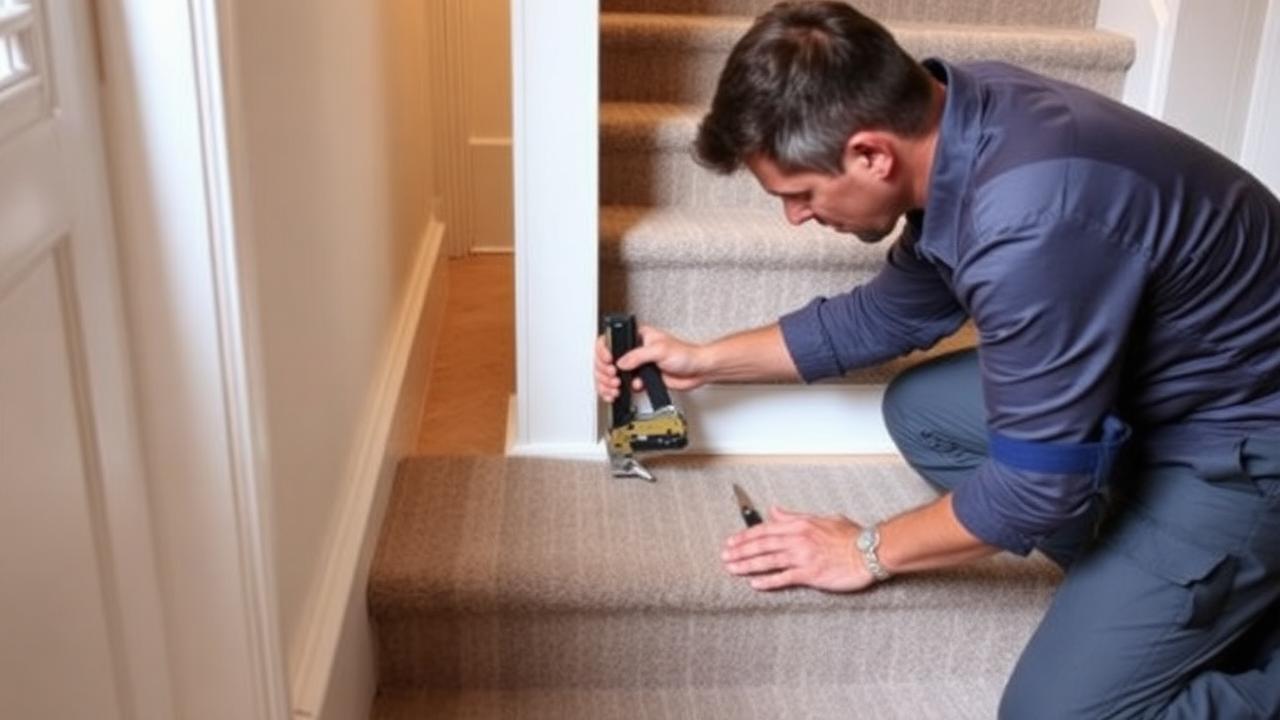
Two different products solving the same problem
Stair treads and stair runners both exist to add grip and softness to a bare staircase, but they're built and sold completely differently. Treads are individual pads, usually 8-10 in (20-25 cm) deep and cut to your stair width, sold in sets of however many steps you have. A runner is a continuous roll cut to one length that covers every tread and riser as a single piece. On a 13-step flight, treads mean buying and fitting 13 separate pads with 13 separate sets of edges to bind or finish, while a runner means one length, one fit, one continuous surface.
On a recent job I did in a converted barn with painted white risers and exposed oak treads either side, treads were the obvious choice because the client specifically wanted the riser wood on show. On a Victorian terrace two streets over, a full runner with stair rods was the better fit because the client wanted the classic wall-to-wall carpeted look with a decorative brass finish at each riser.
Head-to-head comparison
| Factor | Stair runner | Individual stair treads |
|---|---|---|
| Coverage | Full tread and riser, continuous | Tread only, riser usually exposed |
| Look | Traditional, wall-to-wall carpeted feel | Rustic, exposes wood grain and stain colour |
| Sizing complexity | One length calculation for the whole flight | One width x depth measurement, repeated per step |
| Replacing a worn section | Requires refitting the affected length | Swap the single worn pad |
| Typical cost (13 steps, US) | $500-$1,400 fitted | $260-$650 fitted (sets of pads plus fitting) |
| Typical cost (13 steps, UK) | £400-£1,100 fitted | £200-£520 fitted |
| Slip protection on riser face | Full riser coverage adds grip cue | None, riser stays bare wood |
How the look changes the decision
If you've stripped and refinished your staircase, or you've got original wood treads and risers you want visible, individual treads let that wood do the talking while still giving bare feet and paws something soft and grippy to land on. A full runner covers that wood entirely, which some homeowners see as a shame after paying to have it sanded and stained. On the other hand, if your treads and risers are unremarkable builder's-grade timber, or already painted a flat colour, a runner gives a more finished, higher-end look because it reads as one continuous design element rather than a dozen separate pads with visible gaps of wood between them.
Check riser exposure before you decide
If your risers are painted a colour you're proud of or have decorative moulding, treads let that show. If your risers are plain, unfinished or slightly mismatched in colour, a runner hides that inconsistency completely.
How much runner do I need?
If a runner wins out, sizing it is a one-time calculation rather than 13 separate tread measurements. Take a US example: 13 steps, 10 in tread run, 7.5 in riser height, and a 0.75 in nosing wrap allowance per step. Per step that's 18.25 in, times 13 is 237.25 in, or 19.77 ft. Add a 24 in finishing allowance top and bottom for 21.8 ft, then apply a 7% waste margin, landing at roughly 23.3 ft to order.

In UK measurements, that's 25 cm tread run, 19 cm riser height and 1.9 cm nosing wrap, giving 45.9 cm per step. Across 13 steps that's 596.7 cm, plus a 60 cm finishing allowance for 656.7 cm, and with a 7% waste margin you land at about 7.0 m of runner. Compare this to treads, where you'd instead measure width and depth once and multiply by 13 sets - a stair runner calculator handles the runner-length version of this maths instantly rather than you re-adding a column of figures by hand.
- Runner sizing: one tread-run-plus-riser-plus-nosing figure, multiplied by step count.
- Tread sizing: one width-by-depth figure, repeated per step, no multiplication for length.
- Both need a 5-10% waste margin, higher for patterned or bound edges.
- Runners need a top and bottom finishing allowance; individual treads generally don't.
- Measure width the same way for either option, at top, middle and bottom of the flight.
Know your numbers in 30 seconds
Enter your step count, tread depth and riser height — the stair runner calculator gives you the exact length to order, in metres and feet, with waste included.
Open the stair runner calculatorFitting differences worth knowing
Fitting treads is genuinely more forgiving for a first-time DIYer. Each pad is small, easy to handle, and a mistake on one doesn't affect the other twelve - you just recut or reorder that single pad. Fitting a runner is a bigger single job: it needs to be tensioned evenly and kept straight over the full flight, and a mistake partway down usually means unpicking and refitting a much larger section. If you're doing this yourself for the first time and want a lower-risk starting point, treads are the safer bet. If you want the classic runner look and have any doubt about your own fitting skill, this is exactly the kind of job worth paying a professional fitter for.
Durability and maintenance
Treads wear the same way a runner does at the nosing edge, but because each pad is independent, damage stays contained to that one step rather than showing as a worn patch running the length of the flight. That's a genuine practical advantage for households with pets that tend to dig in on the same step every time. Runners, by contrast, spread wear more evenly since foot traffic naturally varies slightly in landing position across a continuous surface, and a well-chosen wool or wool-blend runner can outlast a set of thinner tread pads by several years under the same daily use.
Which to choose
Choose stair treads if you want exposed wood risers, an easier DIY fit, and the ability to replace single worn steps in isolation. Choose a full stair runner if you want the classic carpeted-stair look, don't mind covering the risers, and are happy to fit it once as a single continuous piece, ideally with a professional if it's your first attempt. Both are legitimate, widely used options among people shopping for stair runners, and the right choice really does come down to whether you want your risers on show or covered.
Whatever you decide, get the numbers first: the stair runner calculator doubles as a stair runner length calculator, adding nosing wrap, landings, winders, pattern repeat and waste so you order the right length the first time.
Frequently asked questions
Are stair treads cheaper than a full stair runner?
Usually yes for materials, since treads only cover the tread and not the riser or nosing wrap. A set of 13 treads typically runs $260-$650 (£200-£520) fitted, versus $500-$1,400 (£400-£1,100) for a fitted runner of similar quality.
Do stair treads need the same waste margin as a runner?
A smaller one. Since treads are cut individually to a fixed width and depth rather than a continuous length, you mainly need extra material for binding the edges, typically 5-8% rather than the 5-10% used for full-length runners.
Can I fit stair treads myself?
Yes, more easily than a full runner. Most tread sets come pre-bound and are fitted with double-sided tape or a light adhesive and sometimes finishing nails, with no need to tension a long length evenly.
Will individual treads slip more than a runner?
If fitted with a proper non-slip backing or pad underneath, no. The riser being exposed rather than carpeted doesn't affect grip on the tread itself, since that's where your foot actually lands.
Do treads work with stair rods like a runner does?
No, stair rods are designed to tension a continuous runner at the base of each riser and don't have a role with individual treads, since there's no riser carpet to hold down.
Which option is better for resale value?
A well-fitted full runner tends to read as a more finished, higher-value feature to buyers, especially in period homes. Individual treads are seen as a practical or rustic choice and can work well in the right style of home.
Can I switch from treads to a full runner later?
Yes, but you'll need fresh measurements since a runner calculation includes the riser height and nosing wrap that a tread-only measurement doesn't capture. Treat it as a new measuring job rather than reusing your old tread dimensions.
Do stair treads come in the same materials as runners?
Largely yes - wool, wool-blend, sisal, and synthetic options are all commonly available as either treads or full runners, so material choice doesn't usually decide between the two formats on its own.
Know your numbers in 30 seconds
Enter your step count, tread depth and riser height — the stair runner calculator gives you the exact length to order, in metres and feet, with waste included.
Size a full-length runner with the stair runner length calculatorReady for real prices?
Get quotes from vetted stair runner suppliers and fitters near you. Free, no account, no obligation.
Every guide is written from hands-on measuring and fitting experience, checked against the calculator’s own maths, and re-reviewed whenever prices or methods change. Read our editorial standards.