
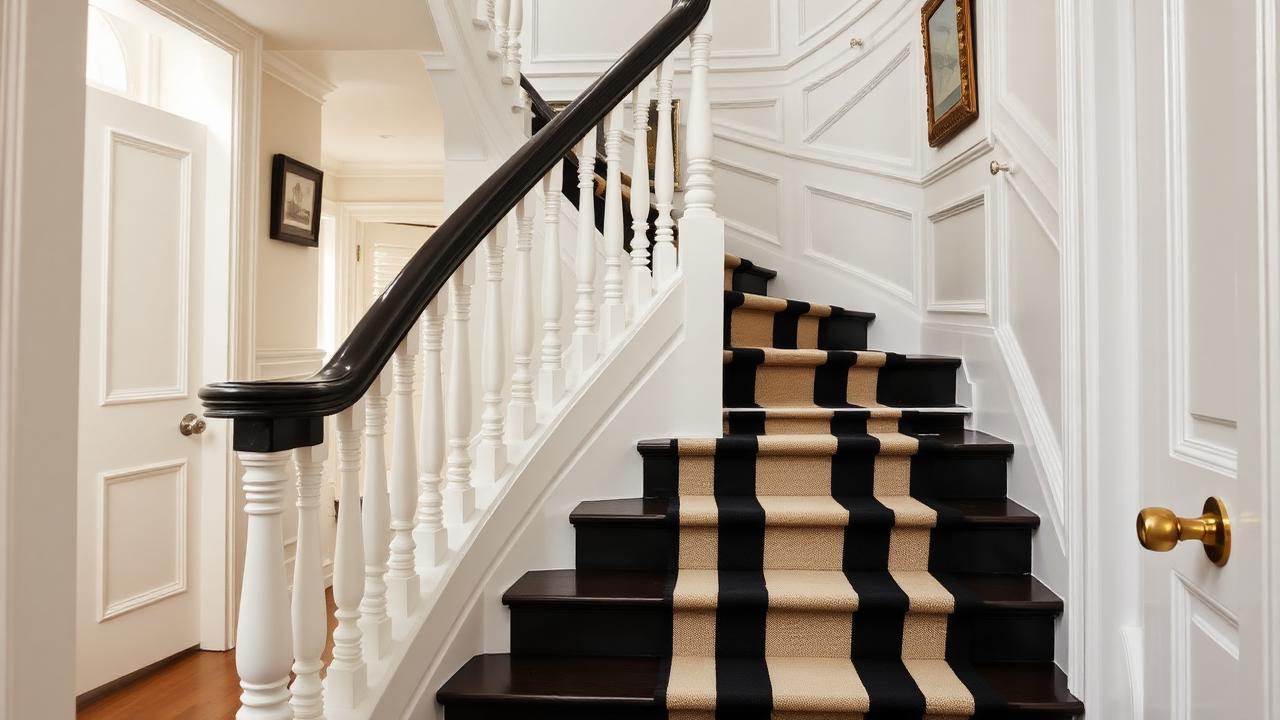
Why the stairwell is the hardest wall in the house to get right
A stairwell is usually the tallest run of continuous wall in a house, seen from multiple angles as people go up and down, which is exactly why it's the room where a bold wallpaper earns its keep and also exactly where a clash between wallpaper and runner is most punishing. On a landing or a lounge wall, a busy print sits in one plane and you view it from a distance. On a staircase, you're walking past it at close range, glancing up the flight from the hallway, and looking down it from the landing, so pattern-on-pattern reads as far more chaotic than it would in a flat room. I've fitted stair runners into stairwells with striking botanical and geometric wallpapers plenty of times, and the flights that work best almost always keep the runner itself calm.
The reverse is just as true. A plain painted stairwell, magnolia, soft grey, off-white, is the ideal backdrop for a runner with genuine pattern: stripes, a herringbone weave, a floral or a geometric border. Because the wall isn't competing for attention, the runner becomes the feature of the space rather than one of two things fighting for the eye, and it tends to photograph and simply live better day to day.
Reading your wallpaper before you choose a runner
Start with scale, not colour. A large-scale floral or a big geometric repeat wants a solid or near-solid runner in a colour lifted from the paper's background or secondary tone, not the dominant motif colour, since matching the loudest colour in the paper tends to make the whole stairwell feel flat and matchy rather than coordinated. A small, tight-repeat wallpaper, a fine stripe, a subtle damask, has more room either way: it can sit happily with a textured plain runner or with a runner that carries a modest pattern of its own, as long as the two repeats aren't a similar size, which creates a slightly dizzying effect when viewed together on the stairs.
Colour temperature matters more on a stairwell than almost anywhere else in the house, because natural light often only reaches the top and bottom of the flight, leaving the middle steps lit mainly by whatever fixture is on the landing or in the hall. Warm wallpapers, terracotta, ochre, warm green, generally want a runner with a warm undertone even if it's a different hue entirely, while cool wallpapers, blue-grey, sage, charcoal, want a cool-leaning runner. Mixing warm paper with a cool-toned grey runner under artificial light at dusk is one of the more common regrets I hear about after the fact.
Take a sample to the actual stairwell
Hold a runner sample against the wallpaper at the top, middle and bottom of the flight, in daylight and again under the evening lighting you'll actually use. Colours that look fine on a swatch card can shift noticeably against a busy paper once they're both under one light source.
How much runner do I need?
Work through a 13-step US flight with a 10 in tread run, a 7.5 in riser height and a 0.75 in nosing wrap per step for a standard rounded nosing: that's 18.25 in per step. Across 13 steps that comes to 237.25 in, or 19.77 ft. Add a combined top and bottom finishing allowance of 24 in to reach 261.25 in, or 21.77 ft, then apply a 7% waste margin, landing at roughly 23.3 ft. If the wallpaper has a strong horizontal band or feature at a specific height on the stairwell, order slightly more so you can adjust where the runner's own pattern repeat, if it has one, lines up against it.
In UK metric terms the same flight is 25 cm tread run, 19 cm riser height and a 1.9 cm nosing wrap, giving 45.9 cm per step. Multiply by 13 for 596.7 cm, add 60 cm finishing allowance for 656.7 cm, then apply a 7% waste margin for around 7.03 m. On a shorter 10-step flight with the same dimensions, expect closer to 5.4 m (17.8 ft), and on a longer 15-step flight, closer to 7.9 m (26 ft).
| Step count | Estimated length (US) | Estimated length (UK) |
|---|---|---|
| 10 steps | 17.8 ft | 5.4 m |
| 13 steps | 23.3 ft | 7.0 m |
| 15 steps | 26.0 ft | 7.9 m |
Know your numbers in 30 seconds
Enter your step count, tread depth and riser height — the stair runner calculator gives you the exact length to order, in metres and feet, with waste included.
Open the stair runner calculatorCommon pairings that actually work
- Bold botanical wallpaper: pair with a solid oatmeal, sage or navy runner, no pattern.
- Fine pinstripe wallpaper: pair with a wider-stripe or herringbone runner in a related tone.
- Plain painted wall (any neutral): pair with a striped, bordered or patterned runner as the feature.
- Geometric wallpaper: pair with a plain textured wool or wool-blend runner to let the wall carry the pattern.
- Dark, dramatic wallpaper: pair with a mid-tone runner rather than another dark colour, or the flight can feel like a tunnel.
Runner material and edging against a decorated wall
Wool and wool-blend runners hold colour and texture better against a decorative wallpaper than a very flat synthetic weave, since the slight sheen variation and depth of a natural fibre reads as more considered next to a printed pattern, whereas a flat, uniform synthetic can look slightly cheap by comparison in a decorated stairwell. A bound edge in a colour picked from the wallpaper, rather than plain matching the runner, is a small detail that ties the two together without adding another competing pattern, and it's worth asking your supplier or fitter about when you order.

Brass, black or antique stair rods across a plain runner also do a lot of work in a wallpapered stairwell, adding a horizontal rhythm that echoes a striped or patterned paper without needing the runner itself to carry a pattern. If your wallpaper already has strong horizontal lines, rods in a metal that picks up a foil or metallic thread in the paper reinforce the pairing nicely.
Getting the order right before wallpaper and runner both arrive
Wallpaper and stair runner carpet are usually ordered from different suppliers on different lead times, so it pays to settle the wall first, since paper is generally harder and more disruptive to change than a runner once it's hung, then choose the runner to complement it rather than the other way round. Before ordering the runner, measure the actual flight rather than guessing from a similar-looking staircase elsewhere in the house, and running your tread, riser and step numbers through a stair runner length calculator removes the risk of ordering short on a job where the wallpaper is already committed and can't easily be redone if the runner doesn't reach.
It's also worth thinking about how the runner and paper will read together over years, not just on installation day. Wallpaper generally outlasts a runner, most household stair runners get refreshed every seven to twelve years depending on traffic, so choose a runner that complements the wallpaper without being so tied to a specific trend that it looks dated against paper you plan to keep for a decade or more.
Whatever you decide, get the numbers first: the stair runner calculator doubles as a stair runner length calculator, adding nosing wrap, landings, winders, pattern repeat and waste so you order the right length the first time.
Frequently asked questions
Can I use a patterned stair runner with patterned wallpaper?
It's possible but risky - two bold patterns on the same stairwell usually compete rather than complement. If you want pattern in both, keep one very subtle, such as a fine wallpaper stripe with a textured plain-look runner, rather than combining two strong prints.
What colour runner suits a bold floral wallpaper?
Pull a solid colour from the wallpaper's background or a secondary tone, not the dominant flower colour, and use it as a plain runner. This lets the wallpaper stay the feature while the runner grounds the staircase without adding competing visual noise.
Does wallpaper make a stairwell feel darker with a dark runner?
Yes, pairing a dark, dramatic wallpaper with a dark runner can make a stairwell feel enclosed or tunnel-like. A mid-tone runner against a dark paper usually keeps the flight feeling open while still reading as coordinated.
How much runner do I need for a 13-step staircase?
For a typical 13-step flight with 10 in (25 cm) treads and 7.5 in (19 cm) risers, plan on roughly 23-24 ft (7-7.3 m) once nosing wrap, a finishing allowance and a 7% waste margin are included.
Should I choose the wallpaper or the runner first?
Choose the wallpaper first if you're set on a specific print, since paper is more disruptive to change once it's hung. Then select a runner that complements its colour temperature and scale rather than trying to force a paper to match an existing runner.
Do stair rods help when there's wallpaper on the stairs?
Yes, rods across a plain runner add horizontal rhythm that pairs well with striped or patterned wallpaper without introducing another competing pattern. A metal finish that echoes a metallic or foil element in the paper strengthens the pairing further.
Will a busy wallpaper make the staircase feel smaller?
A large-scale, dark or densely repeated wallpaper can make a narrow stairwell feel more enclosed, especially with a dark runner underfoot too. Balancing bold paper with a lighter, plainer runner keeps the space feeling more open.
How often will I need to replace the runner compared to the wallpaper?
Most household stair runners are refreshed every seven to twelve years depending on foot traffic, while wallpaper often lasts considerably longer. Choose a runner that pairs well with the paper without being so trend-led that it looks dated well before the wallpaper needs changing.
Know your numbers in 30 seconds
Enter your step count, tread depth and riser height — the stair runner calculator gives you the exact length to order, in metres and feet, with waste included.
Work out your exact runner length with the stair runner calculatorReady for real prices?
Get quotes from vetted stair runner suppliers and fitters near you. Free, no account, no obligation.
Every guide is written from hands-on measuring and fitting experience, checked against the calculator’s own maths, and re-reviewed whenever prices or methods change. Read our editorial standards.