

What a stair tread runner actually is
The phrase covers two related products. The first is a set of individual carpet stair treads — small bound mats sized to sit on one tread each, sold in packs of 4, 7, 13 or 15. The second is a continuous runner that is cut and fixed tread-by-tread, skipping the risers entirely, so you see a series of horizontal bands of carpet with bare timber between them. Both are described as a stair tread runner by retailers and homeowners, and the practical considerations overlap heavily.
The appeal is straightforward. Treads take essentially all the wear and provide essentially all the grip on a staircase; risers take almost none of either. Covering only the treads therefore buys most of the practical benefit of a runner for roughly half the material.
Tread mat sizes and coverage
| Tread mat size | Metric | Suits tread depth | Suits stair width |
|---|---|---|---|
| 8in x 24in | 20 x 61 cm | 9-10in | 30-34in |
| 8in x 30in | 20 x 76 cm | 9-10in | 36-42in |
| 9in x 26in | 23 x 66 cm | 10-11in | 32-38in |
| 9.5in x 30in | 24 x 76 cm | 10-11.5in | 36-42in |
| 10in x 36in | 25 x 91 cm | 11-12in | 42-48in |
Leave 1-1.5in of bare tread at the back where the mat meets the riser, and centre the mat so the reveal is equal each side. The front edge should either stop about 1/2in short of the nosing or wrap over it, depending on the product — the one thing to avoid is a mat that ends exactly on the nosing lip, because the unsupported edge lifts and becomes a trip hazard.
Count treads, not risers
A 14-riser staircase has 13 treads plus the landing surface at the top. Packs are sold by tread count, so ordering by risers leaves you with one spare and ordering by memory usually leaves you one short.
Material saved compared with a full runner
The saving is easy to quantify. On a typical step with a 10in tread, a 7.5in riser and a 1in nosing, a full runner uses about 19.5in of length per step. A tread-only fit that wraps the nosing uses about 11in; a flat tread mat that stops short of the nosing uses about 9in.
| Coverage | Length per step | 13-step flight | Material vs full runner |
|---|---|---|---|
| Full runner (tread + riser + nosing) | 19.5in | 21.1 ft / 6.44 m | 100% |
| Tread wrapped over nosing | 11in | 11.9 ft / 3.63 m | 56% |
| Flat tread mat, short of nosing | 9in | 9.8 ft / 2.98 m | 46% |
Know your numbers in 30 seconds
Enter your step count, tread depth and riser height — the stair runner calculator gives you the exact length to order, in metres and feet, with waste included.
Open the stair runner calculatorGrip, safety and the nosing problem
Most stair falls happen on descent, and the foot lands on or just behind the nosing. That makes the nosing the single most important surface on the staircase for grip, and it is precisely where a flat tread mat provides the least coverage. If safety is a primary reason for fitting anything at all — a household with young children, elderly residents, or a slippery painted or varnished timber flight — a tread runner should always wrap over the nosing rather than stopping short of it.
- Wrap the nosing wherever grip is the objective; a flat mat is a comfort and appearance product, not a safety one.
- Every mat must be mechanically fixed, not just laid on anti-slip backing.
- Check fixings on the top two and bottom two treads every six months; they take the heaviest turning loads.
- Keep the front edge of every mat at exactly the same distance from the nosing — an inconsistent line reads as an uneven step.
- Do not fit tread mats over an existing worn or spongy carpet; fixings will not hold.
Fixing methods
| Method | Hold | Removable for washing? | Best for |
|---|---|---|---|
| Staples at the back edge and nosing | High | No | Permanent installs |
| Hook-and-loop tabs | Medium-high | Yes | Washable tread mats |
| Double-sided carpet tape | Medium | Yes, with residue | Rentals, trials |
| Adhesive gel dots | Medium | Yes | Hard-surface treads |
| Stair rods at the back edge | Medium (plus decoration) | Yes | Period staircases |
Hook-and-loop is the practical winner for most households buying tread mats specifically because they want to lift and wash them. Fix the hook side to the tread with screws or a strong adhesive, and check that the mat backing accepts the loop side — some rubber-backed products need a sewn loop patch instead.
Cost comparison
| Option | Per step (US) | Per step (UK) | 13 steps installed |
|---|---|---|---|
| Carpet tread mats (stock) | $8-22 | £6-18 | $105-290 / £80-235 |
| Tread-only cut runner + binding | $18-34 | £14-27 | $235-440 / £180-350 |
| Full runner, professionally fitted | $50-105 | £40-85 | $650-1,365 / £520-1,105 |
Tread mats are typically a third to a fifth of the cost of a full fitted runner, and most of that gap is labour rather than material: mats are a genuinely DIY-friendly job, where a full runner with underlay, gripper and bound edges usually is not. Use the stair runner cost calculator with your own step count to see the split for your flight.
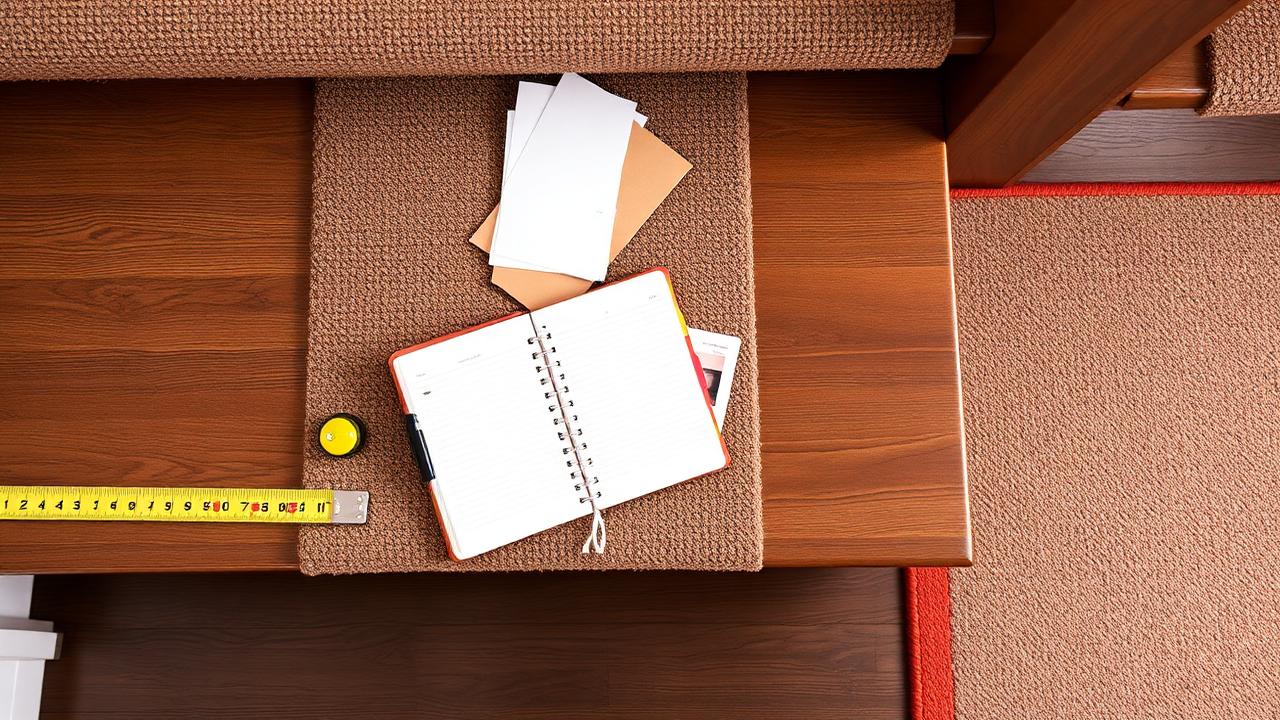
Where a tread runner looks right — and where it does not
Visually, tread-only coverage creates a banded, striped effect up the flight. On an open-riser staircase this looks entirely natural, because there is no riser to cover in the first place. On a painted or contrasting-riser staircase it can look deliberate and smart. On a plain closed-riser timber flight it more often reads as unfinished, and the exposed riser scuffs at foot level within a year or two.
- Open-riser stairs: tread runner is the natural and often the only option.
- Painted risers with timber treads: tread mats work well and keep the paint visible.
- Concrete or stone stairs: tread mats add warmth and grip without a full carpet job.
- Rental properties: cheap, removable, replaceable per step.
- Formal hallway staircases: a full runner almost always looks better.
Measuring for tread mats
- Measure tread depth from the face of the riser behind to the front of the nosing.
- Measure the nosing projection separately — you need it if the mat will wrap.
- Measure stair width at the top, middle and bottom step; work from the narrowest.
- Subtract your chosen reveal (usually 3-6in total) to get mat width.
- Subtract 1-1.5in from tread depth for the gap at the back.
- Count treads, then add one spare mat for future replacement from the same dye lot.
Winders break the pack
Pie-shaped winder treads are not rectangular, so stock tread mats will not fit them. Either order shaped, bound pieces for those steps or accept bare timber on the turn — mixing a rectangular mat onto a wedge-shaped tread always looks wrong.
Washing and replacing
The strongest practical argument for a tread runner is serviceability. A single mat can be lifted, washed and put back, or replaced outright when it wears, without touching the rest of the flight. Check the care label before buying: machine-washable polypropylene mats survive a cool 30C wash on a gentle cycle and air-dry flat, while wool and rubber-backed mats generally need spot cleaning only. Rotate mats between high-wear steps — the bottom three and top two — and low-wear middle steps annually to even out the appearance.
Tread runner or full runner: how to decide
| Priority | Better choice |
|---|---|
| Lowest cost | Tread mats |
| Maximum grip on descent | Full runner, or tread runner wrapped over the nosing |
| Easy washing and replacement | Tread mats with hook-and-loop |
| Best appearance on a closed-riser flight | Full runner |
| Open-riser or floating stairs | Tread runner |
| Noise reduction | Full runner with underlay |
| Rental or short-term fit | Tread mats |
If you are undecided, price both. Put your tread depth, riser height, nosing and step count into the stair runner calculator, take the full-runner length it gives you, then multiply by 0.56 for a nosing-wrapped tread fit or 0.46 for flat mats. Seeing the two material figures side by side, with your own fitting cost added to each, resolves the decision faster than any general rule.
Whatever you decide, get the numbers first: the stair runner calculator doubles as a stair runner length calculator, adding nosing wrap, landings, winders, pattern repeat and waste so you order the right length the first time.
Still deciding on material, width or pattern? Our hub on stair runners compares weaves, widths, backings and fitting styles side by side, then hands the numbers straight to the calculator.
Frequently asked questions
What is a stair tread runner?
A stair tread runner covers only the horizontal tread of each step, leaving the risers bare. It comes either as individual bound carpet tread mats or as a runner cut and fixed tread-by-tread.
What size are stair tread mats?
Common sizes are 8in x 24in, 8in x 30in, 9in x 26in and 9.5in x 30in. Pick the depth 1-1.5in shorter than your tread and the width so 3-6in of bare timber shows in total across the step.
How much material does a tread runner save?
A nosing-wrapped tread fit uses about 56% of a full runner's length, and a flat mat that stops short of the nosing uses about 46%. On a 13-step flight that is roughly 12ft instead of 21ft.
Are stair tread mats safe?
They are safe when mechanically fixed and when they cover or wrap the nosing, which is where the foot lands on descent. Loose-laid mats relying only on a grippy backing are not safe on a staircase.
How do you fix stair tread mats without damaging the stairs?
Hook-and-loop tabs or adhesive gel dots hold well and leave far less mark than staples. Both let you lift the mats for washing, which is the main reason most people choose treads over a full runner.
Do you need underlay under stair tread mats?
Most tread mats have a built-in backing and do not need separate underlay. A cut tread runner without a backing benefits from a thin, dense pad cut slightly smaller than the mat.
Is a tread runner cheaper than a full stair runner?
Yes — typically a third to a fifth of the installed cost, mostly because tread mats are a DIY job while a full runner needs gripper, underlay, binding and a fitter.
Can you fit tread mats on winder stairs?
Not with stock rectangular mats. Winder treads are wedge-shaped and need individually cut and bound pieces, or you leave those steps bare.
Know your numbers in 30 seconds
Enter your step count, tread depth and riser height — the stair runner calculator gives you the exact length to order, in metres and feet, with waste included.
Compare tread and full coverageReady for real prices?
Get quotes from vetted stair runner suppliers and fitters near you. Free, no account, no obligation.
Every guide is written from hands-on measuring and fitting experience, checked against the calculator’s own maths, and re-reviewed whenever prices or methods change. Read our editorial standards.