
Choosing a stripe width
Stripe width has a bigger visual impact than most people expect. Narrow stripes, around 0.5-1 in (1.3-2.5 cm), create a subtle, tailored look and tend to suit narrower staircases well since they do not overwhelm the width. Wider stripes, 2-3 in (5-7.5 cm) or more, make a bolder statement and work best on wider staircases or where you want the runner to be a real feature rather than a background detail.
As a rule of thumb, aim for at least 4-6 full stripe repeats across the width of your runner. Fewer than that and the pattern can look chopped-off or awkward on a standard stair width.
Getting stripes level across each step
Because stripes run across the width of the runner rather than along its length, the biggest fitting challenge is keeping each stripe perfectly horizontal and level as it wraps over the nosing and down the riser. Any drift here is highly visible, more so than with a busier print or textured weave. A chalk line or laser level is worth using during fitting to check each stripe stays true.
How much runner do I need?
For a 13-step flight: 10 in tread + 7.5 in riser + 0.75 in wrap = 18.25 in per step, totalling 237.25 in. Add 24 in finishing to reach 261.25 in, or 21.77 ft. Because stripe patterns need careful cutting to keep repeats aligned, add a 10% waste margin, bringing your order to roughly 24 ft. Metric: 25 cm + 19 cm + 1.9 cm = 45.9 cm per step, 596.7 cm over 13 steps, plus 60 cm finishing is 656.7 cm, and with 10% waste that comes to about 7.3 m. Use the stair runner calculator with your own tread and riser figures to fine-tune this before ordering.
| Stripe width | Visual effect | Best staircase width |
|---|---|---|
| 0.5-1 in (1.3-2.5 cm) | Subtle, tailored | Narrow to standard |
| 1.5-2 in (4-5 cm) | Balanced, classic | Standard |
| 2.5-3+ in (6.5-7.5+ cm) | Bold, statement | Wide staircases |
Know your numbers in 30 seconds
Enter your step count, tread depth and riser height — the stair runner calculator gives you the exact length to order, in metres and feet, with waste included.
Open the stair runner calculatorCheck the stripe count before ordering
Ask your supplier how many full stripe repeats will fit across your exact runner width before you order, so you are not left with a half-stripe awkwardly cut at either edge.
Colour pairing tips
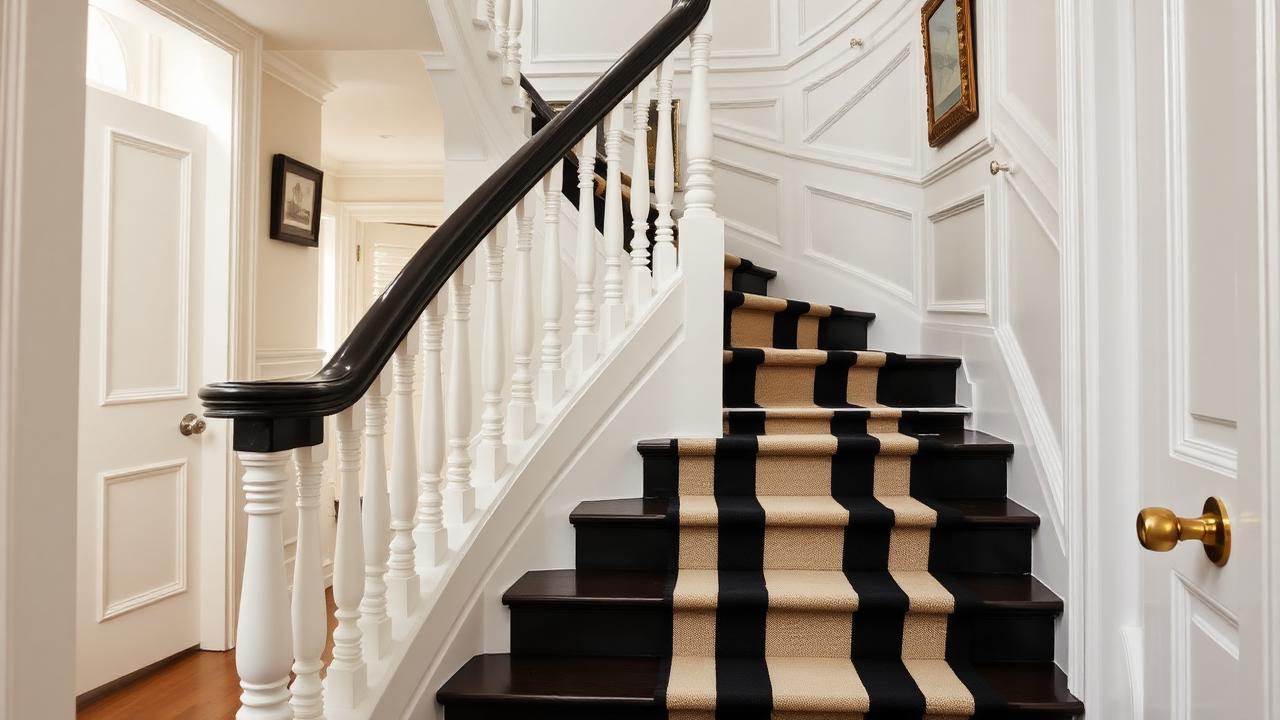
Two-tone stripes in a soft neutral and a deeper accent colour tend to age well and suit most interiors. Reserve high-contrast colour combinations like black and white striped stair runners for hallways with strong architectural lines, where the bold pattern has room to breathe.
Maintenance considerations
Light-coloured stripes will show soiling faster than a darker background. If your household is busy, consider a mid-tone base colour with the stripe as the accent, rather than the reverse, to keep the runner looking fresh for longer between cleans.
Horizontal versus vertical stripe orientation
Most stair runner stripes run across the width of the runner, appearing as horizontal bands as you climb the stairs. Less commonly, a runner is woven or printed with stripes running along its length, which appear as vertical lines flowing down the flight. Lengthwise stripes are more forgiving to fit since there is no need to keep each band level across the nosing, but they are harder to source and generally only available as a custom order.
If you are matching a striped runner to an existing striped rug or hallway runner elsewhere in the home, check that both the stripe width and the colour saturation match under the same lighting conditions, since dye lots and lighting can make a close match look noticeably different in practice.
Cost bands for striped runners
| Grade | US cost per ft | UK cost per m |
|---|---|---|
| Standard synthetic stripe | $10-18 | £22-40 |
| Wool-blend stripe | $20-32 | £44-70 |
| Pure wool, custom colourway | $32-50 | £70-110 |
Spec checklist for stripes
- Confirm the number of full stripe repeats across your exact runner width before ordering
- Ask whether the stripe is woven-in or printed, since woven stripes hold their definition longer
- Check dye lot consistency if ordering a large quantity or matching existing carpet
- Confirm whether the supplier can guarantee level stripe placement at the nosing on delivery
Fitting tip for long flights
On a long flight with many steps, small stripe misalignments compound visually even if each individual step looks fine on its own. Step back and view the whole flight from the bottom every three or four steps during fitting, not just close up, since drift that looks negligible up close can be obvious from a distance.
Stripes on winders and curved staircases
Stripes are one of the more challenging patterns to carry around a winder cleanly, since the horizontal bands need to keep reading as straight, level lines even as the tread shape changes through the turn. Most fitters will either accept a slight visual pinch in the stripe at the narrow inside edge of a winder, or have that section specially cut and pieced so the stripes reset cleanly, which uses more material but gives a noticeably cleaner result on a prominent staircase.
Fibre choice for striped runners
Stripes are available across almost every fibre type, from budget synthetic loop pile through to pure wool. Wool tends to show a striped weave with the most depth and definition, since the natural fibre catches light differently at each stripe boundary, while a flatter synthetic weave gives a more uniform, graphic look that suits a modern interior. Choose fibre first based on traffic and durability needs, then find a striped option within that fibre category, rather than choosing the stripe design first and compromising on performance.
| Fibre | Stripe definition | Best use |
|---|---|---|
| Wool | Rich, dimensional | Main staircases, period homes |
| Wool-blend | Good, more affordable | Most family homes |
| Synthetic | Flat, graphic | Budget or high-traffic rentals |
Whatever you decide, get the numbers first: the stair runner calculator doubles as a stair runner length calculator, adding nosing wrap, landings, winders, pattern repeat and waste so you order the right length the first time.
Frequently asked questions
What stripe width works best for a narrow staircase?
Narrow stripes, around 0.5-1 in (1.3-2.5 cm), tend to suit narrower staircases without overwhelming the width.
How do I keep stripes level when fitting?
Use a chalk line or laser level during fitting to check that each stripe stays horizontal as it wraps over the nosing.
How much extra runner should I order for a striped pattern?
Around a 10% waste margin, slightly more than a plain runner, to allow for careful pattern-matched cutting.
Do stripes show dirt more than solid colours?
Light-coloured stripes can show soiling faster; a mid-tone base with the stripe as an accent hides marks better.
Can I get a custom stripe colour combination?
Yes, many suppliers offer custom colourways for striped stair runners, though lead times are usually longer.
How many stripe repeats should fit across my runner?
Aim for at least 4-6 full repeats across the width to avoid an awkward half-stripe at either edge.
Are striped stair runners harder to fit than plain ones?
Slightly, since keeping each stripe level and consistent down the flight requires more careful attention than a plain weave.
What colour combination works in most homes?
A soft neutral paired with a deeper accent tone tends to suit the widest range of interior styles and ages well over time.
Know your numbers in 30 seconds
Enter your step count, tread depth and riser height — the stair runner calculator gives you the exact length to order, in metres and feet, with waste included.
Get your exact length with the stair runner calculatorReady for real prices?
Get quotes from vetted stair runner suppliers and fitters near you. Free, no account, no obligation.
Every guide is written from hands-on measuring and fitting experience, checked against the calculator’s own maths, and re-reviewed whenever prices or methods change. Read our editorial standards.