
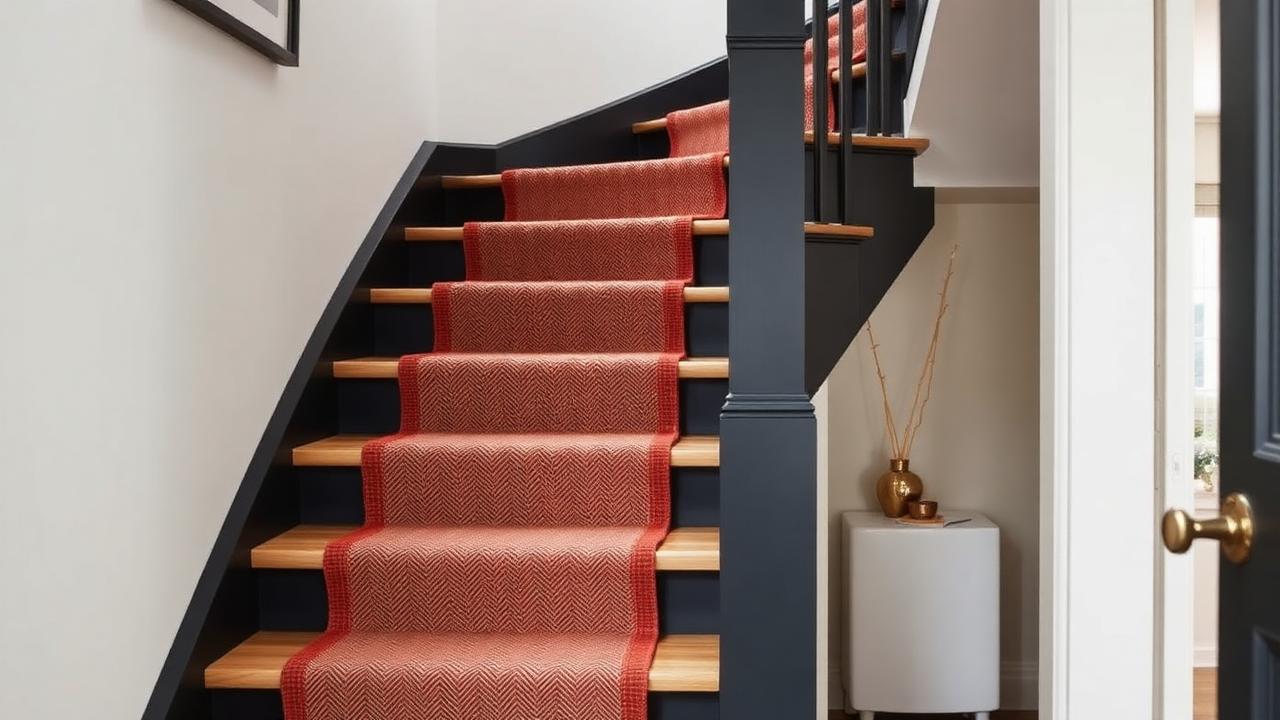
The three main ways two-tone actually gets built
When customers say two-tone, they usually mean one of three quite different constructions, and it's worth knowing which one you're picturing before you start pricing anything up. The first is a bordered runner, a solid main colour with a narrower contrasting stripe running down each edge, which is by far the most common and the easiest to source off the shelf. The second is a striped or banded design, where two colours alternate across the width in even bands, giving a more graphic, rhythmic look. The third, less common but increasingly popular, is a split design where the runner changes from one colour to another partway up the flight, sometimes at a half-landing, sometimes at an arbitrary point chosen for effect.
Each version has different sourcing implications. A bordered runner is usually a single manufactured product ordered to length like any other, so sizing works exactly as it would for a solid colour. A striped or banded design is also typically a single woven product, so the same applies. A split-colour design, however, usually means ordering two separate runners and having them joined at a specific point by your fitter, which needs more careful planning around where the join falls relative to a step edge, since joining mid-tread looks unfinished while joining at a riser or landing hides the seam far more cleanly.
Popular colour pairings and what they suit
Black and white or black and cream is the boldest, most graphic two-tone pairing and suits contemporary or period-grand interiors where you want the staircase to be a genuine feature. Navy and beige, or navy and cream, gives a more classic, slightly nautical or traditional look that works well in period homes and family houses alike. Grey and blush, or grey and a soft green, gives a gentler, more contemporary pairing that reads as considered rather than loud. For a bordered design specifically, the border colour is usually darker or bolder than the main field, since a narrow strip of strong colour reads as a deliberate design choice while a narrow strip of pale colour against a dark field can look like an afterthought.
Plan the seam location before ordering
If you're going for a split-colour design rather than a border or stripe, decide with your fitter exactly where the colour change will fall, ideally hidden at a riser or landing, before either runner length is cut.
How much runner do I need?
The base sizing calculation is identical to a solid colour runner regardless of the two-tone construction. For a 13-step US flight with a 10 in tread run, 7.5 in riser height and a 0.75 in nosing wrap allowance, the per-step total is 18.25 in, giving 237.25 in across 13 steps, or 19.77 ft. Add a 24 in combined finishing allowance for 261.25 in, or 21.77 ft, then apply a 7% waste margin for roughly 23.3 ft. If you're doing a split-colour design across two runners rather than one continuous piece, work out where the colour changes (say, after step 7 of 13) and calculate each section's length separately, adding a small overlap allowance of 1-2 in at the join for a clean, hidden seam.

In UK metric terms: 25 cm tread run, 19 cm riser height and 1.9 cm nosing wrap gives 45.9 cm per step, or 596.7 cm across 13 steps. Add a 60 cm finishing allowance for 656.7 cm, then a 7% waste margin brings you to roughly 7.03 m. For a split design changing colour after step 7, the lower section covers roughly 3.6 m including its own finishing allowance and waste, while the upper section covers the remaining distance to the top, each calculated and ordered as its own length.
| Measurement | US (in/ft) | UK (cm/m) |
|---|---|---|
| Tread run | 10 in | 25 cm |
| Riser height | 7.5 in | 19 cm |
| Nosing wrap per step | 0.75 in | 1.9 cm |
| Per-step total | 18.25 in | 45.9 cm |
| 13 steps subtotal | 19.77 ft | 5.97 m |
| With 7% waste margin | 23.3 ft | 7.03 m |
Know your numbers in 30 seconds
Enter your step count, tread depth and riser height — the stair runner calculator gives you the exact length to order, in metres and feet, with waste included.
Open the stair runner calculatorFitting a two-tone design without it looking amateur
For a bordered runner, keeping the border width exactly even down the full length of the flight is the single detail that separates a professional-looking job from a home job, since even a slight taper or drift in the border width is very noticeable running down a staircase where the eye naturally follows the line. For a striped design, pay close attention to how the stripes fall at the nosing of each step, since a stripe that lands awkwardly right at the edge of a tread can look chopped off compared with one that falls cleanly within a riser or tread face. For a split-colour join, a professional fitter will typically hide the seam under the nosing of a step or at the transition to a landing, using a proper binding or gripper join rather than simply butting two cut edges together and hoping tension holds them in place.
- Bordered design: check border width stays even along the entire flight, not just at the ends.
- Striped design: check how the pattern falls at each nosing before committing to a fixed repeat length.
- Split-colour design: plan the seam location with your fitter before cutting either runner section.
- Any two-tone design: order slightly more waste margin than a solid colour, since pattern or seam alignment eats into usable length.
- Keep an offcut from both colours in case a localised repair is ever needed.
Choosing two-tone for the right reasons
A two-tone stair runner works best when the staircase itself is a genuine feature of the home, an open, visible flight in an entrance hall rather than a narrow, tucked-away staircase that few visitors ever really look at closely. On a very short or narrow flight, a busy two-tone design can feel cramped rather than striking, so a simple bordered runner in a subtle contrast often works better than a bold stripe or split design in a tight space. Whatever combination you choose, get your own tread run, riser height and step count measured accurately and run them through a stair runner calculator before ordering, since two-tone designs are generally more expensive to under-order and reorder than a solid colour, given the added complexity of matching a second colour's dye lot later.
Whatever you decide, get the numbers first: the stair runner calculator doubles as a stair runner length calculator, adding nosing wrap, landings, winders, pattern repeat and waste so you order the right length the first time.
Still deciding on material, width or pattern? Our hub on stair runners compares weaves, widths, backings and fitting styles side by side, then hands the numbers straight to the calculator.
Frequently asked questions
What is a two-tone stair runner exactly?
It's a runner combining two colours, most commonly as a bordered edge on a solid main field, a striped or banded design across the width, or a split design that changes colour partway up the flight at a landing or step join.
How much runner do I need for a two-tone design?
The base calculation is the same as a solid colour: for a 13-step flight with 10 in (25 cm) treads and 7.5 in (19 cm) risers, plan for roughly 23-24 ft (7-7.2 m). Split-colour designs need each section calculated and ordered separately.
Where should the seam go on a split-colour stair runner?
Plan it with your fitter to fall at a riser or landing rather than mid-tread, since a seam hidden at a natural break point looks intentional while one landing mid-step looks unfinished and is more likely to catch underfoot.
What colour pairings work best for a two-tone runner?
Black and white or black and cream gives a bold, graphic look; navy and beige gives a classic, traditional feel; grey and blush or grey and soft green gives a gentler, contemporary pairing. Choose based on the overall style of your hallway.
Is a two-tone stair runner harder to fit than a solid colour?
Bordered and striped designs fit much like any solid runner since they're a single product. Split-colour designs involve joining two separate runners, which needs more careful planning around seam placement than a single continuous piece.
Does a two-tone design need extra waste margin?
Yes, slightly. Pattern alignment on a striped or bordered design, or the overlap needed at a split-colour seam, typically adds a percentage point or two beyond the standard 7% waste margin used for a solid colour.
Is a two-tone runner suitable for a narrow staircase?
A busy stripe or split design can feel cramped on a narrow or short flight. A simple bordered runner in a subtle contrast colour usually works better in a tight space than a bold multi-band design.
Can I order a two-tone runner as one continuous piece?
Bordered and striped designs are usually manufactured as a single continuous product ordered to length. Only a split-colour design, where the colour changes entirely partway up, typically requires two separate runners joined on site.
Know your numbers in 30 seconds
Enter your step count, tread depth and riser height — the stair runner calculator gives you the exact length to order, in metres and feet, with waste included.
Size your two-tone runner with the stair runner length calculatorReady for real prices?
Get quotes from vetted stair runner suppliers and fitters near you. Free, no account, no obligation.
Every guide is written from hands-on measuring and fitting experience, checked against the calculator’s own maths, and re-reviewed whenever prices or methods change. Read our editorial standards.