
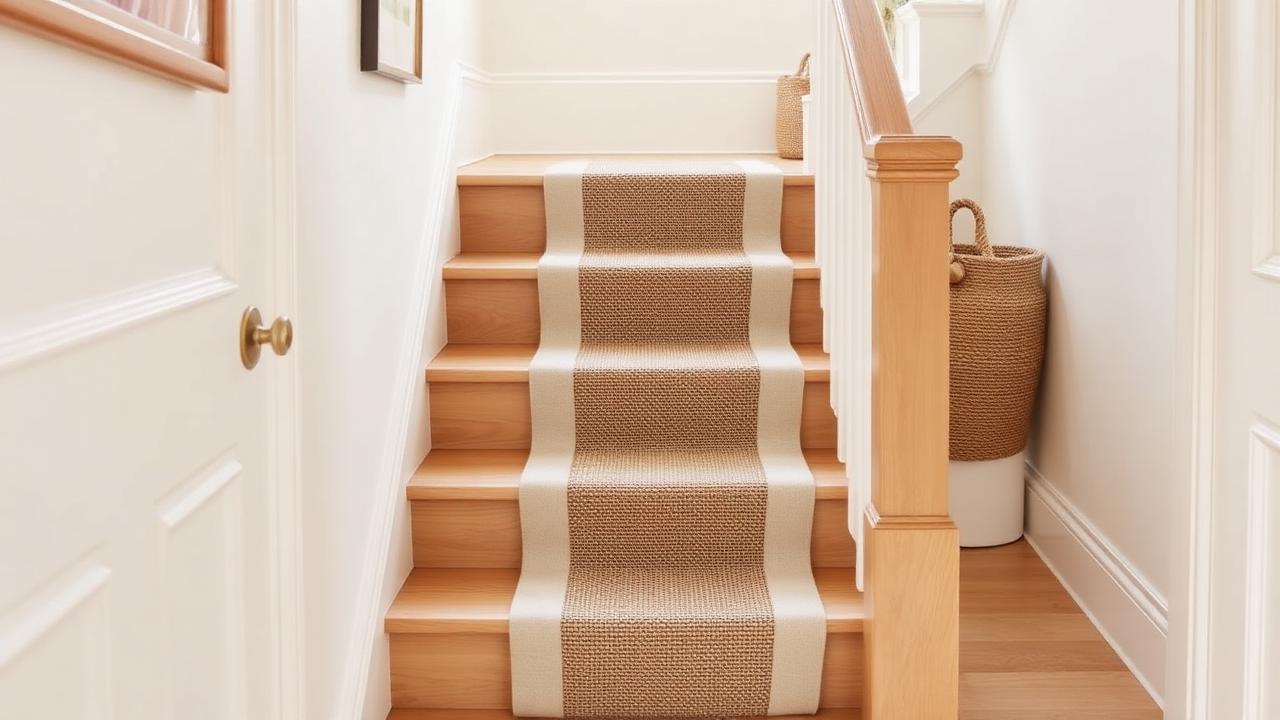
Durability by fibre
| Fibre | Wear resistance | Recovery | Realistic life |
|---|---|---|---|
| Solution-dyed nylon | Excellent | Excellent | 12–20 yrs |
| 80/20 wool blend | Very good | Excellent | 10–20 yrs |
| 100% wool | Good | Excellent | 10–15 yrs |
| Polypropylene | Fair | Poor | 5–8 yrs |
| Sisal | Good | Poor | 7–12 yrs |
Construction beats fibre
- Density: press your thumb in — if you feel backing easily, it will flatten.
- Twist: tightly twisted yarn holds its shape far longer than a loose one.
- Pile height: low and dense outlasts tall and soft, every time.
- Loop vs cut: tight loop resists crushing on nosings best.
- Backing: a firm woven backing keeps the runner square under tension.
Know your numbers in 30 seconds
Enter your step count, tread depth and riser height — the stair runner calculator gives you the exact length to order, in metres and feet, with waste included.
Open the stair runner calculatorThe nosing is the failure point
Runners almost never wear out in the middle of a tread. They fail on the nosing edge. Anything that protects that edge — a wrapped fit, dense pile, quality underlay — buys years.
Making any runner last longer
- Fit a proper underlay pad on every tread.
- Vacuum weekly with a suction-only head; beater bars destroy nosings.
- Where the runner is fitted on rods, lift and shift it a couple of inches after a few years to move the wear point.
- Deal with grit at the door — abrasive particles cut fibres faster than feet do.
How to read a specification sheet
Retailers rarely print a single 'durability' number you can compare directly, so you have to read a few figures together. Face weight, measured in ounces per square yard or grams per square metre, tells you how much fibre is actually in the pile — higher is generally more durable, all else equal. Density, sometimes given as a separate figure or implied by 'pile density', matters just as much as face weight, since a heavy but sparse pile still crushes quickly. Twist level, described in turns per inch on better product sheets, predicts how well the yarn resists untwisting and fuzzing under repeated foot contact.
| Spec figure | What it tells you | Look for |
|---|---|---|
| Face weight (oz/sq yd) | Amount of fibre in the pile | 40oz+ for a busy main staircase |
| Density | How tightly packed the tufts are | High density over high pile height |
| Twist level | Yarn's resistance to untwisting | 5+ turns per inch on cut pile |
| Stain warranty length | Manufacturer's confidence in the fibre | Longer warranties usually track real durability |
Commercial-grade options for genuinely heavy use
Households with a very high number of daily transits — large families, multi-generational homes, shared stair access in a converted building — sometimes do better looking at commercial-grade carpet ranges cut down to runner width, rather than standard residential stair ranges. Commercial carpet tile and broadloom is engineered for offices and hospitality traffic far heavier than any home staircase and often comes with 15 to 25 year commercial wear warranties. The trade-off is a narrower colour and texture range than residential collections, and sometimes a slightly more utilitarian hand-feel.
The role of professional fitting in durability
A runner that is under-tensioned when fitted will develop rippling and premature nosing wear years before an identical runner fitted correctly, because a loose runner shifts slightly under every footstep instead of the fibre absorbing the load in place. This is one of the strongest arguments for professional fitting on a high-traffic main staircase even if you are comfortable with basic DIY — the fitter's experience in getting consistent tension across every step, especially where treads are not perfectly uniform, genuinely extends the runner's working life.
Under-tensioning is invisible until it isn't
A slightly loose runner looks fine on day one. The rippling and accelerated nosing wear it causes typically only becomes obvious after a year or two, by which point the damage is already done.
Warranty terms worth checking
Stair runner warranties usually cover manufacturing defects and sometimes wear, but the fine print often excludes stairs specifically, or applies a shorter wear warranty to stair applications than to flat flooring use, because stairs concentrate wear so much more heavily. Always confirm with the retailer whether the quoted warranty period applies to stair installation before assuming a 20-year wear warranty protects a 20-year-old staircase runner.

Rotating and shifting a runner to spread wear
On a runner fitted with a few extra inches of length folded under at the top or bottom — a technique some fitters use deliberately for this reason — the whole runner can be released, shifted a couple of inches, and re-fixed every three to five years. This moves the nosing wear line to a fresh section of pile each time, meaningfully extending the visual life of the runner even though the total fibre life is unchanged. It is worth asking your fitter to build in this extra length at the time of installation if durability is your priority, since it is not something that can be added retroactively.
Testing durability before you buy
- Ask for a sample large enough to fold and crease repeatedly by hand, mimicking years of foot flex at the nosing.
- Rub the pile firmly with your palm in one direction, then the other — a durable pile springs back quickly with minimal visible shading change.
- Check the sample's backing by bending it double; a firm woven backing resists distortion far better than a soft latex-only backing.
- Ask the retailer for the specific wear rating or commercial test data behind any 'heavy duty' claim, rather than accepting the label alone.
Colour choice and how it hides or shows wear
A mid-tone, subtly textured or lightly patterned runner disguises the earliest stages of nosing wear far better than a plain, pale, solid colour, where a flattened patch or slight sheen change is immediately visible against the surrounding pile. This is a genuinely practical reason, not just an aesthetic one, that busy family staircases are more often finished in flecked, tweed-effect or patterned wool blends than in plain cream or ivory.
Pets, kids and the realistic worst case
Households weighing durability against budget often overestimate how gentle their own use will be. Dogs' claws catch and pull loop pile in particular, children drag toys and furniture up and down, and a busy family staircase can see well over a hundred transits a day between school runs, laundry and general household traffic. When in doubt, spec one tier above what feels necessary for a quiet adult household — the incremental cost of a denser, better-constructed runner is small next to the cost of replacing an underspecified one years early.
A sensible budget ceiling for a high-traffic runner
There is a point of diminishing returns above which extra spend buys more brand name than extra durability. For most family staircases, a dense, well-constructed wool blend or solution-dyed nylon in the $45-70 per linear foot range delivers close to the maximum realistic wear performance available; spending significantly more usually buys finer aesthetics or a designer name rather than a meaningfully longer working life.
Whatever you decide, get the numbers first: the stair runner calculator doubles as a stair runner length calculator, adding nosing wrap, landings, winders, pattern repeat and waste so you order the right length the first time.
Still deciding on material, width or pattern? Our hub on stair runners compares weaves, widths, backings and fitting styles side by side, then hands the numbers straight to the calculator.
Frequently asked questions
What is the most durable stair runner material?
Solution-dyed nylon for pure wear resistance, or an 80/20 wool blend if you want durability with the look and feel of wool.
How long should a stair runner last on busy stairs?
Ten to twenty years for a dense wool blend or nylon, five to eight for budget polypropylene.
Does underlay make a stair runner last longer?
Significantly. It cushions the nosing impact that causes almost all visible wear on a staircase.
What face weight is good for a high-traffic stair runner?
Look for 40oz per square yard or higher for a busy main staircase. Combined with high density and a tight yarn twist, this predicts durability far better than fibre type alone.
Is commercial-grade carpet a good choice for stairs?
For very heavy daily use, yes. Commercial ranges are engineered for far more traffic than any home staircase sees and often carry longer wear warranties, though the colour and texture range is narrower than residential collections.
Does professional fitting affect how long a runner lasts?
Yes, significantly. An under-tensioned runner ripples and develops nosing wear years earlier than a correctly tensioned one, even if the fibre and construction are identical.
Know your numbers in 30 seconds
Enter your step count, tread depth and riser height — the stair runner calculator gives you the exact length to order, in metres and feet, with waste included.
Spec a runner for my stairsReady for real prices?
Get quotes from vetted stair runner suppliers and fitters near you. Free, no account, no obligation.
Every guide is written from hands-on measuring and fitting experience, checked against the calculator’s own maths, and re-reviewed whenever prices or methods change. Read our editorial standards.