
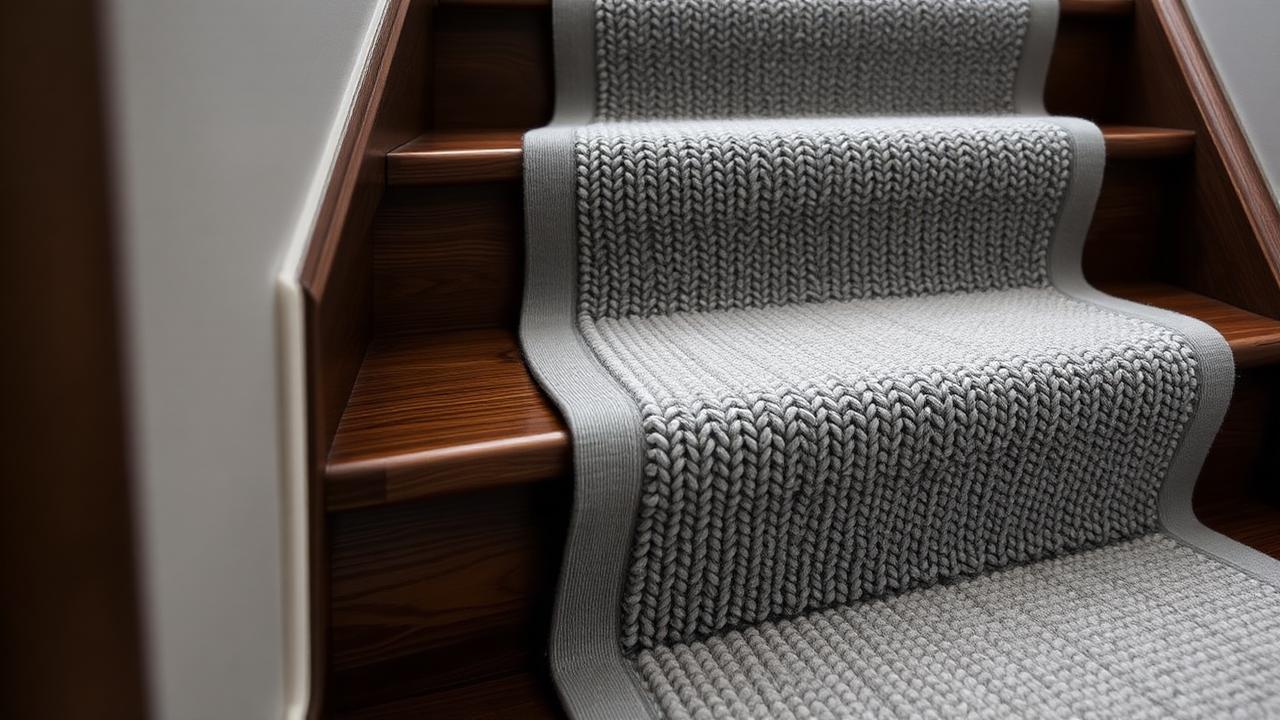
What makes a runner 'high traffic' rated
High traffic ratings usually come down to three factors: fiber type, pile density, and construction method. A dense, low-pile loop or cut-loop weave in a resilient fiber like nylon will consistently outperform a plush, high-pile weave, even if both are technically the same fiber. This is because stairs concentrate wear at the nosing of each step, where feet pivot repeatedly, and a lower, denser pile resists crushing and abrasion far better than a taller, looser one.
Comparing fibers for high-traffic use
Nylon remains the gold standard for high-traffic stair carpet, thanks to its excellent resilience, stain resistance, and ability to bounce back after crushing. Wool-nylon blends combine wool's natural beauty and durability with nylon's resilience, often outperforming either fiber alone. Pure wool is still a strong performer but benefits from proactive stain protection in very high-use settings. Polyester and softer synthetics, while affordable and often stain-resistant, tend to mat down faster under heavy daily use and are better suited to bedrooms or low-traffic areas rather than a busy staircase.
| Fiber | Traffic rating | Notes |
|---|---|---|
| Nylon | Excellent | Best all-round choice for busy stairs |
| Wool-nylon blend | Excellent | Combines beauty and resilience |
| Wool | Very good | Needs proactive stain treatment |
| Polyester | Fair | Better for low-traffic areas |
The role of density and construction
Beyond fiber type, look at the density of the weave. A good way to judge this yourself is to fold a sample backward; if you can easily see the backing material through the fibers, the pile isn't dense enough for stairs. High-quality stair carpet should show little to no backing when folded, indicating a tight, hard-wearing construction that will resist crushing at the high-wear nosing points.
How much runner do you need?
The length formula stays consistent regardless of the fiber's durability rating. For a 13-step flight: 10 in tread + 7.5 in riser + 0.75 in nosing wrap = 18.25 in per step, times 13 steps = 237.25 in. Add a 24 in finishing allowance, giving 261.25 in (21.77 ft). With an 8-10% waste margin, order roughly 23.5-24 ft. Metric: 25 + 19 + 1.9 cm = 45.9 cm per step, times 13 = 596.7 cm, plus 60 cm finishing = 656.7 cm, plus waste, roughly 7-7.3 m.

Know your numbers in 30 seconds
Enter your step count, tread depth and riser height — the stair runner calculator gives you the exact length to order, in metres and feet, with waste included.
Open the stair runner calculatorUnderlay matters as much as the fiber
Even the toughest fiber will wear out faster over a thin or low-quality underlay. Pair your high-traffic runner with a dense, stair-specific pad to maximize the lifespan of your investment.
Additional tips for maximizing durability
Choosing a patterned or mid-tone colored runner will help disguise the earliest, subtlest signs of wear, buying you time before the change becomes visually obvious. Regular vacuuming, prompt stain treatment, and periodically checking gripper rods for tightness will also meaningfully extend the practical lifespan of even a moderately durable runner.
- Prioritize nylon or wool-nylon blends for the toughest daily wear resistance.
- Choose a dense, low-pile weave over a plush high-pile one for stairs specifically.
- Fold a sample to check for backing visibility as a quick density test.
- Pair with a quality stair-specific underlay for maximum lifespan.
- Select a patterned or mid-tone color to disguise early wear.
When to consider professional-grade options
If your staircase serves as the primary route for a large family, frequent guests, or a commercial-style setting like a bed and breakfast, consider commercial-grade nylon carpet products specifically engineered for extreme traffic. These typically cost more upfront but deliver significantly longer service life in the busiest households.
Cost versus lifespan: running the numbers
A cheap runner replaced every 3 years costs more over a decade than a durable one bought once. A budget synthetic runner at roughly 20 USD (16 GBP) per linear foot might need replacing after 3 to 4 years of heavy use, meaning two to three replacements over a 10-year span, for a cumulative cost (excluding labor) of roughly 1,400 to 2,100 USD (1,120 to 1,680 GBP) on a 23-24 ft (7-7.3 m) flight. A quality nylon or wool-blend runner at 45 USD (36 GBP) per linear foot lasting 10-12 years costs about 1,050 to 1,100 USD (840 to 880 GBP) once, with far less disruption from repeated re-installations.
Factor in that each replacement also means another round of fitting labor, typically 300 to 700 USD (240 to 560 GBP), and the long-term math favors the durable option even more clearly. For genuinely heavy-use households, such as large families or homes that also run as short-term rentals, commercial-grade nylon products priced at 50 to 80 USD (40 to 64 GBP) per linear foot often pay for themselves within 5 to 7 years compared to cycling through cheaper synthetic runners.
| Approach | Cost per ft (US / UK) | 10-year cost incl. re-fitting |
|---|---|---|
| Budget synthetic, replaced twice | $20 / £16 | $1,700-2,800 / £1,360-2,240 |
| Mid-range nylon/blend, once | $45 / £36 | $1,350-1,800 / £1,080-1,440 |
| Commercial-grade nylon, once | $65 / £52 | $1,850-2,300 / £1,480-1,840 |
- Calculate 10-year cost including likely replacements and re-fitting labor, not just sticker price.
- Expect a budget synthetic runner to need replacing every 3-5 years under heavy use.
- Expect a mid-range nylon or wool-blend runner to last 8-12 years with proper underlay.
- Consider commercial-grade nylon for households with exceptionally heavy or continuous traffic.
- Factor in 300-700 USD in fitting labor for every future replacement when comparing total lifetime cost.
Whatever you decide, get the numbers first: the stair runner calculator doubles as a stair runner length calculator, adding nosing wrap, landings, winders, pattern repeat and waste so you order the right length the first time.
Still deciding on material, width or pattern? Our hub on stair runners compares weaves, widths, backings and fitting styles side by side, then hands the numbers straight to the calculator.
Frequently asked questions
What is the best fiber for high traffic stairs?
Nylon and wool-nylon blends consistently perform best under heavy daily use.
Does pile height matter for durability?
Yes, a lower, denser pile resists crushing and wear better than a tall, plush pile on stairs.
How can I test a sample's density?
Fold it backward; if you can easily see the backing material, the pile isn't dense enough for heavy stair use.
Does color affect perceived durability?
Patterned or mid-tone colors disguise early wear and soiling better than pale solids, even if the underlying fiber wears at the same rate.
Is underlay important for high-traffic stairs?
Extremely important; a dense, stair-specific underlay significantly extends the life of any runner.
How much runner do I need for a high-traffic staircase?
The same amount as any staircase of the same size, roughly 23-24 ft (7-7.3 m) for a standard 13-step flight.
Are commercial-grade carpets worth it for a busy home?
Yes, if your staircase sees exceptionally heavy use, a commercial-grade nylon product can offer meaningfully longer service life.
How often should a high-traffic runner be replaced?
With proper fiber choice and underlay, a well-maintained high-traffic runner can last 10-15 years or more before replacement is needed.
Know your numbers in 30 seconds
Enter your step count, tread depth and riser height — the stair runner calculator gives you the exact length to order, in metres and feet, with waste included.
Measure your busy staircase with the stair runner calculatorReady for real prices?
Get quotes from vetted stair runner suppliers and fitters near you. Free, no account, no obligation.
Every guide is written from hands-on measuring and fitting experience, checked against the calculator’s own maths, and re-reviewed whenever prices or methods change. Read our editorial standards.