
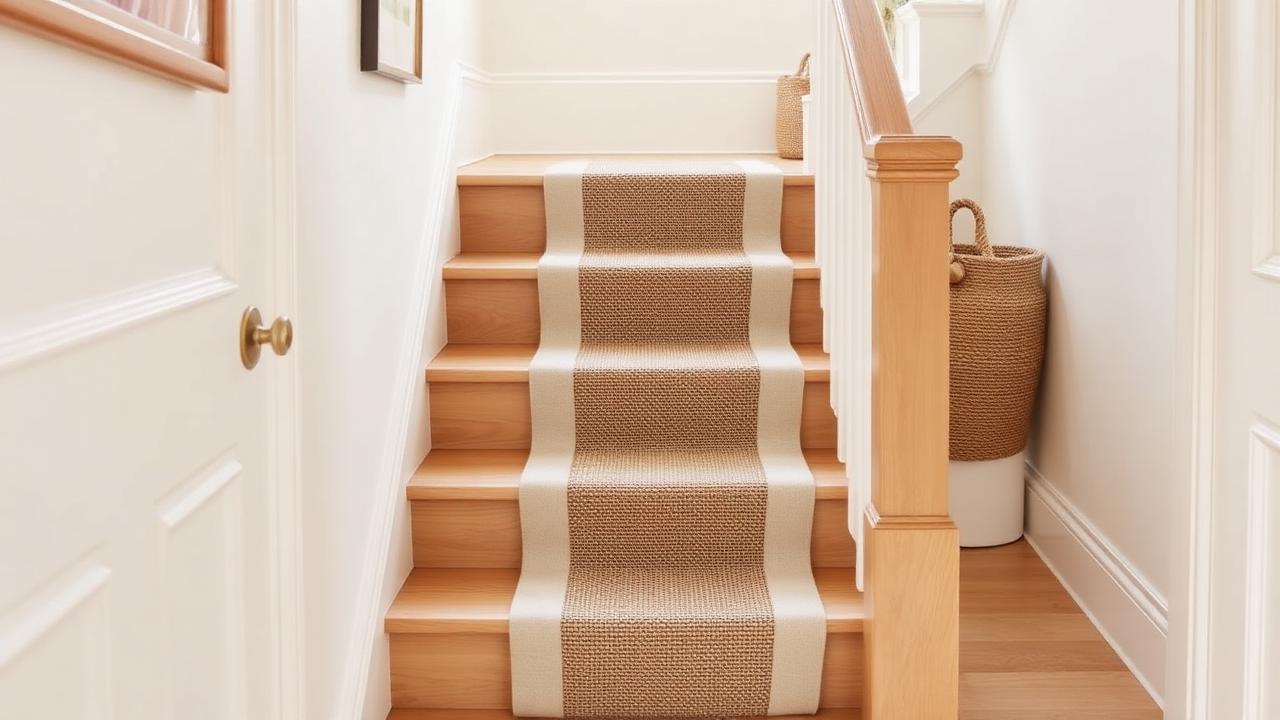
What burlap-style runners actually are
True burlap, the loosely woven jute fabric used for sacking, is rarely used on its own as a stair runner because it is too flimsy and prone to fraying under repeated foot traffic. What is usually marketed as a burlap-look stair runner is actually a jute or jute-blend weave, styled to mimic that coarse, natural, tan-toned texture while being constructed with a tighter weave and a backing suitable for flooring use. Understanding this distinction matters when you are comparing products, since a genuinely loose burlap weave will not hold up on a staircase.
Durability considerations
Jute and burlap-style fibres are naturally softer and less resilient than wool or nylon. They are prone to flattening under heavy traffic, can be damaged by moisture, and tend to shed fibres, especially in the first few months after installation. For a low-traffic staircase, such as one leading to a rarely used guest floor or a decorative back staircase, this trade-off is often worth it for the look. For a busy family staircase used dozens of times a day, a burlap-style runner will likely need replacing sooner than a synthetic alternative.
How much do I need for 13 steps?
The length calculation is the same regardless of fibre: 10 in tread + 7.5 in riser + 0.75 in nosing wrap = 18.25 in per step. Across 13 steps that is 237.25 in, plus 24 in finishing allowance, giving 261.25 in (21.77 ft). Because natural fibres like jute can fray more easily during cutting, add a slightly larger waste margin of 12% rather than the usual 10%, bringing your order to around 24.5 ft. Metric: 25 + 19 + 1.9 cm = 45.9 cm per step, times 13 is 596.7 cm, plus 60 cm is 656.7 cm, plus 12% waste is approximately 7.4 m.
| Attribute | Burlap/jute style | Wool or nylon |
|---|---|---|
| Texture | Coarse, natural, rustic | Smooth to plush |
| Durability | Moderate, wears faster under heavy use | High |
| Moisture resistance | Poor | Fair to good |
| Best use | Low-traffic or decorative stairs | Any traffic level |
Know your numbers in 30 seconds
Enter your step count, tread depth and riser height — the stair runner calculator gives you the exact length to order, in metres and feet, with waste included.
Open the stair runner calculatorStyling a burlap-look runner
The natural tan and tonal variation of burlap-style runners pairs especially well with farmhouse, coastal, and rustic-modern interiors. Because the fibre has an inherently textured, imperfect look, minor shading or slub variation across the width is normal rather than a defect. If you want a crisper, more formal look, pair the runner with a contrasting binding tape or a border in a solid colour to frame the natural texture.

Protect against moisture
Never install a burlap-style or jute runner near an entryway, a bathroom, or anywhere prone to spills or humidity. These fibres absorb moisture readily and can develop mildew or staining that is very difficult to remove.
- Confirm you are buying a flooring-grade jute weave, not true loose-weave burlap.
- Reserve burlap-style runners for low-to-moderate traffic staircases.
- Add a slightly larger waste margin (around 12%) when ordering natural fibres.
- Avoid installing near moisture-prone areas.
- Consider a border or binding for a more finished look.
Sizing and cost for a typical flight
Because jute and burlap-style runners are usually sold at a lower price point per linear foot or metre than wool, the material cost for a 13-step flight needing roughly 24.5 ft (7.4 m) is often noticeably lower than an equivalent wool order. However, the shorter expected lifespan under moderate to heavy use means the effective cost per year of service can end up similar to, or even higher than, a more durable fibre, particularly on a busy household staircase. Factor this lifetime cost comparison in alongside the upfront price when deciding whether a natural jute look is right for your budget.
| Factor | Burlap/jute style | Wool or nylon equivalent |
|---|---|---|
| Typical upfront cost | Lower | Higher |
| Expected lifespan (moderate traffic) | 3-6 years | 10-15+ years |
| Effective cost per year | Can be similar or higher | Often lower long-term |
When a burlap look still makes sense
Despite the durability trade-offs, a burlap-style runner remains a good choice in several situations: a decorative staircase that sees only occasional foot traffic, a vacation or seasonal property used part of the year, or a design scheme where the natural texture is central to the room's look and a synthetic alternative simply would not deliver the same visual warmth. In these cases, the shorter lifespan is an acceptable trade for the aesthetic, provided you go in with realistic expectations about replacement timing.
- Compare cost per year of expected use, not just the upfront price.
- Reserve burlap-style runners for decorative or low-traffic settings.
- Budget for earlier replacement than you would with wool or nylon.
- Keep the runner away from direct sun to reduce fading over its shorter life.
- Consider a washable rug pad style protector in entry-adjacent zones if traffic is unavoidable.
Care and maintenance
Vacuum burlap-style runners gently and infrequently with a low-suction setting, since aggressive vacuuming can pull at the loose weave. Blot spills immediately rather than scrubbing, and avoid steam cleaning, which can cause shrinkage or discolouration in natural jute fibres. With appropriate care and the right traffic setting, a burlap-style runner can still deliver several years of good-looking service.
Whatever you decide, get the numbers first: the stair runner calculator doubles as a stair runner length calculator, adding nosing wrap, landings, winders, pattern repeat and waste so you order the right length the first time.
Still deciding on material, width or pattern? Our hub on stair runners compares weaves, widths, backings and fitting styles side by side, then hands the numbers straight to the calculator.
Frequently asked questions
Is a burlap stair runner durable?
It is less durable than wool or nylon and is best suited to low-to-moderate traffic staircases rather than a busy family stairway.
What is actually used instead of true burlap?
Most products marketed as burlap-look stair runners are actually a tighter jute weave designed for flooring, since true loose-weave burlap is too flimsy.
How much runner do I need for 13 steps?
Approximately 23-24.5 ft (7-7.4 m), including a slightly larger waste margin for natural fibre cutting.
Does jute stain easily?
Yes, jute and burlap-style fibres absorb moisture readily and are prone to staining, so keep them away from entryways and wet areas.
Can I vacuum a burlap-style runner normally?
Use a gentle, low-suction setting, as aggressive vacuuming can pull at the loose natural weave.
Does burlap shed fibres?
Some shedding is normal, especially in the first few months, and typically reduces over time with regular gentle vacuuming.
What interior styles suit a burlap-look runner?
Farmhouse, coastal, and rustic-modern interiors tend to pair especially well with the natural tan texture.
Should I add a border to a burlap runner?
A contrasting border or binding tape can give the natural texture a more finished, formal look if you want to dress it up.
Know your numbers in 30 seconds
Enter your step count, tread depth and riser height — the stair runner calculator gives you the exact length to order, in metres and feet, with waste included.
Confirm your length with the stair runner calculatorReady for real prices?
Get quotes from vetted stair runner suppliers and fitters near you. Free, no account, no obligation.
Every guide is written from hands-on measuring and fitting experience, checked against the calculator’s own maths, and re-reviewed whenever prices or methods change. Read our editorial standards.