

Why underlay matters more on stairs than on a flat floor
On a landing or a bedroom, underlay is mostly about comfort underfoot. On a staircase it's doing structural work: it protects the runner from grinding directly against the nosing edge every time someone puts weight on the stair, it cushions the impact that would otherwise flatten the pile within a couple of years, and it stops the runner sliding under load if it's fitted without rods. Skip it, or fit the wrong type, and you'll see the pile crush and thin exactly where feet land, usually within 18 months on a busy family staircase.
I've re-fitted more than a few stair runners that were laid straight onto bare wood to save a few pounds, and every single one showed the same wear pattern: a flattened, shiny strip across the centre of each tread where the ball of the foot lands, while the edges stayed relatively plush. That's underlay doing its job by its absence, and it's the single easiest mistake to avoid before you even order your runner.
Felt, rubber-crumb or combination: which one
Felt underlay, made from recycled or virgin wool and synthetic fibre pressed into a dense mat, is the traditional choice on stairs and remains a solid one. It's firm, doesn't compress unevenly, and holds its shape on the nosing for years. Rubber-crumb underlay, made from recycled tyre rubber bonded into a sheet, is denser still and often slightly cheaper, and it copes well with heavy traffic, though some cheaper rubber-crumb products have a faint smell for the first few weeks that some clients notice and some don't. Combination felt-and-rubber underlay tries to take the firmness of rubber and the slightly softer feel of felt, and it's a fair middle ground if you can't decide.
Skip anything marketed as 'luxury' or extra-thick for stairs
Thick, soft underlay feels lovely in a showroom under your hand but behaves badly on a stair nosing. It compresses more on the front edge where weight lands than along the flat of the tread, creating a dip that shows through the runner within months.
How much runner do I need?
Underlay is bought by the same length as the runner itself, cut into pads per step rather than one continuous run, so getting your runner length right first matters just as much. Take a 13-step US flight: 10 in tread run, 7.5 in riser height, and a 0.75 in nosing wrap allowance, giving 18.25 in per step. Across 13 steps that's 237.25 in, or 19.77 ft. Add a 24 in combined top and bottom finishing allowance for 261.25 in, or 21.77 ft, then apply an 8% waste margin (a touch higher than a flat installation, since stair cuts create more offcuts) to land at roughly 23.5 ft of runner, and buy underlay pads to match, typically one pad per step plus one for the landing nosing if there is one.
In UK measurements, the same flight is 25 cm tread run, 19 cm riser height and 1.9 cm nosing wrap, giving 45.9 cm per step, or 596.7 cm across 13 steps. Add 60 cm finishing allowance for 656.7 cm, then apply an 8% waste margin to reach roughly 7.1 m of runner. Underlay pads for a flight this length usually come as a pack of 13-15 pre-cut pieces, one per step with a couple spare for cutting errors or an awkward winder step.
| Item | US | UK |
|---|---|---|
| Runner length (13 steps) | 23.5 ft | 7.1 m |
| Underlay pad size | ~30 x 20 in | ~76 x 51 cm |
| Pads needed | 13-15 | 13-15 |
| Recommended thickness | 1/4-3/8 in | 6-9 mm |
Know your numbers in 30 seconds
Enter your step count, tread depth and riser height — the stair runner calculator gives you the exact length to order, in metres and feet, with waste included.
Open the stair runner calculatorFitting underlay so it doesn't move
- Cut one underlay pad per tread, sized slightly smaller than the tread and riser combined so it doesn't poke out from under the runner edges.
- Staple or tack the pad to the tread, not the riser, keeping fixings away from where the nosing gripper strip will sit.
- Leave a small gap, roughly half an inch (1.2 cm), between the pad and the front edge of the nosing so the runner can wrap the nosing cleanly without a lump underneath.
- Check each pad sits flat with no wrinkles before laying the runner over the top, since a wrinkle under the runner telegraphs through the pile almost immediately.
- On winder or pie steps, cut the pad to the narrow point of the tread rather than trying to force a rectangular pad to fit.
Underlay and rods together
If you're fitting stair rods rather than a fully tacked or gripper installation, the underlay still needs to be secured to the tread independently of the runner, because rods hold the runner at the back of each riser but don't stop the underlay itself shifting. A thin double-sided carpet tape along the tread edge under the pad is usually enough, combined with a couple of staples where the tape won't be seen once the runner and rod are in place.
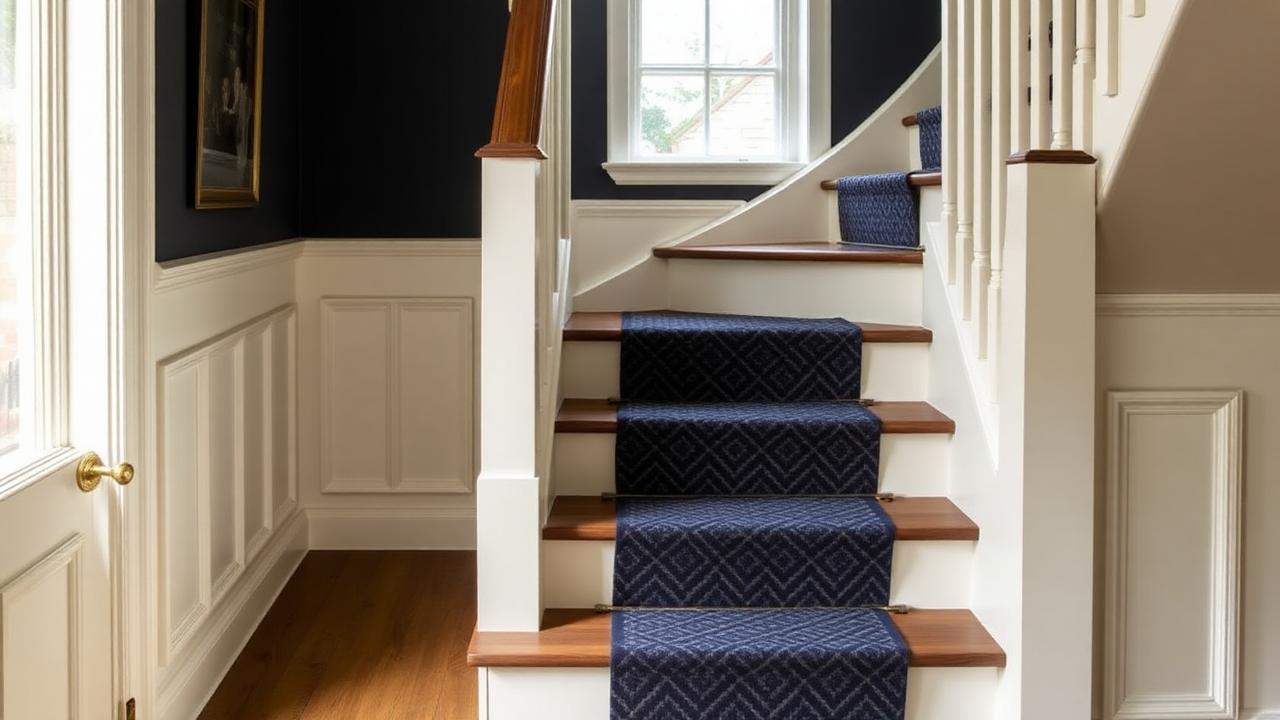
When underlay density matters most
Density matters more than thickness on a stair that gets heavy daily traffic, a family with teenagers, a dog that uses the stairs constantly, or a rental property between tenants. A denser 8-10lb pad resists compression for longer even if it's thinner than a softer 6lb pad, which is counterintuitive to most people buying underlay for the first time since thicker sounds like it should mean more cushioning and more durability. On a lightly used secondary staircase or a holiday home, you can get away with a slightly lower density without seeing much difference over the runner's lifespan.
Before you order either the runner or the underlay, run your measurements through a stair runner calculator so the lengths match and you're not guessing at pad counts from a rough tape-measure estimate. Getting the underlay quantity right at the same time as the runner length saves a second delivery wait, and it means the fitter isn't left improvising with an odd offcut on the last step. Stair runners laid over the correct underlay also tend to need re-stretching less often, which matters if you've paid for a wool or wool-blend runner and want it to earn its keep over a decade rather than five years.
Whatever you decide, get the numbers first: the stair runner calculator doubles as a stair runner length calculator, adding nosing wrap, landings, winders, pattern repeat and waste so you order the right length the first time.
Frequently asked questions
What thickness of underlay should I use on stairs?
Between 6mm and 9mm (roughly 1/4 to 3/8 in) is the sweet spot for stairs. Thicker underlay feels plush but compresses unevenly on the nosing edge, creating a dip that shows through the runner and shortens its life.
Can I use regular carpet underlay on stairs?
Not ideally. Standard foam underlay made for flat flooring compresses unevenly across a stair nosing and wears out faster than felt or rubber-crumb underlay designed specifically for stairs, which hold their shape under the repeated impact of foot traffic on the front edge of each tread.
Is felt or rubber-crumb underlay better for stairs?
Both work well; felt is traditional, firm and holds its shape for years, while rubber-crumb is denser and often slightly cheaper but can have a faint smell for a few weeks after fitting. Either is a better choice than foam underlay for a stair installation.
Do I need a separate underlay pad for every step?
Yes, stair underlay is cut into individual pads sized to each tread rather than laid as one continuous roll. This lets each pad be positioned precisely around the nosing gripper without wrinkling, which a single long piece can't achieve on a stepped surface.
How much underlay do I need for a 13-step staircase?
For a typical 13-step flight you'll need 13-15 pre-cut pads, one per tread plus a couple spare for cutting errors or an awkward winder step. Pad size is usually around 30 x 20 in (76 x 51 cm) per tread.
Does underlay density matter more than thickness?
Yes, on stairs specifically. A denser 8-10lb pad resists compression under repeated foot traffic for longer than a thicker but softer pad, even though thicker sounds like it should last longer. Density is the number worth prioritising when comparing products.
Will underlay make my stair runner sit too high on the nosing?
Not if you choose the recommended 6-9mm thickness and leave the correct gap between the pad and the nosing edge during fitting. Overly thick underlay is what causes a runner to sit proud and look lumpy over the nosing, not correctly sized underlay.
Can I reuse old underlay when replacing a worn stair runner?
Generally no. Underlay compresses and loses its cushioning over the same years the runner wears, so fitting a new runner over old, flattened underlay wastes the benefit of the new carpet. Replace both together for the best result.
Know your numbers in 30 seconds
Enter your step count, tread depth and riser height — the stair runner calculator gives you the exact length to order, in metres and feet, with waste included.
Work out your runner length and order the matching underlay with the stair runner calculatorReady for real prices?
Get quotes from vetted stair runner suppliers and fitters near you. Free, no account, no obligation.
Every guide is written from hands-on measuring and fitting experience, checked against the calculator’s own maths, and re-reviewed whenever prices or methods change. Read our editorial standards.