

Match the runner to the style already in the hallway
A carpet stair runner is one of the most visible, longest-lived decisions in a hallway, so it reads as part of the architecture rather than a piece of furniture you can swap next season. The fastest way to a shortlist that works is to name the interior style you already have — or want — in the hall, and pick from the palette and pattern families that historically suit it, rather than starting from a blank list of every runner style available.
Traditional and period hallway ideas
- Deep jewel tones — bottle green, claret, navy — in a woven wool with a contrast cord or fabric edge.
- Classic Greek key or acanthus border patterns for a formal Georgian or Victorian hall.
- Tonal stripe in two close shades of the same colour, which reads as texture rather than pattern from a distance.
- Brass stair rods over the runner reinforce the period feel far more than the carpet alone.
Coastal and light-filled hallway ideas
Coastal schemes favour pale, warm neutrals and blues that do not fight with a lot of natural light. A herringbone-weave natural fibre or a wool-blend in oatmeal or driftwood, with a navy or soft teal stripe, is a common combination. Avoid very dark carpet in a bright coastal hall — it tends to look heavy against pale walls and white woodwork rather than grounding the space as intended.
Farmhouse and rustic hallway ideas
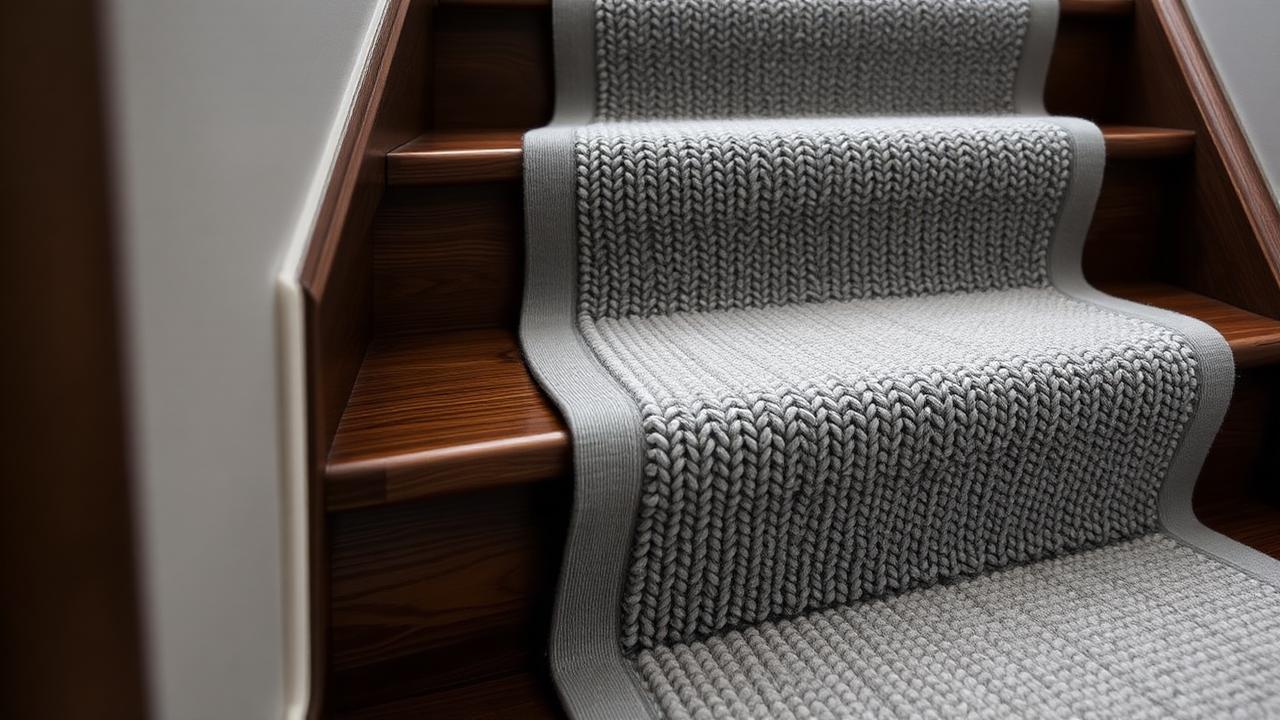
Farmhouse hallways generally want texture over pattern: a chunky wool loop, a herringbone weave, or a plain runner in a warm mid-tone (rust, mustard-adjacent neutral, deep taupe) sits comfortably against exposed timber and reclaimed brick. Where pattern is used, it tends to be a simple two-tone stripe rather than anything intricate, keeping the emphasis on natural materials.
Minimalist and contemporary hallway ideas
Minimalist schemes usually want the runner to recede: a single flat colour close to the wall or floor tone, or a very low-contrast weave, laid with a clean narrow border rather than a decorative one. Where pattern appears, it is typically graphic and restrained — a single pinstripe or a subtle geometric rather than a busy repeat. See the contemporary and modern runner guides for detail on this direction specifically.
| Style | Typical palette | Pattern tendency | Edge treatment |
|---|---|---|---|
| Traditional | Jewel tones, deep neutrals | Border patterns, tonal stripe | Contrast cord or wide fabric border |
| Coastal | Pale neutrals, soft blue/teal | Herringbone, light stripe | Narrow self-coloured binding |
| Farmhouse | Warm mid-tones | Texture over pattern | Simple wool binding |
| Minimalist | Tonal neutrals | Plain or single pinstripe | Slim matching border |
| Eclectic/maximalist | Saturated, mixed | Bold geometric or floral | Contrast or patterned border |
Eclectic and maximalist hallway ideas
If the rest of the hallway already carries pattern and colour confidently, the stair runner is a natural place to add another layer rather than pull back — a bold floral, a large-scale geometric, or a saturated colour runner can anchor a maximalist scheme. The main planning risk here is pattern clash with existing wallpaper or art on the stairwell wall, so lay a sample length against the wall before ordering the full flight.
Test in situ before committing
Every runner sample looks different lit by a hallway window than it does under a shop's lighting. Pin or weight a sample length on your actual stairs for at least a day before ordering.
Budget ranges by style
These are broad, indicative ranges for a typical 13-step flight at a common width; get a figure specific to your stairs with the calculator before committing to a look.
| Style direction | Typical flight budget (material + fit) |
|---|---|
| Traditional wool border pattern | £600-1,400 / $800-1,900 |
| Coastal natural-fibre blend | £450-1,000 / $600-1,350 |
| Farmhouse wool texture | £500-1,100 / $650-1,500 |
| Minimalist plain wool-blend | £450-950 / $600-1,300 |
| Eclectic bold pattern wool | £650-1,600 / $850-2,150 |
Know your numbers in 30 seconds
Enter your step count, tread depth and riser height — the stair runner calculator gives you the exact length to order, in metres and feet, with waste included.
Open the stair runner calculatorTurning a shortlist into an order
- Name your interior style, or the two closest to it, from the list above.
- Pick two or three palette and pattern combinations from that style's row in the table.
- Order physical samples in each and test them against your actual walls and light.
- Measure your stairs and price your final shortlist with the cost calculator.
- Confirm supplier lead time before committing to an installation date.
Pattern repeat maths across the five interior styles
Whichever interior style you pick from, the underlying repeat maths for a patterned carpet stair runner does not change: on a typical 13-step flight with a 10in (25cm) going and 7.5in (19cm) rise, you need roughly 13ft 6in (4.1m) of running length before any waste allowance. A traditional border pattern or an eclectic bold geometric both need 10-15% extra yardage to centre the repeat and match it across any turn, while a farmhouse texture-led weave or a minimalist plain colour needs only 5-8%, since there is no motif to align.
Wear expectations by style direction
Traditional wool border patterns and farmhouse wool textures both tend to be specified in denser, heavier constructions that resist crushing well, typically lasting 8-12 years on a main household stair. Minimalist plain wool-blends in a lower-pile weight can show wear slightly sooner, around 6-9 years, simply because there is less pile depth to begin with. Eclectic bold pattern wool sits closer to the traditional end for durability, since bold woven patterns are usually specified in a similarly dense construction to carry the colour and design cleanly.
Pairing a chosen style with stair rods and hardware
| Style direction | Suggested hardware | Why |
|---|---|---|
| Traditional | Polished or antique brass rods | Reinforces period detailing already in a traditional hallway |
| Coastal | Brushed nickel or painted rods | Keeps the pared-back, beachy feel rather than adding formality |
| Farmhouse | Matte black or aged iron rods | Suits rustic, exposed-timber surroundings |
| Minimalist | Low-profile clips or no visible rods | Keeps the clean, uncluttered look intact |
| Eclectic/maximalist | Mixed metals or a statement finish | The runner already carries pattern, so hardware can add texture too |
Checking your style choice against your stair runner calculator estimate
Once you have narrowed a style direction and a rough pattern from the table earlier in this guide, run your actual stair measurements through the stair runner calculator before ordering samples, since the budget ranges given for each style assume a standard 13-step, 36in-wide flight and your own staircase may need meaningfully more or less material. A longer flight, a turn, or a wider-than-standard runner all change the total noticeably, and it is far easier to adjust a style shortlist before ordering than after a non-returnable made-to-measure piece has arrived.
Whatever you decide, get the numbers first: the stair runner calculator doubles as a stair runner length calculator, adding nosing wrap, landings, winders, pattern repeat and waste so you order the right length the first time.
Frequently asked questions
How do I choose a stair runner style for my hallway?
Start from the interior style already established in the hallway — traditional, coastal, farmhouse, minimalist or eclectic — and pick from the palette and pattern tendencies that suit it, rather than browsing patterns with no anchor.
What colour stair runner suits a bright hallway?
Pale, warm neutrals and soft blues generally suit bright, light-filled hallways better than very dark colours, which can look heavy against white woodwork.
Do patterned runners work in minimalist hallways?
Usually only restrained ones — a single pinstripe or subtle geometric — since minimalist schemes typically want the runner to recede rather than dominate.
Can I mix a bold runner with patterned wallpaper?
Yes, in eclectic or maximalist schemes it is common, but test a sample length against the actual wall first to check the two patterns do not clash.
What edge treatment suits a traditional runner?
A contrast cord or a wider fabric border is typical for traditional and period hallways, reinforcing the formal look.
How much does a styled carpet stair runner cost?
Roughly £450-1,600 or $600-2,150 for a typical flight depending on style, pattern complexity and fibre, though this varies by supplier.
Should the runner match the hall carpet exactly?
It helps continuity if it does, but a coordinating rather than identical carpet also works well, especially where the stair carries more pattern or colour than the hall floor.
Where can I check the price for my chosen style?
Use the stair runner cost calculator with your stair measurements once you have a shortlist of two or three carpets.
Know your numbers in 30 seconds
Enter your step count, tread depth and riser height — the stair runner calculator gives you the exact length to order, in metres and feet, with waste included.
Price my carpet runnerReady for real prices?
Get quotes from vetted stair runner suppliers and fitters near you. Free, no account, no obligation.
Every guide is written from hands-on measuring and fitting experience, checked against the calculator’s own maths, and re-reviewed whenever prices or methods change. Read our editorial standards.