
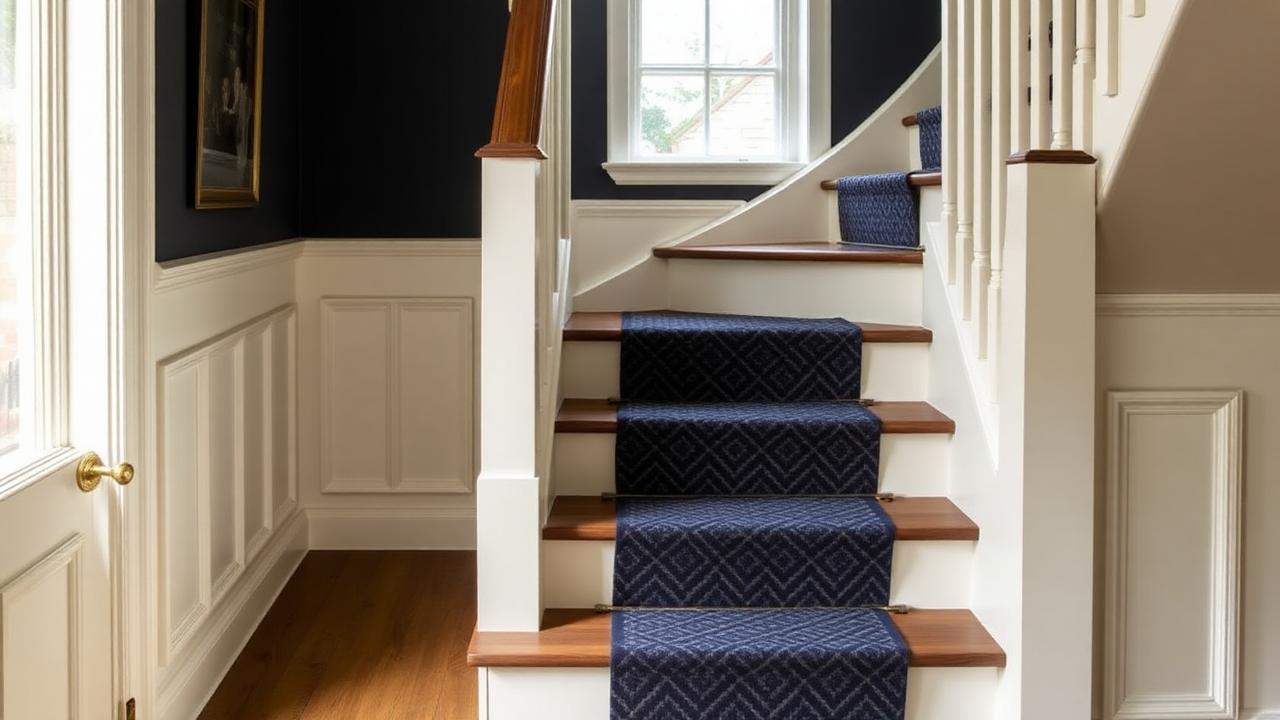
The graphic impact of checkerboard on stairs
The checkerboard pattern has enjoyed a massive resurgence in recent years, moving from traditional tiled entryways to modern carpeted stairs. It's a pattern that makes a massive statement; it's impossible to ignore. In my experience as a fitter, checkerboard runners are particularly effective in hallways that are otherwise quite simple. A black and white checkerboard runner can act as the primary 'artwork' for the space. However, if you want something less intense, a checkerboard in shades of beige and cream, or sage green and off-white, can feel surprisingly soft and traditional.
The scale of the squares is the most important factor in how the runner will look. Large squares (10 cm / 4 inches or larger) create a very modern, almost 'Alice in Wonderland' vibe. Smaller squares (around 5 cm / 2 inches) feel more like a traditional woven texture and are often easier to live with in the long term. One thing to consider is the 'diagonal' checkerboard (or harlequin) versus the standard 'square' grid. For stairs, a standard square grid is much easier to align. When using a stair runner length calculator, you must be extremely precise, as even a half-inch of drift will make the checkerboard squares look 'stepped' rather than straight.
Visual Rhythm
Checkerboard patterns create a strong visual beat. If your staircase is very long, a small-scale checkerboard can sometimes feel a bit dizzying; a larger scale or a lower-contrast colour pairing is often better for tall flights.
Measuring and sizing for checkerboard
Measuring for a checkerboard runner is all about the pattern repeat. You ideally want a full square to start at the front edge of each tread. Let's look at the US example: 13 steps, 10 inch tread, 7.5 inch riser, 1 inch nosing wrap = 18.5 inches per step. 18.5 x 13 = 240.5 inches (20.04 ft). Adding 2 feet for allowances = 22.04 ft. For checkerboard, I recommend a 15% waste margin to ensure you can align the 'rows' of squares perfectly, bringing the order to 25.3 feet.
For UK fitters, a 13-step flight (25 cm tread, 19 cm riser, 2.5 cm nosing wrap) totals 604.5 cm (6.05 m). Adding 60 cm for the start and finish = 6.65 m. With a 15% waste margin, the final order is 7.65 metres. It is vital to ensure that the width of the runner you order matches the pattern repeat. For example, if your squares are 5 cm wide, your runner width should ideally be a multiple of 5 cm to avoid having half-squares at the edges. A professional stair runner calculator can help you work out the best width and length for your specific grid.
| Step Component | US Units | UK Units |
|---|---|---|
| Tread/Riser Total | 17.5 in | 44 cm |
| Nosing Wrap | 1 in | 2.5 cm |
| Per Step Subtotal | 18.5 in | 46.5 cm |
| 13 Steps Total | 20.04 ft | 6.05 m |
| Finishing Margin | 2 ft | 0.6 m |
| Total Before Waste | 22.04 ft | 6.65 m |
| Order (15% Waste) | 25.3 ft | 7.65 m |
Know your numbers in 30 seconds
Enter your step count, tread depth and riser height — the stair runner calculator gives you the exact length to order, in metres and feet, with waste included.
Open the stair runner calculatorInstallation tips for checkerboard patterns
Installing a checkerboard runner is all about the 'tuck'. I use a laser level to ensure the vertical lines of the grid are perfectly plumb. When I am driving staples into the 'crotch' of the stair, I make sure the staple goes exactly into the grout-line (the line between squares) to hide it. A 'Hollywood' installation is usually best for checkerboard, as it allows you to pull the carpet tight under the nosing, ensuring the squares on the riser are perfectly square. If you have a winding staircase, checkerboard is incredibly difficult to install, as the grid will 'break' at every turn. In these cases, a professional might suggest a mitred landing to reset the pattern.

Because checkerboard is such a busy pattern, I usually recommend a very simple, solid-coloured binding in one of the colours found in the pattern (e.g., black binding for a black and white checkerboard). This gives the grid a firm boundary. Stair rods can also look great, especially in a modern finish like chrome or black. If you're doing a DIY fit, be prepared for it to take twice as long as a plain runner. Every single step needs to be checked against the previous one to ensure the grid hasn't shifted. Searching for 'stair runners' will show you just how many variations of the checkerboard grid are available today.
- Use a laser level to keep the grid lines perfectly straight from top to bottom.
- Choose a low-contrast checkerboard (e.g., two shades of grey) for a more subtle, sophisticated look.
- Ensure the squares are centered on the treads so that you have full squares at the front edge.
- Avoid using checkerboard on very winding stairs unless you are an expert at pattern mitering.
- Use a high-quality, firm underlay to prevent the grid from distorting as the carpet settles.
Style and Durability
Checkerboard runners are surprisingly durable because the 'busy' pattern is excellent at hiding dirt and wear. A wool checkerboard runner will last for decades if properly cared for. The main thing to watch out for is 'optical' wear - if the pile gets crushed in a high-traffic area, the crisp lines of the checkerboard can look a bit blurred. Regular vacuuming is essential. In terms of style, checkerboard is a 'brave' choice that pays off by giving your home a distinct, designer identity. Whether you're going for a retro 1950s look or a ultra-modern graphic aesthetic, a checkerboard stair runner carpet is a fantastic way to elevate your space.
Frequently asked questions
Is checkerboard a trendy choice for stairs?
It's currently very trendy, but it's also a classic motif with roots in traditional flooring. It's a pattern that offers both a modern edge and a sense of history.
Does a checkerboard runner hide dirt?
Yes, particularly if you choose a multi-tonal or darker colour combination. The high-contrast grid is very effective at camouflaging footprints.
Is checkerboard hard to install?
Yes, it is very difficult because the grid must be perfectly straight. Any misalignment is very obvious. Professional installation is recommended.
What scale of checkerboard is best for stairs?
Medium-sized squares (5cm to 8cm) are usually best for standard stairs. Very large squares can look overwhelming, while tiny ones can be dizzying.
Can I use checkerboard on winding stairs?
It's difficult because the pattern will naturally skew on the turns. A professional will need to mitre the joins to keep the grid looking coherent.
How much extra material should I order?
We recommend at least 15% waste to allow for precise alignment of the squares at each step.
What colours go with a checkerboard runner?
Neutrals work best for the surrounding walls, but you can also pull one of the colours from the checkerboard for a bold, monochromatic look.
Will a checkerboard runner make me dizzy?
It can if the contrast is very high and the squares are small. Choosing a lower-contrast colour pairing or a larger square size can mitigate this effect.
Know your numbers in 30 seconds
Enter your step count, tread depth and riser height — the stair runner calculator gives you the exact length to order, in metres and feet, with waste included.
Calculate checkerboard runner lengthReady for real prices?
Get quotes from vetted stair runner suppliers and fitters near you. Free, no account, no obligation.
Every guide is written from hands-on measuring and fitting experience, checked against the calculator’s own maths, and re-reviewed whenever prices or methods change. Read our editorial standards.