
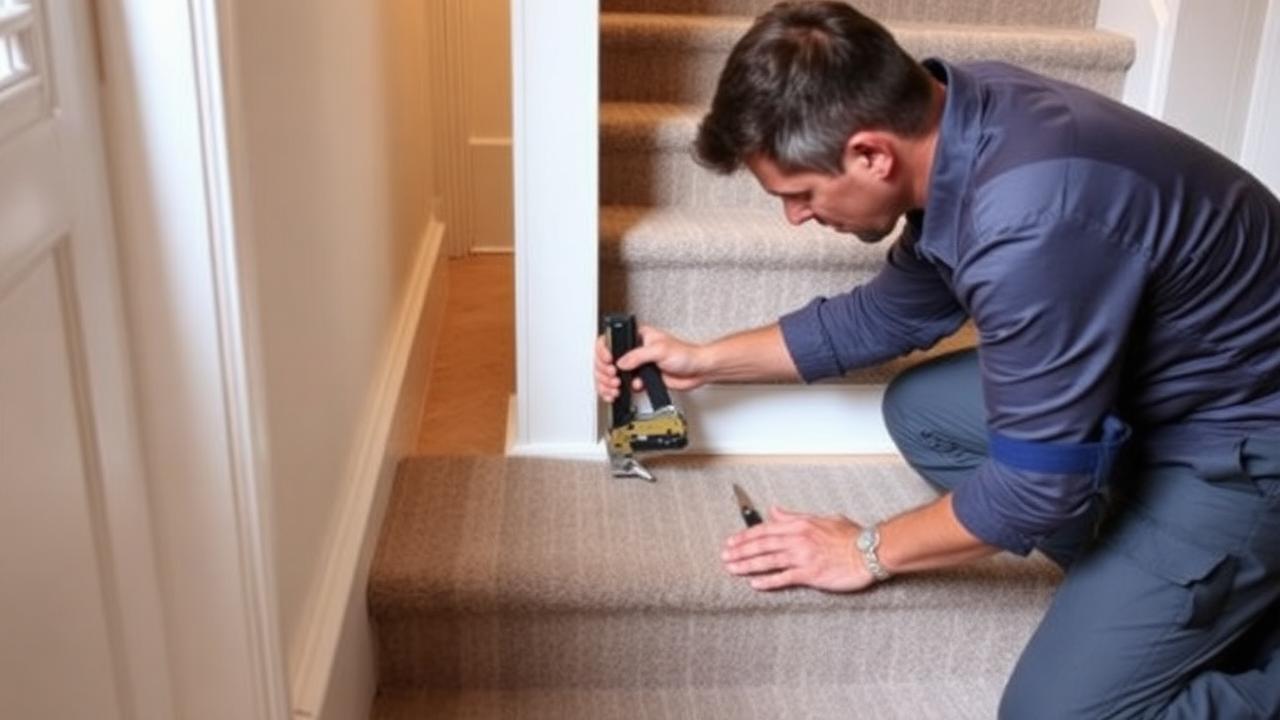
Why the entryway is your home's hardest-working stair
The stairs directly inside your front door see more grit, moisture, and debris than any other flight in the house. Because they are the first point of entry, the fibre you choose here needs to be easy to clean and resilient enough to handle constant traffic without showing premature matting or wear.
How much runner do I need?
Using standard 10 in (25 cm) treads and 7.5 in (19 cm) risers over 13 steps, each step requires roughly 18.25 in (45.9 cm) of runner including the nosing. Total length for the steps is 19.77 ft (5.97 m). Adding a 24 in (60 cm) allowance for finishes and a 10% waste factor for complex entry designs, your total order should be around 24 ft (7.3 m).

| Item | Measurement (US) | Measurement (UK) |
|---|---|---|
| Tread + Riser + Nosing | 18.25 in | 45.9 cm |
| 13 Steps Total | 19.77 ft | 5.97 m |
| Finishing Allowance | 2 ft | 0.6 m |
| Order with 10% Waste | 24 ft | 7.3 m |
Know your numbers in 30 seconds
Enter your step count, tread depth and riser height — the stair runner calculator gives you the exact length to order, in metres and feet, with waste included.
Open the stair runner calculatorPro Tip
Always request a high-quality underlay for entryway stairs; it will extend the life of your runner significantly by absorbing the impact of heavy boots.
- Choose dense nylon or wool-nylon blends for high traffic.
- Ensure the runner is securely fastened at the top and bottom.
- Vacuum regularly to remove grit before it works into the fibres.
Whatever you decide, get the numbers first: the stair runner calculator doubles as a stair runner length calculator, adding nosing wrap, landings, winders, pattern repeat and waste so you order the right length the first time.
Still deciding on material, width or pattern? Our hub on stair runners compares weaves, widths, backings and fitting styles side by side, then hands the numbers straight to the calculator.
Frequently asked questions
What is the best material for an entryway stair runner?
Nylon or high-twist wool blends are excellent choices due to their durability and ability to recover from constant traffic.
Do I need a specific underlay for the entryway?
Yes, a firm, high-density underlay is essential for stairs to prevent the runner from stretching and to provide necessary cushioning.
How often should I clean an entryway stair runner?
Vacuum weekly to prevent grit accumulation, and have it professionally cleaned annually to remove deep-seated dirt.
Can I use a natural fibre like sisal in an entryway?
It is not recommended, as natural fibres like sisal are harder to clean and can be damaged by the moisture and grit common in entryways.
What should I look for in a stair runner for my front hall?
Look for high durability ratings (often called 'heavy contract' or 'extra heavy domestic') and colours that hide dirt, such as tweeds or darker tones.
How do I secure an entryway runner?
A combination of carpet staples, tack strips, and stair rods ensures the runner stays firm and looks professional.
Is it worth fitting a runner myself?
While possible for experienced DIYers, fitting on stairs is tricky due to the complex shapes. Professional fitting is recommended for a long-lasting, safe result.
Does the entryway runner need to match other hall flooring?
It is not required, but coordinating the colour or texture helps create a cohesive look between the stairs and your hall flooring.
Know your numbers in 30 seconds
Enter your step count, tread depth and riser height — the stair runner calculator gives you the exact length to order, in metres and feet, with waste included.
Size your entryway stair runner with the stair runner calculatorReady for real prices?
Get quotes from vetted stair runner suppliers and fitters near you. Free, no account, no obligation.
Every guide is written from hands-on measuring and fitting experience, checked against the calculator’s own maths, and re-reviewed whenever prices or methods change. Read our editorial standards.