
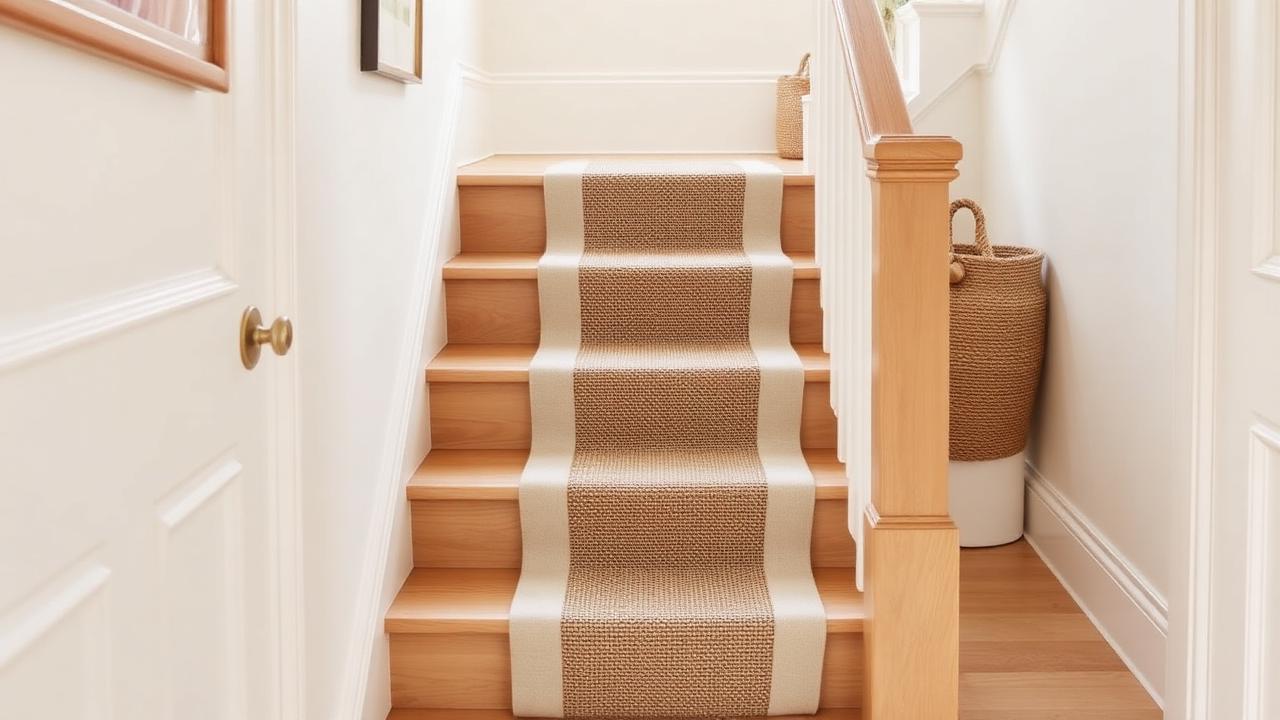
The farmhouse look in stair runners
Farmhouse style borrows heavily from utilitarian, agricultural textiles - grain sacks, ticking stripes, undyed wool and coarse natural weaves - and applies that texture to a domestic staircase. On a stair runner this usually means visible weave texture, a muted or two-tone palette, and pattern that reads as woven-in rather than printed, since farmhouse decorating tends to favour materials that look and feel authentically made rather than decorative in a formal sense.
Fibre choices for a farmhouse runner
| Fibre | Farmhouse fit | Durability note |
|---|---|---|
| Sisal | Excellent - classic coarse, natural texture | Firm underfoot; not ideal with bare feet or moisture |
| Jute | Good, softer and more matte than sisal | Less durable; better for lower-traffic stairs |
| Wool flatweave | Very good, especially in oatmeal or cream | Durable, warmer underfoot than sisal or jute |
| Cotton ticking-stripe weave | Excellent for the classic stripe look | Softer wear; best blended with wool or synthetic backing |
| Wool/sisal blend | Very good - texture with better softness | Balances durability and comfort |
Pattern and colour
- Ticking stripes - narrow, evenly spaced stripes in navy, black or charcoal on a cream or oatmeal ground.
- Herringbone or basketweave texture in a single neutral tone, letting the weave itself provide the pattern.
- Grain-sack style wide stripes, usually in muted red, blue or black on undyed cream.
- Solid oatmeal, jute-tone or dove grey for a quieter farmhouse look that leans more modern-rustic.
- Avoid heavily saturated colours or busy florals - farmhouse palettes stay muted and tonal.
Natural fibres need a moisture-aware fitting plan
Sisal and jute absorb moisture and can shrink, stain or discolour if fitted in a damp hallway, near an exterior door, or cleaned with a wet method. For farmhouse-style stairs in an entryway, a wool or wool-blend flatweave with a similar look gives more forgiving performance.
Width, margin and edge
Farmhouse schemes typically use a moderate margin - 4-5in (10-13cm) exposed tread each side - wide enough to show off reclaimed or painted timber but not so wide it feels stark. Edges are usually a simple cotton or linen binding in a matching or slightly darker tone, rather than a decorative woven border, keeping the finish practical rather than ornate.
Steps to plan a farmhouse stair runner
- Assess moisture and traffic levels on the stair - a busy family entry stair favours wool-blend over pure jute.
- Choose a pattern direction: ticking stripe, grain-sack stripe, or a textured solid neutral.
- Pick a width that leaves a comfortable, not stark, margin of exposed timber either side.
- Confirm the binding colour against your stripe or base tone.
- Use a stair runner calculator to total the length needed, including the wrap at each riser and nosing.
- Ask your fitter about a moisture-resistant underlay if the stair sits near an entryway or mudroom.
Cost expectations
Sisal and jute runners are generally mid-priced, while wool and wool-blend flatweaves in a ticking stripe sit slightly higher. For a 13-step straight flight, expect roughly £350-£800 / $450-$1,000 fitted for sisal or jute, and £500-£1,100 / $650-$1,350 for wool or wool-blend in a similar style, with underlay and fitting included in both cases.
| Fibre | Typical fitted cost (13-step flight) |
|---|---|
| Sisal or jute | £350-£800 / $450-$1,000 |
| Wool or wool-blend flatweave | £500-£1,100 / $650-$1,350 |
| Cotton ticking-stripe (with backing) | £400-£900 / $500-$1,150 |
Pairing with the rest of the hallway
Farmhouse stair runners generally sit best against painted shaker panelling, whitewashed or reclaimed timber, matte black or bronze stair rods, and simple pendant or lantern lighting. Avoid pairing a strong ticking stripe with a heavily patterned hallway wallpaper - farmhouse schemes generally rely on one clear pattern statement (usually the runner) with everything else kept plain.

Regional and seasonal variation in farmhouse style
US farmhouse schemes, especially in warmer, drier climates, lean toward jute and sisal more readily because humidity swings that cause natural fibre to shrink or buckle are less of a concern. UK farmhouse interiors, particularly in older stone or brick cottages with less consistent heating, more often use wool or wool-blend flatweaves specifically because they tolerate the damp, cooler conditions of a hallway or stairwell better than jute. If you are sourcing the look from a supplier abroad, ask specifically how the product performs in a humid stairwell rather than assuming a US-sourced sisal will behave the same in a UK entryway.
Matching runner width to staircase type
| Staircase type | Typical width choice | Margin effect |
|---|---|---|
| Narrow cottage stair (under 32in / 80cm wide) | 22-24in (55-60cm) runner | Tight margin, shows timber character |
| Standard straight flight (36in / 90cm wide) | 27-30in (68-76cm) runner | Balanced, classic farmhouse proportion |
| Wide farmhouse hallway stair (42in+ / 107cm+) | 32-36in (80-90cm) runner | Generous margin either side, still reads informal |
Caring for a farmhouse-style runner
Natural fibre runners like sisal and jute should be vacuumed with suction only, never a rotating beater brush, since the brush can fray the coarse weave over time. Spills need blotting immediately rather than rubbing, since both fibres absorb liquid quickly and can stain or discolour within minutes on an unsealed weave. Wool and wool-blend farmhouse runners tolerate a wider range of cleaning methods and are the more forgiving choice for a household that spends a lot of time cleaning up after children or pets on the stairs.
Sourcing reclaimed or vintage-look materials
Part of the farmhouse look leans on runners that appear to have been there for decades, and a few suppliers on both sides of the Atlantic now offer deliberately irregular, hand-loomed jute and cotton-rag weaves that mimic older mill production rather than a perfectly uniform modern extrusion. These cost more per yard or metre than machine-made equivalents because the weave is genuinely slower to produce, but the visual payoff on a farmhouse stair is real: slight width variation and colour drift along the length reads as authentic rather than a flaw. If budget does not stretch to a hand-loomed option, a striped cotton or wool flatweave with a slightly irregular hand-drawn stripe pattern gets close to the same effect at a fraction of the cost.
Pairing runner colour with painted stair components
- Sample the runner colour against your actual stringer and riser paint, not against a paint chip, since farmhouse whites vary from warm cream to cool grey-white.
- Choose a runner background a shade or two warmer than stark white risers, since a pure white runner against pure white paint reads flat and loses definition at the edges.
- If risers are painted a soft sage, navy or charcoal (common in current farmhouse schemes), pick a runner with a matching thread in the border rather than a fully contrasting colour.
- Test swatches in both daylight and evening lamp light before ordering a full flight, since natural fibre tones shift more under warm bulbs than synthetic fibres do.
Whatever you decide, get the numbers first: the stair runner calculator doubles as a stair runner length calculator, adding nosing wrap, landings, winders, pattern repeat and waste so you order the right length the first time.
Frequently asked questions
What fibre is best for a farmhouse stair runner?
Sisal and wool flatweave are the two most common choices - sisal for classic coarse texture, wool-blend for similar looks with better softness and moisture tolerance. Jute suits lower-traffic stairs but wears faster and is more moisture-sensitive.
What pattern is typical of a farmhouse stair runner?
Ticking stripes (narrow navy or black stripes on cream), grain-sack style wide stripes, and textured neutral weaves like herringbone are the classic patterns. All favour a muted, tonal palette rather than saturated colour or floral prints.
Is sisal or jute a good choice for a farmhouse entry stair?
Sisal handles moderate traffic well but can be uncomfortable barefoot and stains easily if the entry gets wet. In a damp or high-moisture entryway, a wool or wool-blend flatweave with a similar coarse texture is generally the more forgiving choice.
How wide should the margin be on a farmhouse stair runner?
A moderate margin of around 4-5in (10-13cm) exposed tread on each side is typical, wide enough to show off reclaimed or painted timber without feeling stark or overly minimal, which suits the informal farmhouse aesthetic.
How much does a farmhouse-style stair runner cost?
For a 13-step flight, sisal or jute typically runs £350-£800 / $450-$1,000 fitted, while wool or wool-blend in a ticking stripe runs £500-£1,100 / $650-$1,350, both including underlay and professional fitting.
Can I get a farmhouse look without natural fibres?
Yes - wool-blend or synthetic flatweaves woven to mimic sisal or jute texture give a similar farmhouse look with better stain resistance and comfort, particularly useful on stairs with pets, children or high moisture exposure.
What colour rods suit a farmhouse stair runner?
Matte black, aged bronze or brushed brass rods are the most common pairings, chosen to look handmade or slightly worn rather than polished and formal, in keeping with the overall farmhouse aesthetic.
Does a farmhouse stair runner need a decorative border?
No - most farmhouse schemes use a simple cotton or linen binding in a matching or slightly darker tone rather than an ornate woven border, keeping the finish practical and understated rather than formal.
Know your numbers in 30 seconds
Enter your step count, tread depth and riser height — the stair runner calculator gives you the exact length to order, in metres and feet, with waste included.
Calculate how much farmhouse-style runner you needReady for real prices?
Get quotes from vetted stair runner suppliers and fitters near you. Free, no account, no obligation.
Every guide is written from hands-on measuring and fitting experience, checked against the calculator’s own maths, and re-reviewed whenever prices or methods change. Read our editorial standards.