

The timeless elegance of the Greek Key
The Greek Key pattern consists of a continuous line that folds back on itself, mimicking the Meander River in ancient Greece. On a stair runner, this pattern acts as a strong visual border or a full-width motif that communicates sophistication and order. In my career as a fitter, I've found that Greek Key runners are the go-to choice for homeowners wanting a 'high-end' look. It works exceptionally well in Georgian, Victorian, and modern Neo-Classical homes. The beauty of the Greek Key is its versatility; a black and white Greek Key is strikingly modern, while a gold and cream version feels traditionally opulent.
The most important design consideration with a Greek Key is the scale. A very large Greek Key can look clumsy on a narrow staircase, while a tiny, intricate meander can get lost and look like a simple textured line from a distance. You also need to decide if you want the Greek Key as a 'border' (running down the sides of a plain runner) or as a 'field' pattern (covering the entire surface). Bordered Greek Keys are particularly popular because they frame the stairs perfectly, drawing the eye upward in a clean, linear fashion. When using a stair runner length calculator, be extremely precise with your measurements, as geometric patterns like this show even the smallest errors in alignment.
Precision is Paramount
Greek Key patterns are unforgiving. If the runner is installed even slightly crooked, the straight lines of the 'key' will clash with the straight lines of your stair treads, making the whole installation look amateur.
Measuring and sizing for a Greek Key
When measuring for a Greek Key runner, you must account for the pattern repeat to ensure the 'keys' are not cut off awkwardly at the top or bottom of the flight. Let's look at the US example: 13 steps, 10 inch tread, 7.5 inch riser, plus 1 inch nosing wrap = 18.5 inches per step. 18.5 x 13 = 240.5 inches (20.04 ft). Add 2 feet for finishing = 22.04 ft. For a Greek Key, I recommend a 12% waste margin to allow for pattern matching, bringing the total order to about 24.7 feet.
For UK fitters, a 13-step flight (25 cm tread, 19 cm riser, 2.5 cm nosing wrap) totals 604.5 cm (6.05 m). Adding 60 cm for ends = 664.5 cm (6.65 m). With a 12% waste margin, the final order should be 7.45 metres. I always suggest ordering a little extra, as you might need to 'waste' a few inches of material at the start of the installation to ensure the pattern starts with a full 'key' rather than a half-fragment. A professional stair runner calculator can help you refine these numbers based on the specific repeat of the carpet you've chosen.
| Step Part | US Measure | UK Measure |
|---|---|---|
| Tread & Riser | 17.5 in | 44 cm |
| Nosing Wrap | 1 in | 2.5 cm |
| Per Step Subtotal | 18.5 in | 46.5 cm |
| 13 Steps Total | 20.04 ft | 6.05 m |
| Finishing Ends | 2 ft | 0.6 m |
| Total (Before Waste) | 22.04 ft | 6.65 m |
| Final Order (12% Waste) | 24.7 ft | 7.45 m |
Know your numbers in 30 seconds
Enter your step count, tread depth and riser height — the stair runner calculator gives you the exact length to order, in metres and feet, with waste included.
Open the stair runner calculatorInstallation tips for Greek Key runners
Installing a Greek Key runner is a test of a fitter's skill. The 'keys' must be perfectly parallel to the stair strings and perfectly perpendicular to the nosings. I use a laser level to project a line down the center of the staircase to ensure the pattern doesn't 'drift'. When working with a bordered Greek Key, you must ensure the border is the same distance from the edge of the stairs on every single step. This is surprisingly difficult on older stairs that might vary in width by a few millimetres. I also recommend a 'Hollywood' fit for Greek Key runners; by tucking the carpet under the nosing, you emphasize the geometric precision of the pattern.
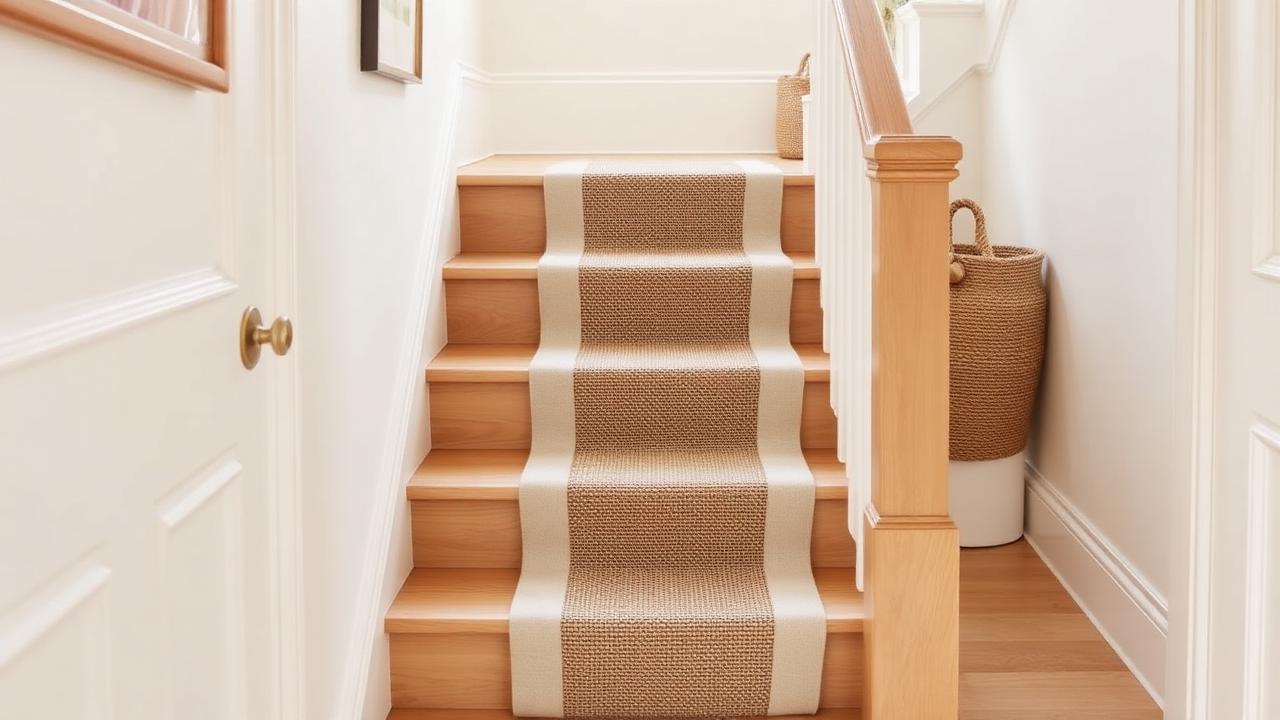
Stair rods are a natural companion to Greek Key runners. A polished chrome or nickel rod looks fantastic with a monochrome Greek Key, while brass rods suit a more traditional colour palette. When installing rods over a Greek Key, make sure the rod brackets do not obscure the pattern's corners. If you are doing a DIY fit, take your time. A Greek Key runner isn't a project you can rush. If you're searching for 'stair runners' to buy, look for those with a 'woven-in' pattern rather than a 'printed-on' pattern, as woven patterns are much easier to keep straight during the stretching process.
- Use a laser level or a long straight-edge to ensure the pattern is perfectly centered and square.
- Choose a high-quality wool Wilton for a Greek Key runner; the stiff backing helps keep the pattern straight.
- Ensure your tack strips are positioned exactly the same distance from the riser on every step.
- Avoid using Greek Key patterns on winding stairs if you are a DIYer, as mitering the corners is extremely difficult.
- Regularly check the pattern alignment as you work your way up the stairs; don't wait until the top to realize it's crooked.
Style and Value
A Greek Key runner is an investment in style that rarely goes out of fashion. It has been used in interiors for over two thousand years, which is about as 'timeless' as it gets. It adds a layer of formality and luxury that can significantly enhance the first impression of your home. In terms of maintenance, treat it like any high-quality wool carpet: regular vacuuming and prompt spot cleaning. Because the pattern is so geometric, any 'pilling' or 'fuzzing' of the wool can be more noticeable than on a shaggy runner, so use a vacuum with an adjustable height setting to avoid overly aggressive brushing. If you're looking to add value and a sense of 'gravitas' to your entryway, a Greek Key stair runner carpet is a top-tier choice.
Frequently asked questions
What does the Greek Key pattern represent?
Historically, it represents infinity or the eternal flow of things. In design, it is a symbol of classic elegance, order, and architectural harmony.
Is a Greek Key runner hard to install?
Yes, it is one of the more challenging patterns to install because the geometric lines must be perfectly aligned. A professional fitter is highly recommended.
Does Greek Key look good on modern stairs?
Absolutely. A large-scale, high-contrast Greek Key (like black and white) is a staple of modern luxury interior design.
Can I use Greek Key on winding stairs?
It is possible but very difficult. The pattern must be mitred at the corners to maintain the 'flow' of the key, which requires advanced fitting skills.
What colours are best for Greek Key runners?
High-contrast pairings like black/white, navy/cream, or grey/silver are most common, but tone-on-tone versions (e.g., beige on tan) offer a more subtle look.
How much extra material should I order?
We recommend at least a 12% waste margin to allow for precise pattern matching and starting the flight with a full 'key'.
Do I need stair rods for a Greek Key runner?
They are not required, but they complement the formal, architectural feel of the pattern beautifully.
Is wool or synthetic better for a Greek Key?
Wool is generally better because the weave is more stable, making it easier to keep the geometric lines straight during installation.
Know your numbers in 30 seconds
Enter your step count, tread depth and riser height — the stair runner calculator gives you the exact length to order, in metres and feet, with waste included.
Calculate Greek Key runner lengthReady for real prices?
Get quotes from vetted stair runner suppliers and fitters near you. Free, no account, no obligation.
Every guide is written from hands-on measuring and fitting experience, checked against the calculator’s own maths, and re-reviewed whenever prices or methods change. Read our editorial standards.