

The classic appeal of tartan on stairs
Tartan is more than just a pattern; it's a statement of tradition and durability. In the UK, tartan stair runners have been a staple of country houses and Victorian terraces for generations, but they are increasingly finding a home in modern US interiors too. The beauty of a tartan runner lies in its ability to introduce multiple colours into a space through a single piece of carpet. Whether it's a classic Red Royal Stewart, a moody Black Watch, or a contemporary grey-toned plaid, the interlocking lines create a sense of order and rhythm that guides the eye up the stairs. When I'm fitting a wool tartan, the first thing I check is the alignment of the vertical stripes - if these aren't parallel to the stair strings, the whole flight will look 'off'.
Wool is the natural partner for tartan patterns. The way wool fibres take dye allows for deep, rich colours that won't fade or bleed, which is crucial for a pattern that relies on high-contrast lines. Furthermore, a high-quality wool Axminster or Wilton tartan runner is incredibly hard-wearing. The dense weave provides excellent 'step definition', meaning the carpet won't sag or stretch, keeping those all-important tartan lines straight over years of use. If you are using a stair runner length calculator, be aware that tartans often come in specific widths (usually 69cm or 27 inches), so you need to ensure this fits your staircase while leaving a consistent gap of timber showing on either side.
Pattern Repeat and Alignment
The 'sett' of a tartan is the size of the square pattern before it repeats. For stairs, a medium-sized sett (around 10cm to 15cm) is often best, as it allows the pattern to be fully visible on both the tread and the riser.
Measuring for a tartan runner
Measuring for a tartan runner is slightly more complex than for a plain carpet because you must account for the pattern repeat. Most tartans have a vertical repeat that you need to match. To get a clean look, you ideally want the same part of the pattern to sit on the edge of every stair nosing. This means you might lose a few inches of carpet per step to 'drop' the pattern into the correct position. In a US home with 13 steps (10 in tread, 7.5 in riser, 1 in nosing wrap), the basic length is 22.04 ft, but I always recommend adding at least 15% for waste when dealing with tartan, bringing the total order to about 25.5 feet.
For UK fitters working in metric, a 13-step flight (25 cm tread, 19 cm riser, 2.5 cm nosing wrap) needs a basic length of 6.65 m. Factoring in a 15% waste margin for pattern matching, the final order should be around 7.65 metres. It is much better to have an extra half-metre of tartan than to find yourself one step short and unable to match the lines of a new batch of carpet. Using a stair runner calculator that allows for custom waste percentages is a lifesaver for these types of geometric projects.
| Measurement Type | Standard (US/UK) | Tartan Allowance (Add 15%) |
|---|---|---|
| Per Step (US) | 18.5 in | 21.28 in |
| Per Step (UK) | 46.5 cm | 53.48 cm |
| 13 Steps Subtotal (US) | 20.04 ft | 23.05 ft |
| 13 Steps Subtotal (UK) | 6.05 m | 6.96 m |
| Total with ends (US) | 22.04 ft | 25.35 ft |
| Total with ends (UK) | 6.65 m | 7.65 m |
Know your numbers in 30 seconds
Enter your step count, tread depth and riser height — the stair runner calculator gives you the exact length to order, in metres and feet, with waste included.
Open the stair runner calculatorInstallation challenges: Keeping lines straight
The biggest challenge when installing a tartan stair runner is preventing 'pattern wander'. Even the best-quality wool runners can have slight variations in the weave. As a fitter, I use a combination of heavy-duty tack strips and a pneumatic staple gun to 'lock' the tartan into place at every junction of the tread and riser. If the staircase is slightly out of square (which most older houses are), you have to make a choice: do you keep the runner parallel to the wall, or do you keep the tartan lines square to the steps? I always advise keeping the tartan lines square to the steps, as the human eye is much quicker to notice a crooked pattern than a slightly varying gap at the edge of the stairs.
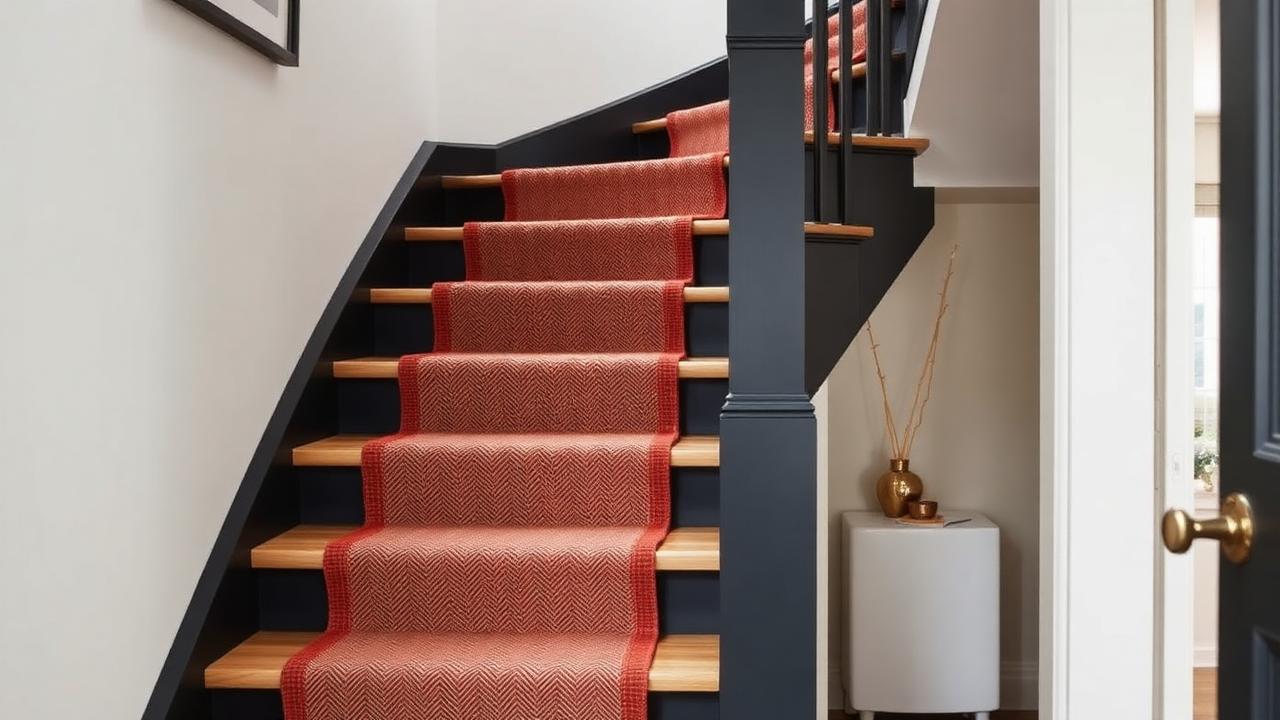
For winding stairs, tartan becomes significantly more difficult. When the stairs turn, the tartan pattern will naturally 'fan out', causing the lines to become diagonal across the tread. This can look fantastic if done intentionally as a 'mitred' join on a landing, but for a DIYer, it is a nightmare. If you have a winder staircase, I strongly suggest hiring a professional who has experience with geometric patterns. They can 'work the pattern' to ensure the transitions between straight and turning sections look deliberate rather than accidental. Always mention 'stair runners' to your local carpet shop and ask for a fitter who specialises in patterns.
- Use a bolster tool to drive the carpet deep into the 'crotch' of the stair (where the tread meets the riser) for a crisp line.
- Check that the vertical lines of the tartan are centered on the staircase before you drive in the first staple.
- Consider black or antique bronze stair rods to complement the traditional look of a tartan wool runner.
- Always order all your tartan runner from the same 'dye lot' to avoid subtle colour shifts halfway up the stairs.
- For the cleanest finish, have the edges of the tartan runner professionally whipped or bound in a solid colour found within the pattern.
Maintenance and longevity of wool tartans
A 100% wool tartan runner is one of the most durable things you can put on your stairs. Wool is naturally fire-retardant, soil-resistant, and has a 'memory' that helps it bounce back from crushing. To keep it looking its best, vacuum at least twice a week with a vacuum that has a beater bar (though be careful not to catch the edges). Because tartan is so busy, it is incredibly good at hiding 'tracking' - those paths of flattened pile that appear on plain carpets over time. If a spill occurs, blot it immediately with lukewarm water and a mild detergent; never rub a wool tartan, as you can distort the fibres and blur the crisp lines of the pattern.
Over time, even the best-fitted runner might shift slightly. Every few years, check the tension of the runner. If you notice any bagging or if the tartan lines are starting to look wavy, it may be time to have a fitter come back and re-stretch the runner. This is a simple job that can add another decade to the life of your carpet. When shopping, search for 'stair runner carpet' to find ranges specifically tested for the high-impact environment of a staircase.
Frequently asked questions
Are tartan stair runners out of style?
Not at all. While they are a traditional choice, tartans are currently seeing a resurgence in 'modern country' and 'maximalist' interior design. Grey and monochrome tartans are also popular for contemporary homes.
Is wool the best material for a tartan runner?
Yes. Wool's ability to hold vibrant dye and its natural resilience make it the perfect fibre for a geometric pattern like tartan, ensuring the lines stay crisp and the colours stay rich.
How do I choose the right tartan for my stairs?
Consider the scale of the pattern. A large 'sett' (repeat) can be overwhelming on a narrow stair, while a very small pattern can look messy. Medium-sized tartans are usually the safest bet for standard domestic stairs.
Can I use a tartan runner on winding stairs?
Yes, but it is complex. The pattern will naturally skew on the turns. A professional fitter can often mitigate this with clever cutting and mitering, but it's not a recommended DIY project.
Do I need stair rods with a tartan runner?
They are not strictly necessary, but they look excellent with tartan. They add a layer of traditional detail that complements the heritage feel of the pattern.
How much extra tartan should I order for pattern matching?
We recommend adding at least 15% to your base measurement to account for pattern repeats and ensures the lines line up correctly at every step.
Will a tartan runner hide dirt?
Extremely well. The multi-coloured, busy nature of the pattern is excellent at masking dust, footprints, and pet hair, making it a very practical choice for busy families.
Can I get a tartan runner in modern colours?
Yes, many manufacturers now offer tartans in 'non-traditional' palettes like soft greys, teals, and even neon accents for a more contemporary look.
Know your numbers in 30 seconds
Enter your step count, tread depth and riser height — the stair runner calculator gives you the exact length to order, in metres and feet, with waste included.
Calculate tartan runner yardageReady for real prices?
Get quotes from vetted stair runner suppliers and fitters near you. Free, no account, no obligation.
Every guide is written from hands-on measuring and fitting experience, checked against the calculator’s own maths, and re-reviewed whenever prices or methods change. Read our editorial standards.