
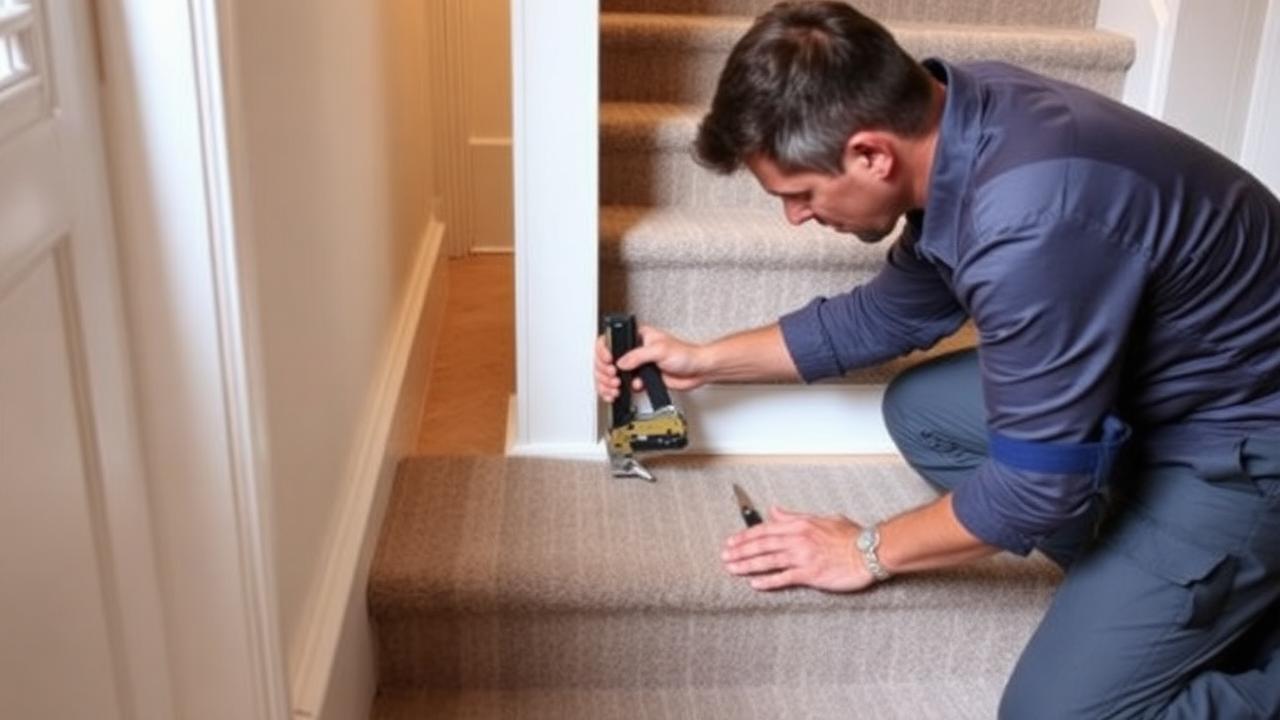
The three common top finishes
How to finish a stair runner at the top of the stairs comes down to what flooring is waiting at the top of the flight. Against fitted carpet, the runner end tucks under the carpet's gripper edge so the join is invisible. Against a hard floor such as tile or timber, the runner is bound off and finished with a metal or wood edging trim, or a stair rod, right at the top nosing.
| Top-of-stairs flooring | Finish method | Visible seam? |
|---|---|---|
| Fitted carpet on landing | Tuck under gripper edge | No |
| Tile or timber landing | Bound edge plus trim strip | Yes, deliberately styled |
| Another runner in a hallway | Butt join with seam tape | Minimal |
| Open top step, no landing wall | Wrap and staple underneath | No |
How much extra length to allow
Always add 2-3 in (5-7.5 cm) of extra runner length at the top before cutting, whichever finish you plan to use. This margin lets you tension the runner over the final nosing and gives room to correct if a stair runner length calculator estimate was slightly short once you are on site with the tape measure.
Know your numbers in 30 seconds
Enter your step count, tread depth and riser height — the stair runner calculator gives you the exact length to order, in metres and feet, with waste included.
Open the stair runner calculatorTucking under landing carpet gripper
- Lift the front edge of the landing carpet from its gripper strip along the top step.
- Slide the raw end of the runner underneath by at least 1.5 in (3.8 cm).
- Staple the runner end into the floor through the overlap, 20-22 gauge staples at 2 in (5 cm) centres.
- Smooth the landing carpet back down over the join and re-press it onto the gripper pins.
Why this method disappears completely
Because the landing carpet's own pile sits directly over the join, there is nothing to see once the carpet is pressed back down. This is the standard finish in most UK homes where a full-width hallway or landing carpet continues from the stair runner.
Binding off against a hard floor
Where the top step meets tile, stone or bare timber, the runner needs a factory-bound or serged edge so the cut end does not fray, then a threshold or stair edging trim screwed or glued down over it. A 1/2 in to 1 in (12.5-25 mm) aluminium or brass trim is typical and costs $12-30 (about £10-24) per length.
Wrapping and stapling underneath
On an open top step with no adjoining wall or carpet, wrap the last 2-3 in of runner fully over the top nosing and staple it to the underside of the tread, the same waterfall or Hollywood technique used at every riser below. This keeps the cut edge completely hidden from view when standing on the landing.
Do not cut the runner flush with no finish
A raw cut edge left exposed at the top step will fray within weeks of foot traffic. Always plan one of the three finishes before you cut, not after.
Using stair rods at the top
If the flight is finished with stair rods throughout, the top rod usually sits at the very top riser junction rather than on the landing itself, holding the runner's last fold in place decoratively. This works well whether the top finish is a tuck, a bind, or a wrap.

| Rod position | Typical price (US) | Typical price (UK) |
|---|---|---|
| Standard 24-36 in brass rod | $15-40 | 12-32 GBP |
| Cut-to-width bespoke rod | $25-60 | 20-48 GBP |
Common mistakes at the top step
- Cutting the runner too short and having no margin left to tension or re-finish.
- Using a staple gauge too fine to hold under the heaviest-traffic point on the whole staircase.
- Forgetting to check the landing carpet's own gripper is intact before tucking the runner under it.
- Mismatching trim finish, such as bright chrome against oiled oak, at the visible top edge.
Worked example
For a 13-step flight with a tuck-under finish at the top, allow the calculated run length plus 3 in (7.5 cm) for the tuck and 8% waste overall. A stair runner calculator that only accounts for treads and risers will under-order slightly unless you manually add this top allowance.
| Item | Imperial | Metric |
|---|---|---|
| Base run length, 13 steps | 227.5 in | 5.78 m |
| Top tuck allowance | 3 in | 7.5 cm |
| 8% waste | 18.4 in | 46.7 cm |
| Total to order | 248.9 in | 6.32 m |
Special cases: half landings and turns near the top
On a staircase that turns before reaching the upper floor, the runner usually finishes twice: once at the half landing and again at the top of the second flight. Treat each transition independently, choosing the tuck, bind or wrap method that suits the flooring at that specific point rather than assuming one treatment carries through both.
Matching pile or pattern direction across a half landing
Where pattern or pile direction matters, such as a striped runner or a directional cut pile, check the second flight's runner is oriented to match the first before cutting either piece. A mismatched pile direction on either side of a half landing catches the light differently and is a noticeable finishing error on two-flight staircases.
Tools for a clean top finish
| Tool | Purpose | Typical cost |
|---|---|---|
| Pneumatic or hammer stapler, 20-22 gauge | Fixing the runner end and overlap | $40-180 (£32-145) |
| Stair tool or bolster | Pressing the fold tight into the top nosing angle | $15-30 (£12-24) |
| Seam sealant or edge binding tape | Preventing fray at a cut or bound edge | $8-20 (£6-16) |
| Trim bar, metal or timber | Finishing against a hard floor threshold | $12-30 (£10-24) |
Photograph the finish before refitting landing carpet
If you are tucking a runner under existing landing carpet, photograph the staple pattern and overlap before smoothing the carpet back over it. This makes any future repair or re-fit far faster since the hidden work will not need to be guessed at again.
Still deciding on material, width or pattern? Our hub on stair runners compares weaves, widths, backings and fitting styles side by side, then hands the numbers straight to the calculator.
Frequently asked questions
Does a stair runner need to be finished at the top, or can it just stop?
It needs a deliberate finish. A cut end left unfinished will fray and lift within weeks. Tuck it under landing carpet, bind and trim it against a hard floor, or wrap it under the top nosing.
How much extra runner do I need for the top finish?
Add 2-3 in (5-7.5 cm) beyond your calculated length so there is enough to tension and tuck or wrap without running short.
What if the top of the stairs has no landing wall to tuck into?
Wrap the runner over the top nosing and staple underneath the tread, the same waterfall or Hollywood method used on every riser lower down the flight.
Should I use a metal trim at the top step?
Only where the runner meets a hard floor like tile or timber. Against carpet, a tuck-under join is neater and does not need visible trim.
Can I use a stair rod to finish the top instead of stapling?
A rod dresses the top fold decoratively but usually still needs staples or tacks underneath for security; the rod alone is rarely enough to hold the fabric.
What is the biggest mistake people make at the top step?
Cutting the runner exactly to the calculated length with no margin, then finding there is nothing left to tension or fold when finishing the top.
Does the top finish differ on a staircase with a half landing?
Yes. Treat each landing transition separately, choosing the tuck, bind or wrap method appropriate to the flooring at that point, and check pile or pattern direction matches across both flights.
What tools do I need to finish the top of a stair runner properly?
A 20-22 gauge stapler, a stair tool or bolster for pressing folds tight, edge binding tape or sealant for cut edges, and a trim bar if the top meets a hard floor.
Know your numbers in 30 seconds
Enter your step count, tread depth and riser height — the stair runner calculator gives you the exact length to order, in metres and feet, with waste included.
Measure my stairsReady for real prices?
Get quotes from vetted stair runner suppliers and fitters near you. Free, no account, no obligation.
Every guide is written from hands-on measuring and fitting experience, checked against the calculator’s own maths, and re-reviewed whenever prices or methods change. Read our editorial standards.