

Decide the look before the join
| Approach | How it reads | Best when |
|---|---|---|
| Runner continues across the landing | Seamless, most expensive | Same runner available in enough length |
| Runner stops, landing fully carpeted | Calm, hides the join completely | Landing carpet is a close tonal match |
| Runner stops, landing bare with a rug | Sharp, contemporary | Good floorboards on the landing |
| Contrast landing carpet | Deliberate, designer-led | You want the stairs to be the feature |
The 'nearly matching' trap
Two similar-but-different beiges meeting at a doorway looks like a mistake; two clearly different colours looks like a decision. If you cannot match exactly, contrast on purpose.
Where the join physically goes
- Bring the stair runner up over the top nosing and onto the landing floor by at least 5–8cm.
- Terminate it at the back edge of that top step zone, or run it to the nearest natural break line.
- Butt the landing carpet against the runner's bound edge — do not overlap.
- Fix both sides independently: gripper for the landing carpet, staples or clips for the runner.
- Where the two meet in a doorway, use the door line as the break so the join is only ever seen from one room.
Three ways to finish the join
1. Bound edge to bound edge
The neatest domestic solution. Both pieces are bound, butted tight and fixed independently. No metal, no visible hardware, and each piece can be replaced separately later.
2. Seamed join
Where the runner and landing carpet are the same product, a professional can hot-melt seam them into a single continuous surface. It looks superb and is worth paying for, but only works with identical carpet from the same batch.
3. Transition bar
A carpet-to-carpet bar in brass or a matched finish gives a hard, definitive line. It suits period properties with brass rods, and it is the only sensible option where pile heights differ by more than a few millimetres.
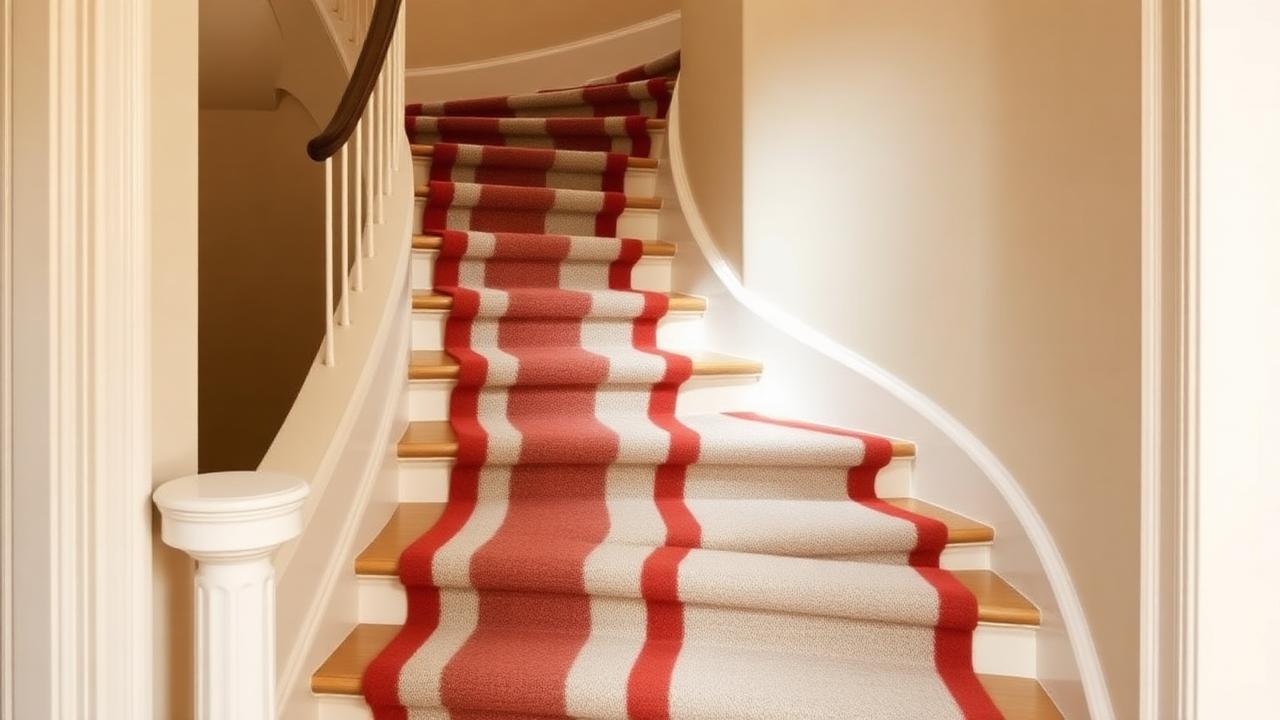
Matching pile height and direction
- Different pile heights create a step edge at the join — a genuine trip point. Use a bar if the difference is over about 4mm.
- Run both piles in the same direction so light hits them the same way; the same carpet laid two ways looks like two colours.
- On patterned goods, line the pattern up at the join even if it costs an extra repeat of material.
Getting the length right
The most common landing mistake is forgetting that the landing surface itself is part of the runner length when the runner continues across it. Measure the landing depth and enter it as a landing in the calculator — it adds the full run plus a tuck allowance and, on patterned runners, an extra repeat for the new piece.
Know your numbers in 30 seconds
Enter your step count, tread depth and riser height — the stair runner calculator gives you the exact length to order, in metres and feet, with waste included.
Open the stair runner calculatorStep-by-step: fitting the join neatly
- Fit the runner up over the top nosing and 5–8cm onto the landing floor.
- Mark a cut line for the runner's landing end at your chosen break point — a door line or the back of the top step zone.
- Bind or overlock the cut edge if it is not already bound.
- Lay the landing carpet and gripper up to that bound edge without overlap.
- Fix each piece independently so either can be replaced later without disturbing the other.
Cost of each transition method
| Method | Typical cost | Best for |
|---|---|---|
| Bound edge to bound edge | £0 extra beyond binding | Most homes, any pile height match |
| Seamed join | £15–£35 / $20–$45 per join | Identical carpet on both sides |
| Transition bar | £10–£40 / $13–$50 per bar | Different pile heights or period brass detailing |
Order the landing carpet with the runner
Buying both pieces at the same time from the same batch avoids a dye-lot mismatch that only shows up once both are laid — a common and entirely avoidable regret.
DIY versus professional for this join
A bound-to-bound butt join is entirely achievable for a confident DIYer with a staple gun and gripper. Hot-melt seaming needs a proper seaming iron and practice, so it is worth paying a fitter for if you want that fully continuous look. Transition bars are the easiest of the three and come with fitting instructions in the box.
Common mistakes at the landing join
- Overlapping the two carpets instead of butting them, creating a trip edge that gets worse over time.
- Choosing a 'close enough' colour match instead of matching exactly or contrasting deliberately.
- Forgetting to include the landing depth when calculating total runner length, leading to an unplanned join in an awkward spot.
- Mixing pile directions so the two carpets catch light differently even when the colour matches.
Choosing the right join method for your situation
| Method | Best for | Skill level | Visible seam? |
|---|---|---|---|
| Butt join with gripper | Matching or near-matching carpets | DIY-friendly | Faint line if done well |
| Hot-melt seam tape | Same fibre type both sides | Needs a seaming iron | Nearly invisible |
| Metal transition bar | Different carpet types or colours | Easiest of all | Visible, but neat |
| Gripper with binding on both edges | Runner meeting a rug-style landing piece | DIY-friendly | Slight ridge |
Step-by-step: a butt join at the landing
- Fit gripper strip right up to the join line on both the stair runner side and the landing carpet side, leaving the standard gap for tucking.
- Cut both edges dead straight with a straight edge and sharp knife, checking square against the wall.
- Fit the landing carpet first, tucking it fully into the gripper up to the join.
- Lay the runner's top end into place, tension it, and press both edges together onto the gripper pins.
- Run a carpet bolster along the seam to bed both edges evenly before final stapling of the runner.
Measuring the landing correctly before you order
The landing depth is one of the most commonly mis-measured parts of a stair project because it is easy to measure the visible floor rather than the true distance the runner needs to travel, including any turn onto the next flight. Measure from the top nosing of the last step, across the full landing, to the point where the runner will stop or turn, and add this figure to your total length calculation rather than treating it as a separate, unrelated piece.
Cost of professional landing joins
| Join type | Typical cost (US) | Typical cost (UK) |
|---|---|---|
| Simple butt join, gripper | $40-80 | £32-64 |
| Hot-melt seam | $60-120 | £48-96 |
| Metal transition bar, supplied and fitted | $25-60 | £20-48 |
Order the landing piece and runner together
Ordering the landing carpet from a different batch or supplier than the runner risks a dye-lot mismatch that only shows up once both are laid side by side. Order both from the same roll wherever possible.
Whatever you decide, get the numbers first: the stair runner calculator doubles as a stair runner length calculator, adding nosing wrap, landings, winders, pattern repeat and waste so you order the right length the first time.
Still deciding on material, width or pattern? Our hub on stair runners compares weaves, widths, backings and fitting styles side by side, then hands the numbers straight to the calculator.
Frequently asked questions
Should a stair runner match the landing carpet?
Either match it exactly or contrast it clearly. A near-match reads as an error, whereas a deliberate contrast reads as a design choice.
Where do you join a stair runner to landing carpet?
Bring the runner over the top nosing and onto the landing, then butt the landing carpet against its bound edge at the back of that top zone or on the door line, fixing each piece independently.
Do you need a transition bar between a runner and landing carpet?
Only if the pile heights differ noticeably — over about 4mm — or you want a defined architectural line. Bound edge to bound edge is neater where pile heights are similar.
Can a stair runner continue across the landing?
Yes, and it looks excellent, but it is fitted as a separate piece on the landing rather than one continuous length. Include the landing depth in your measurements so you order enough.
Can I fit the runner-to-landing join myself?
A bound-edge butt join is straightforward DIY with a staple gun and gripper. Hot-melt seaming for a fully invisible join needs a seaming iron and some practice, so it is often worth hiring a fitter for that specific technique.
How much does a landing transition bar cost?
Typically £10–£40 / $13–$50 depending on finish, with brass and period styles at the upper end. It is the simplest of the three transition methods to fit yourself.
What happens if I order the runner and landing carpet separately?
You risk a dye-lot mismatch that only becomes obvious once both pieces are laid side by side. Order both at the same time from the same batch whenever the design calls for a close match.
Know your numbers in 30 seconds
Enter your step count, tread depth and riser height — the stair runner calculator gives you the exact length to order, in metres and feet, with waste included.
Include the landing in your calculationReady for real prices?
Get quotes from vetted stair runner suppliers and fitters near you. Free, no account, no obligation.
Every guide is written from hands-on measuring and fitting experience, checked against the calculator’s own maths, and re-reviewed whenever prices or methods change. Read our editorial standards.