

First, identify which corner you have
| Turn type | What it is | Runner approach |
|---|---|---|
| Half landing (dog-leg) | A flat square landing between two flights | Separate pieces, joined at the landing |
| Quarter landing | A flat landing at a 90° turn | Separate pieces, join hidden at the back of the landing |
| Winders / pie steps | Wedge-shaped steps that turn as they rise | Individual pieces cut per step |
| Curved / continuous | Sweeping curve with no flat landing | Templated, tapered pieces — specialist work |
The rule that governs every corner
A stair runner is only continuous while the direction of travel is constant. As soon as the stair turns, you are fitting separate pieces — and pieces mean extra length, because every piece needs its own tuck allowance and, on a patterned runner, its own full pattern repeat.
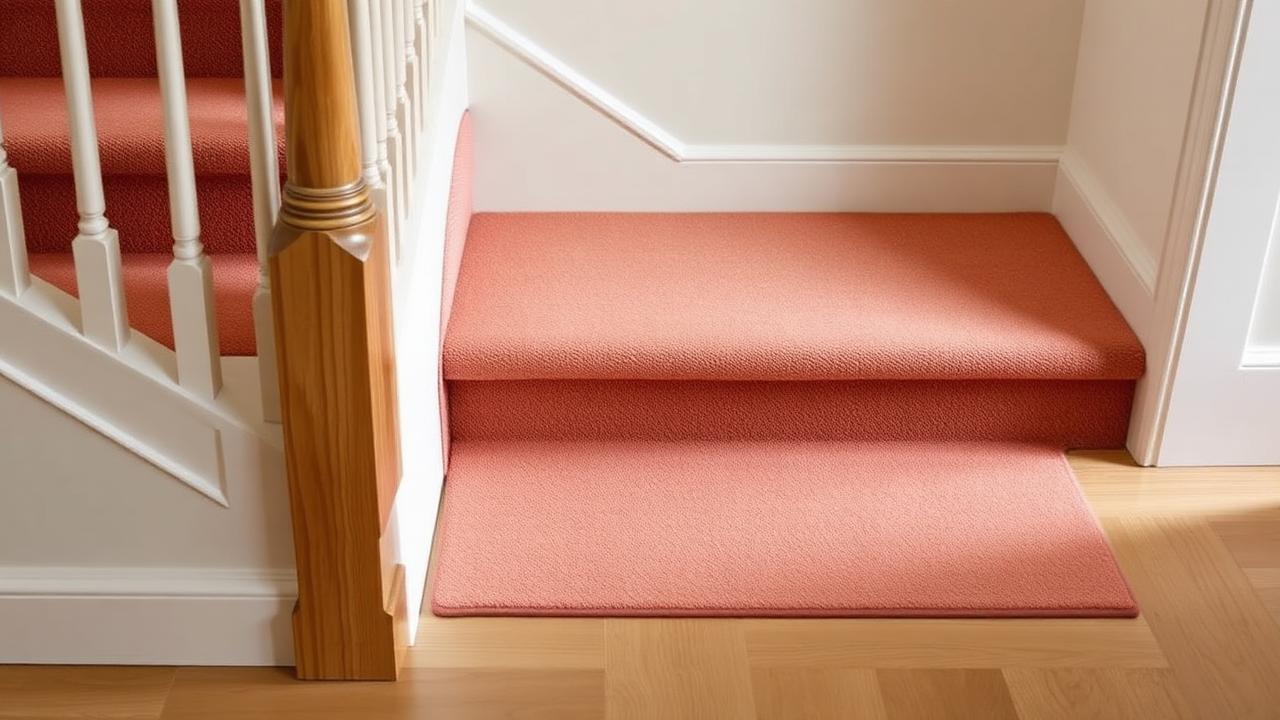
Fitting around a landing turn
- Fit the upper flight first, running the runner down and finishing it at the back of the landing, tucked and stapled into the crease.
- Cut a separate landing piece to cover the landing floor, aligning it with the direction of the lower flight.
- Butt the landing piece against the upper flight's finish, never overlap.
- Run the lower flight piece up onto the landing so it meets the landing piece at the back of the top step, hiding that join in the crease.
- Check the reveal on both flights before fixing anything permanently — turns are where runners drift out of centre.
Fitting winders (pie steps)
Winders are cut individually. The runner cannot be one continuous strip across a wedge, because the inner edge travels far less distance than the outer edge.
- Template each winder in paper or card first — this takes ten minutes and saves metres of carpet.
- Cut each piece with the runner width kept parallel to the walking line, not to the tread edges.
- Fold and tuck the excess on the narrow inside edge into the crease rather than trimming it flush; that fold gives you adjustment.
- Staple the outside edge first, then work in toward the newel.
- Keep the visible width identical on every step — the eye reads width, not geometry.
Patterns around a corner
- Stripes running across the runner are the most forgiving; they simply restart at the landing.
- Stripes running lengthwise must line up on both sides of the turn — measure twice.
- Large geometrics and herringbone need a full extra repeat per piece; order accordingly.
- On winders, accept that a bold pattern will not resolve perfectly. Choose a plain, subtle texture, or a small-scale pattern, for turning staircases.
Extra material to allow
As a rule of thumb, add 10–15cm of tuck allowance per piece, plus one full pattern repeat per piece on patterned goods, plus 5–10% general waste. On a staircase with a half landing and three winders you are looking at five separate pieces — the allowances add up quickly, which is exactly what the calculator's landing and winder fields handle for you.
Know your numbers in 30 seconds
Enter your step count, tread depth and riser height — the stair runner calculator gives you the exact length to order, in metres and feet, with waste included.
Open the stair runner calculatorMeasuring a turning staircase correctly
Measure each flight and each landing separately rather than trying to capture the whole run as one number. On a half-landing staircase that means an upper flight length, a landing depth, and a lower flight length — three figures, not one. On winders, measure each pie step individually at the walking line, roughly two-thirds of the way from the newel post, since that is where the tread depth actually matters for the calculation.
| Turn type | Measurements needed | Typical extra length |
|---|---|---|
| Half landing | Upper flight + landing depth + lower flight | 30–60cm for tuck allowances |
| Quarter landing | Upper flight + landing width + lower flight | 25–50cm |
| 3 winders | Each winder's walking-line depth individually | 60–120cm across all pieces |
| Curved sweep | Templated at 20–30cm intervals | Specialist calculation, allow 15–20% extra |
Template winders even if you are confident
Paper templates cost nothing but ten minutes, and they catch the fact that no two winders on a real staircase are ever quite the same wedge shape — even in a new-build.
DIY versus professional for turning staircases
Half-landing joins are within reach of a competent DIYer, since the geometry is simple — two flat surfaces meeting at a right angle. Winders and curved sweeps are where professional fitting earns its cost. Getting the visible width consistent across a wedge-shaped tread while keeping the walking line comfortable takes practice most homeowners will not get from a single flight. Expect £25–£45 / $32–$58 per winder step from a professional, against 20–40 minutes and real risk of wasted material if attempting it cold.
Keeping the reveal consistent through a turn
- Measure the reveal on the last straight step before the turn and the first straight step after it — they should match.
- On winders, the reveal will vary slightly step to step because the tread shape changes; keep the runner's visible width constant instead of the reveal.
- Use the width calculator against your narrowest winder tread, not the widest straight tread, so the runner fits everywhere.
Common mistakes on turning staircases
- Trying to force one continuous piece around a turn — it puckers at the inside edge and pulls loose within weeks.
- Centring winders on the tread's geometric middle rather than the actual walking line, which looks odd from the hallway.
- Skipping templates to save time, then discovering three winders differ enough that one piece does not fit at all.
- Placing a join on a nosing where footfall lands directly on the seam.
Tools specific to turned staircases
- Cardboard or thin plywood for making individual winder templates.
- A sharp trim knife with plenty of spare blades — winder cuts blunt blades faster than straight cuts.
- A seaming iron or fray-stop sealant for joins at the turn.
- A story pole marked with each step's rise, to keep rod or clip heights consistent through the turn.
Budget extra material for winders
Winders waste more fabric than straight treads because each template is a slightly different shape. Add a full extra step's worth of runner to your order for every three winders in the flight.
Whatever you decide, get the numbers first: the stair runner calculator doubles as a stair runner length calculator, adding nosing wrap, landings, winders, pattern repeat and waste so you order the right length the first time.
Still deciding on material, width or pattern? Our hub on stair runners compares weaves, widths, backings and fitting styles side by side, then hands the numbers straight to the calculator.
Frequently asked questions
Can a stair runner go around a corner in one piece?
No. Once the stair changes direction, the inner and outer edges travel different distances, so the runner is fitted as separate pieces with joins hidden at the back of a tread or landing.
Where should you join a stair runner on a turn?
At the back of a tread or landing, in the crease where the horizontal surface meets the riser. Joins there take no direct footfall and are invisible from below.
How do you fit a runner on winder steps?
Template each pie step, cut a separate piece per step, keep the visible width parallel to the walking line, and tuck the surplus on the narrow inner edge into the crease rather than trimming it flush.
How much extra runner do I need for a turn?
Allow roughly 10–15cm of tuck per separate piece, one extra pattern repeat per piece on patterned runners, and 5–10% general waste on top.
Should I DIY a stair runner turn or hire a fitter?
Half-landing joins are manageable for a confident DIYer since the geometry is simple. Winders and curved sweeps are worth paying a professional for — expect £25–£45 / $32–$58 per winder step, which reflects the skill needed to keep a wedge-shaped tread looking consistent.
How do I measure a staircase with winders for a runner?
Measure each winder individually at the walking line, roughly two-thirds of the way across the tread from the newel post, rather than averaging or measuring only the widest or narrowest step.
Why does my runner pucker on the inside of a turn?
This happens when a single piece is forced around a turn instead of being split into separate pieces. Fit the turn as individual pieces joined at the back of a tread or landing so the inside edge is not under tension it cannot handle.
Know your numbers in 30 seconds
Enter your step count, tread depth and riser height — the stair runner calculator gives you the exact length to order, in metres and feet, with waste included.
Calculate a turning staircaseReady for real prices?
Get quotes from vetted stair runner suppliers and fitters near you. Free, no account, no obligation.
Every guide is written from hands-on measuring and fitting experience, checked against the calculator’s own maths, and re-reviewed whenever prices or methods change. Read our editorial standards.