
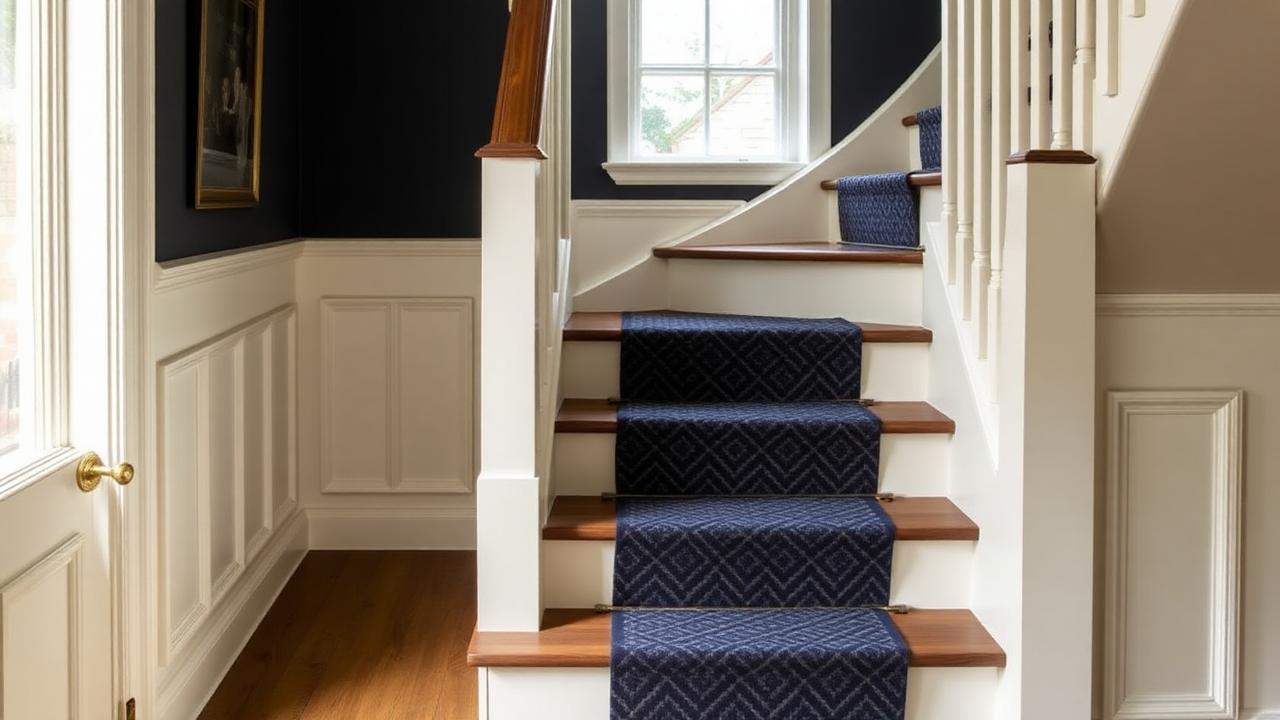
The unique allure of Ikat on stairs
Ikat is a dyeing technique where the yarns are tie-dyed before they are woven, resulting in a characteristic 'blurry' or 'bleeding' edge to the patterns. While true hand-woven Ikats are rare for stair runners, the aesthetic has been widely adopted by modern carpet manufacturers. On a staircase, Ikat patterns provide a sense of movement and energy. The lack of harsh, straight lines (unlike a tartan or a Greek key) makes Ikat very easy to live with; it doesn't 'buzz' in the eyes as much as a high-contrast geometric might. In my years of fitting, I've found that Ikat runners are particularly popular in 'transitional' homes - spaces that blend traditional architecture with modern furniture.
When selecting an Ikat runner, pay attention to the scale of the 'blur'. A fine, small-scale Ikat can look like a textured solid from a distance, whereas a large-scale Ikat with bold splashes of colour creates a dramatic, painterly effect. Because Ikat patterns often feature multiple shades of the same colour, they are fantastic for pulling together different design elements in a hallway. For example, a blue Ikat runner can tie together various shades of blue in your wall art or upholstery. When using a stair runner length calculator, remember that while Ikat is more forgiving of alignment than a stripe, you still want the main motifs to be roughly centered on each tread for the best visual impact.
Masquerading Wear
The 'blurred' nature of Ikat patterns is a secret weapon for high-traffic stairs. Any slight crushing or matting of the pile over time blends into the pattern's own aesthetic, keeping the runner looking new for longer.
Measuring and sizing for Ikat
Calculating the length for an Ikat runner is straightforward, but you should always verify the pattern repeat. Let's look at the US example: 13 steps, 10 inch tread, 7.5 inch riser, plus a 1 inch nosing wrap. This gives 18.5 inches per step. 18.5 x 13 = 240.5 inches (20.04 ft). Adding 2 feet for the top and bottom finishes gives 22.04 ft. For Ikat, I usually recommend a standard 10% waste margin, resulting in a final order of 24.25 feet. If the Ikat design has a very large vertical repeat (over 30 inches), you might want to add an extra 5% to ensure you have enough 'room' to start the pattern at the same point on each flight.
For UK homeowners, the metric calculation for a 13-step flight (25 cm tread, 19 cm riser, 2.5 cm nosing wrap) totals 604.5 cm (6.05 m). Adding a 60 cm finishing allowance brings this to 6.65 m. With a 10% waste margin, your final order should be 7.32 metres. It's always worth double-checking these figures with a professional stair runner calculator before hitting 'buy', especially if your stairs have any unusual features like a decorative bullnose bottom step.
| Measurement Component | US Units | UK Units |
|---|---|---|
| Step Depth (Tread) | 10 in | 25 cm |
| Step Height (Riser) | 7.5 in | 19 cm |
| Nosing Wrap | 1 in | 2.5 cm |
| Length per Step | 18.5 in | 46.5 cm |
| Total for 13 Steps | 20.04 ft | 6.05 m |
| Allowance (Ends) | 2 ft | 0.6 m |
| Total Order (+10% Waste) | 24.25 ft | 7.32 m |
Know your numbers in 30 seconds
Enter your step count, tread depth and riser height — the stair runner calculator gives you the exact length to order, in metres and feet, with waste included.
Open the stair runner calculatorInstallation tips for Ikat patterns
Fitting an Ikat runner is generally less stressful than fitting a rigid geometric like a grid or a diamond pattern. The slightly irregular nature of the pattern means that if your stairs are a quarter-inch out of square, it's very hard to tell. However, you still need to be careful with the 'waterfall' vs. 'Hollywood' installation methods. A waterfall installation (where the carpet falls straight from the nosing to the next tread) works beautifully with Ikat, as it maintains the 'flow' of the blurry pattern. A Hollywood installation (where the carpet is tucked under the nosing) can sometimes break up the Ikat motif in a way that looks a bit disjointed, so I usually recommend the waterfall style for these patterns.

Another tip for Ikat installations is to consider the binding. Because the pattern itself is so busy, a simple, solid-coloured binding in a neutral tone (like tan, grey, or black) can provide a necessary 'frame' that anchors the design. This stops the pattern from feeling like it's 'bleeding' off the edge of the stairs. If you're doing a DIY installation, make sure you have a high-quality carpet tucker to get the runner into the corners tightly. Any looseness in an Ikat runner can cause the pattern to look wavy, which ruins the effect. When you're searching for 'stair runner carpet', check if the manufacturer offers matching binding services to ensure a perfect colour match.
- Choose a high-quality wool-blend for your Ikat runner to ensure the colours remain vibrant for years.
- Ensure the 'blurred' edges of the pattern are oriented vertically to enhance the sense of height in your hallway.
- Use a 9mm or 11mm foam or rubber underlay to provide a plush feel underfoot.
- For the best finish, ensure the runner is centered with an equal amount of wood showing on both sides.
- Avoid using Ikat patterns on very short staircases, as the pattern may not have enough space to fully develop.
Styling and Maintenance
Ikat stair runners are a great way to introduce 'global' style without it feeling like a theme room. They pair excellently with natural materials like oak, walnut, or even painted white stairs. Maintenance is relatively simple: regular vacuuming will prevent grit from wearing down the fibres. If you have a wool Ikat, be careful with harsh chemical cleaners as they can sometimes cause the dyes to bleed - always test a small, hidden area first. The longevity of an Ikat runner is largely dependent on the quality of the weave; look for a high 'row count' or 'pitch' in the technical specs to ensure the pattern is densely packed and resistant to crushing. Ultimately, an Ikat runner is a bold choice that rewards the homeowner with a staircase that feels like a work of art.
Frequently asked questions
What is an Ikat pattern stair runner?
It is a runner featuring a design inspired by the Ikat dyeing technique, characterized by 'blurred' or 'hazy' edges to geometric or organic motifs. It offers a global, artistic look.
Does Ikat hide stains well?
Yes, extremely well. The busy, multi-tonal, and 'blurred' nature of the pattern is excellent at masking small spills, dust, and general wear.
Is Ikat a modern or traditional pattern?
It's both. The technique is ancient, but the aesthetic is very popular in modern and transitional interior design because of its organic feel.
What colours do Ikat runners come in?
Almost any colour. Indigo blues are classic, but you can find Ikats in neutrals, vibrant reds, teals, and multi-coloured palettes.
Can I install an Ikat runner myself?
Yes, Ikat is more forgiving than many other patterns for DIY installation because the lines aren't perfectly straight to begin with.
How much extra should I order for an Ikat runner?
A standard 10% waste margin is usually sufficient, though you should check the pattern repeat for very large designs.
Do I need special underlay for Ikat?
No, a standard high-quality stair underlay is fine. The choice of underlay depends more on the runner's material (wool vs. synthetic) than the pattern.
Will an Ikat runner date quickly?
Ikat has been a design staple for centuries. While its popularity peaks at times, its classic, hand-crafted aesthetic ensures it remains a stylish choice.
Know your numbers in 30 seconds
Enter your step count, tread depth and riser height — the stair runner calculator gives you the exact length to order, in metres and feet, with waste included.
Calculate your Ikat runner lengthReady for real prices?
Get quotes from vetted stair runner suppliers and fitters near you. Free, no account, no obligation.
Every guide is written from hands-on measuring and fitting experience, checked against the calculator’s own maths, and re-reviewed whenever prices or methods change. Read our editorial standards.