
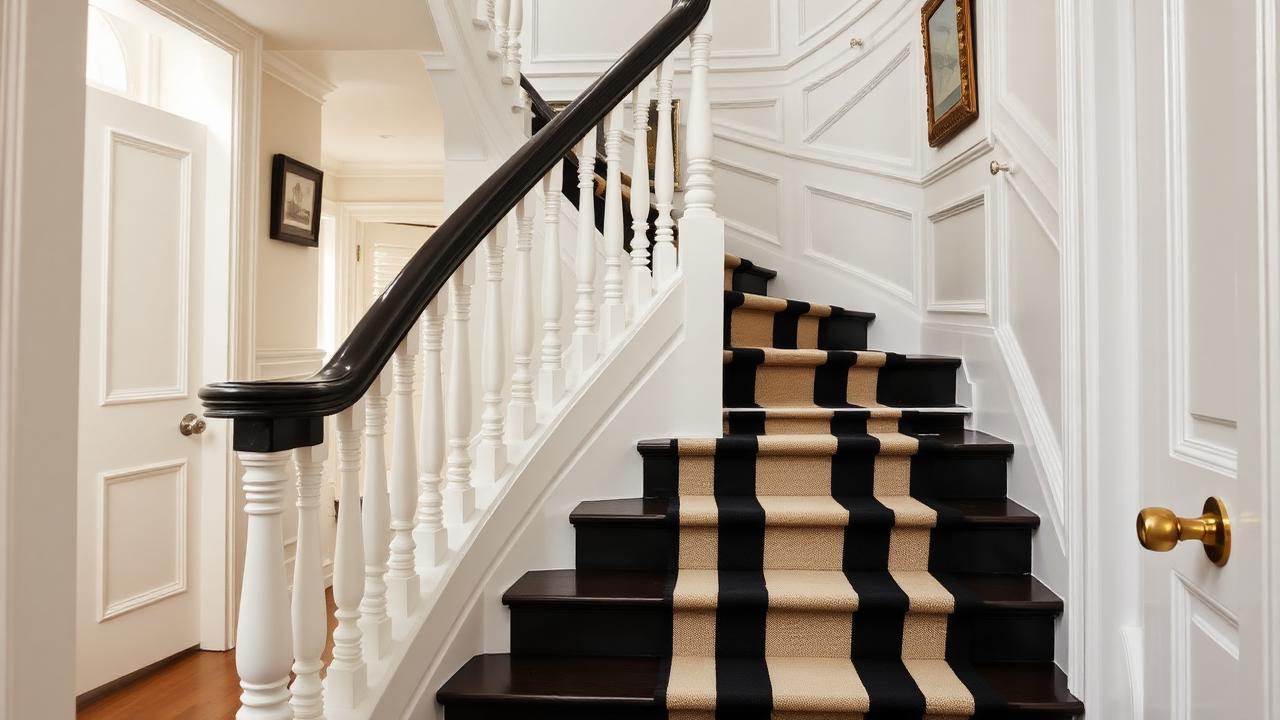
The aesthetic of Moroccan runners on stairs
The 'Moroccan' look in stair runners typically falls into two categories: the plush, shaggy look of a Beni Ourain-inspired pattern or the flat, colourful, geometric look of a Kilim. Both bring an immediate sense of character and warmth to a staircase. In my experience as a fitter, Moroccan patterns are incredibly versatile. A monochrome diamond pattern (classic Beni Ourain style) can look remarkably modern in a minimalist home, while a vibrant, multi-coloured Kilim can be the centerpiece of a traditional Victorian hallway. The key is how the pattern flows down the stairs. Unlike a strict stripe, the slightly irregular, hand-drawn feel of many Moroccan patterns is very forgiving of older, slightly 'wonky' staircases.
When choosing a Moroccan runner, consider the texture. A high-low pile, where the pattern is raised above the background, adds a wonderful tactile dimension to the stairs. However, be aware that very shaggy Moroccan-style carpets can be a bit of a trip hazard if not fitted correctly with a firm underlay. If you prefer a flatter profile, look for 'flatweave' Moroccan runners. These are often made from wool or a cotton-wool blend and are very durable, though they can be a bit 'lively' underfoot (meaning they shift more easily) so they must be secured tightly with a high-quality stair runner calculator helping you determine the exact amount of fixing material needed.
Authenticity vs. Practicality
While authentic hand-knotted Moroccan rugs are beautiful, for stairs, it is often better to choose a 'runner-by-the-roll' that mimics the Moroccan aesthetic. These are designed with the necessary structural integrity for the high-tension environment of a staircase.
How much runner do I need?
Sizing a Moroccan runner involves checking both the length and the width. Most Moroccan-style runners are slightly narrower than standard broadloom-cut runners, often coming in at 60cm to 66cm (approx. 24-26 inches). Let's work through the length for a US home: 13 steps with a 10 inch tread and a 7.5 inch riser. Adding a 1 inch nosing wrap gives 18.5 inches per step. 18.5 x 13 = 240.5 inches (20.04 ft). Add 1 foot at the top and 1 foot at the bottom for securement, bringing the total to 22.04 ft. With a 10% waste margin, you need to order 24.25 feet.
In the UK, with 25 cm treads and 19 cm risers, plus a 2.5 cm nosing wrap, you get 46.5 cm per step. For 13 steps, that is 604.5 cm (6.05 m). Add 60 cm for the start and finish allowances to get 664.5 cm (6.65 m). With a 10% waste margin, the final order is 7.32 metres. If the Moroccan pattern has a very large, distinct diamond repeat, I sometimes suggest adding an extra 5% (15% total waste) to ensure the diamonds are perfectly centered on the main treads of the flight. This level of detail is what separates a good fit from a great one.
| Step Component | US (in/ft) | UK (cm/m) |
|---|---|---|
| Tread & Riser | 17.5 in | 44 cm |
| Nosing Wrap | 1 in | 2.5 cm |
| Per Step Total | 18.5 in | 46.5 cm |
| 13 Step Total | 20.04 ft | 6.05 m |
| Finishing Margin | 2 ft | 0.6 m |
| Total (Pre-Waste) | 22.04 ft | 6.65 m |
| Order (10% Waste) | 24.25 ft | 7.32 m |
Know your numbers in 30 seconds
Enter your step count, tread depth and riser height — the stair runner calculator gives you the exact length to order, in metres and feet, with waste included.
Open the stair runner calculatorInstallation tips for Moroccan flatweaves
Many Moroccan style runners are flatwoven, which presents unique challenges for the fitter. Unlike tufted carpet, flatweaves have no 'face' pile to hide staples or tack strips. When I install a Moroccan flatweave, I use 'micro-tack' strips and a very fine-gauge staple gun to ensure the fixings are invisible. It is also vital to use a rubber-based, non-slip underlay that is specifically rated for stairs. This 'grabs' the flatweave from underneath and prevents it from 'puckering' or 'rucking' over time. If you are fitting a Beni Ourain style runner with a thicker pile, you may need to 'shear' a tiny bit of the pile where it meets the tack strip to ensure a flat, secure fit that won't trip people up.

The edges of Moroccan runners are often their most beautiful feature, sometimes including a contrasting fringe or a hand-sewn whip-stitch. If your runner has a fringe, DO NOT wrap the fringe around the bottom step - it looks messy and will wear out in weeks. Instead, have the fringe removed and the edge bound, or stop the runner just before the floor and use a tidy metal binder bar. For the sides, if the runner is a 'true' Moroccan rug cut into a runner, ensure the edges are properly overcast (sewn) to prevent the weave from unraveling. Search for 'stair runners' online to see how different edge treatments can drastically change the look of a Moroccan installation.
- Select a low-profile, high-density rubber underlay to provide stability for flatwoven Moroccan runners.
- Ensure the geometric 'diamonds' are centered on the stair treads for a balanced look.
- Consider using 'antique' finish stair rods to complement the rustic, handcrafted feel of Moroccan patterns.
- Be careful with vacuuming; use a suction-only setting for flatweaves to avoid pulling at the fibres.
- For winding stairs, consider a 'turn and tuck' method to keep the geometric pattern looking coherent through the curves.
Durability and Cleaning
Moroccan wool runners are surprisingly durable. Wool naturally contains lanolin, which acts as a stain repellent. However, the lighter colours common in Beni Ourain styles (creams and whites) will show 'traffic paths' more quickly than a darker Kilim. I always advise clients to have their Moroccan runner professionally cleaned every 18 to 24 months to keep the whites looking bright. For everyday maintenance, a light vacuuming is all that's needed. If you have chosen a cotton-based Moroccan runner, be aware that it will not have the same 'bounce back' as wool and may show wear on the stair nosings within a few years. When browsing for your next project, look for 'stair runner carpet' options that specifically mention wool content for the best long-term results.
Whatever you decide, get the numbers first: the stair runner calculator doubles as a stair runner length calculator, adding nosing wrap, landings, winders, pattern repeat and waste so you order the right length the first time.
Frequently asked questions
What is a Moroccan stair runner?
It is a runner that features patterns or textures inspired by Moroccan rug-making traditions, such as geometric Beni Ourain diamonds or colourful Kilim weaves. They are known for their global, bohemian aesthetic.
Are Moroccan runners good for high-traffic stairs?
Wool Moroccan runners are very durable, but the lighter-coloured versions can show dirt more easily. Flatwoven Kilims are excellent for high-traffic areas as they don't have a pile that can be crushed.
Can I use a real Moroccan rug as a stair runner?
You can, but it must be a specific 'runner' size and have a stable enough weave to handle being stretched over stairs. Often, purpose-made runners with a Moroccan design are more practical for installation.
Do Moroccan runners work in modern homes?
Yes, they are a favourite among modern interior designers. A monochrome Moroccan runner adds warmth and texture to a minimalist space without introducing too much visual noise.
What underlay do I need for a Moroccan flatweave?
A firm, non-slip rubber underlay is essential. This prevents the thin flatweave from moving or stretching, which is vital for safety on a staircase.
How do I calculate the length for a Moroccan runner?
Measure the tread, riser, and nosing wrap, multiply by the number of steps, and add at least 10% for waste and finishing. Use a dedicated stair runner calculator for the most accurate results.
Do Moroccan runners have fringes?
Some do, but fringes are generally not recommended for stairs as they can be a trip hazard and wear out quickly. Most fitters recommend binding the ends instead.
Are Moroccan style runners expensive?
Prices vary wildly. Machine-made synthetic Moroccan-style runners are very affordable, while hand-woven wool versions can be a significant investment but will last much longer.
Know your numbers in 30 seconds
Enter your step count, tread depth and riser height — the stair runner calculator gives you the exact length to order, in metres and feet, with waste included.
Measure your Moroccan runnerReady for real prices?
Get quotes from vetted stair runner suppliers and fitters near you. Free, no account, no obligation.
Every guide is written from hands-on measuring and fitting experience, checked against the calculator’s own maths, and re-reviewed whenever prices or methods change. Read our editorial standards.