
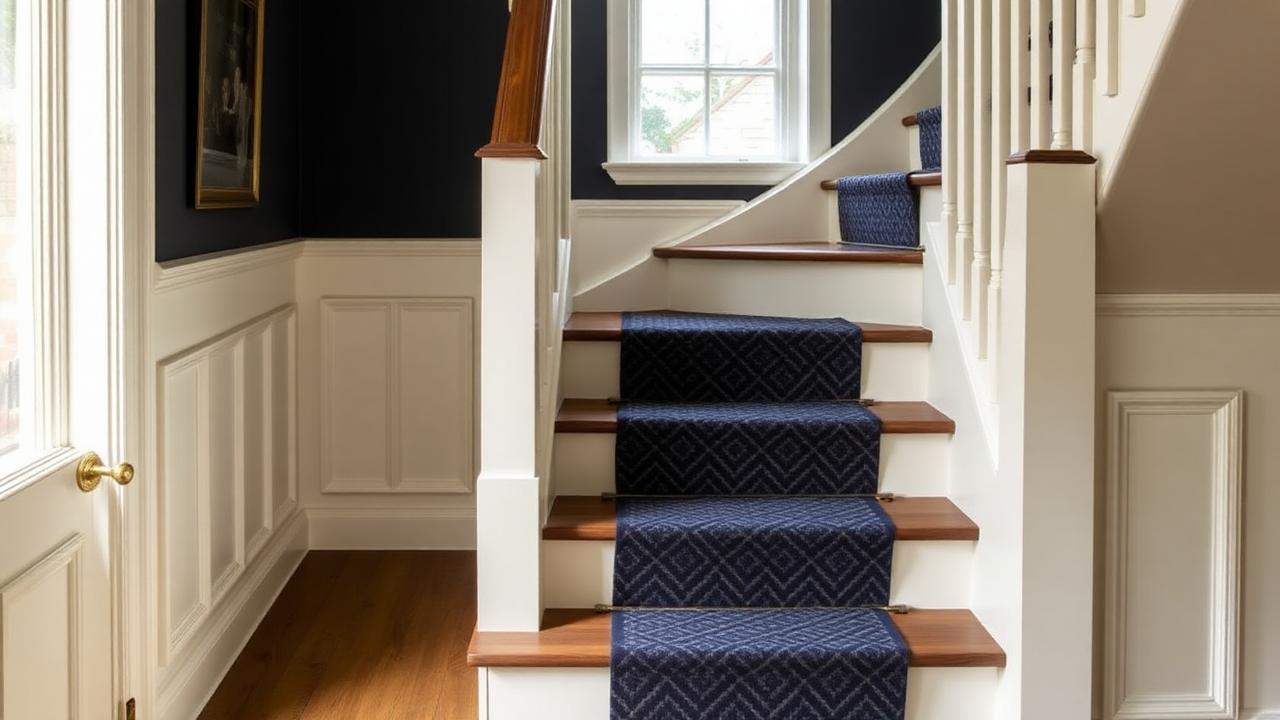
Why leopard print endures
Leopard print has been a staple of interior design for decades because it behaves like a neutral in practice, even though it looks bold on the roll. Its warm tan and black tones pick up wood, brass, and gold accents easily, which is why it works equally well in a Victorian townhouse hallway and a modern open-plan entryway.
On stairs specifically, a leopard stair runner has a practical advantage: the broken, irregular spots disguise everyday dirt, pet hair, and light scuffing far better than a plain colour, making it a smart choice for busy households as well as a stylish one.
Choosing the right leopard print
Leopard prints vary significantly in scale and colour saturation. A classic warm tan-and-black print suits traditional interiors, while a greyscale or muted taupe leopard print reads as more contemporary and works better against cool-toned walls. Check the print repeat carefully on a sample - a large-scale print can look disjointed if it is chopped awkwardly at the nosing of each step.
How much stair runner do I need?
For a 13-step flight: 10 in tread + 7.5 in riser + 0.75 in nosing wrap = 18.25 in per step. Across 13 steps, that is 237.25 in, plus about 24 in of finishing allowance gives 261.25 in, or 21.77 ft. Because patterned runners like leopard print often need a slightly larger waste margin for matching, add 10% and order around 24 ft. In metric: 25 cm + 19 cm + 1.9 cm = 45.9 cm per step, times 13 is 596.7 cm, plus 60 cm finishing is 656.7 cm, plus 10% waste is about 7.3 m.
| Step | US (in/ft) | UK (cm/m) |
|---|---|---|
| Per-step total | 18.25 in | 45.9 cm |
| 13 steps | 19.77 ft | 5.97 m |
| Finishing | 21.77 ft | 6.57 m |
| With 10% waste | 24 ft | 7.3 m |
Know your numbers in 30 seconds
Enter your step count, tread depth and riser height — the stair runner calculator gives you the exact length to order, in metres and feet, with waste included.
Open the stair runner calculatorCheck the base colour, not just the print
Leopard prints come on different base tones - cream, tan, grey, even black. The base colour affects how the runner reads in your specific hallway lighting far more than the print itself.
Fibre choice for a busy staircase
A leopard stair runner in a dense, heat-set nylon will hold its shape and colour far longer than a thin printed synthetic. Wool-blend leopard prints are also widely available and offer a softer, more luxurious underfoot feel, though they typically cost more than a synthetic equivalent.
Pairing with hardware and walls
Brass stair rods are the classic pairing with a warm-toned leopard runner, echoing the tan and gold undertones in the print. For a cooler, greyscale leopard print, matte black or pewter rods create a more modern finish. Keep wall colours simple - warm white, soft grey, or a deep charcoal all let the print take centre stage without competing for attention.
Checking the spec sheet before ordering
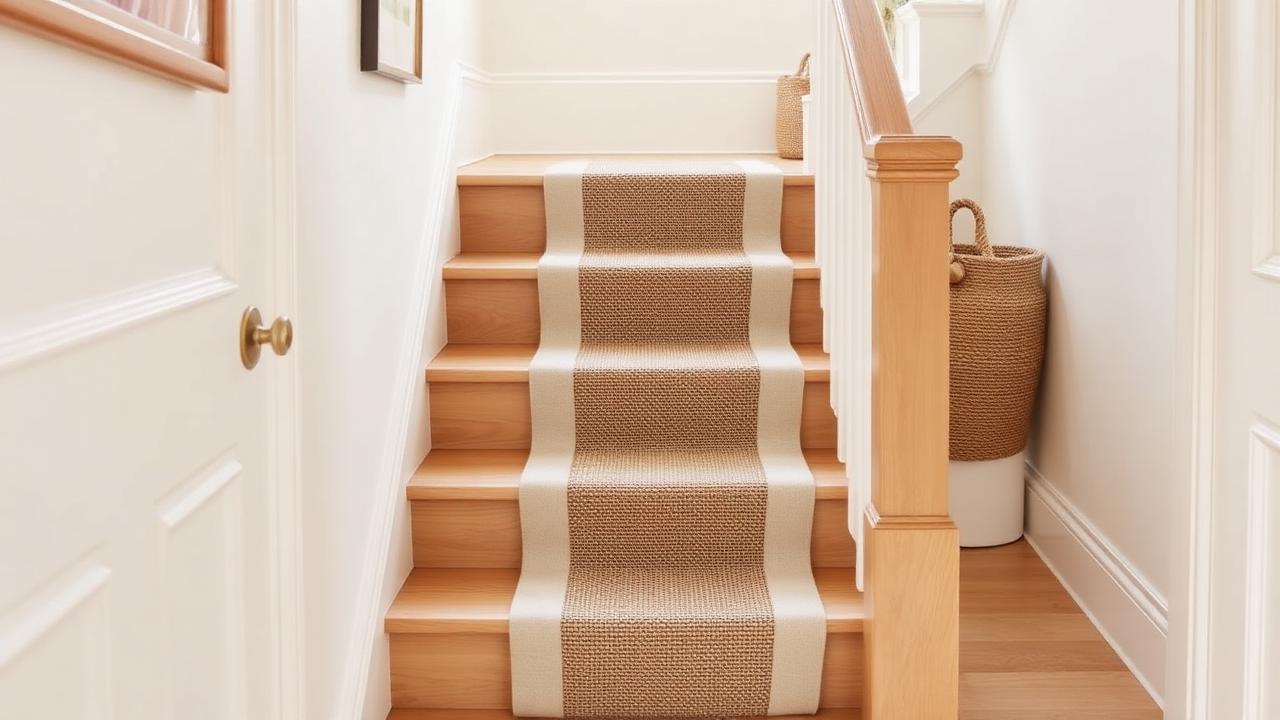
Ask your supplier for three specific numbers before committing to a leopard stair runner: pile height (0.25-0.5 in / 6-13 mm is typical for stairs), face weight, and pattern repeat length. A short, tight repeat - typically 4-8 in (10-20 cm) - reads more cleanly across a standard 10 in (25 cm) tread than a large, sprawling repeat of 12 in (30 cm) or more, which is more likely to get visually chopped at the nosing on every second or third step.
Also confirm whether the base fabric is pre-shrunk and whether the dye is fixed against wet cleaning, since leopard prints with a cream or tan base can be prone to slight bleeding if cleaned with the wrong product. A reputable supplier will confirm this in writing or on the product spec sheet rather than leaving you to test it on the finished installation.
Fitting sequence for a printed leopard runner
- Dry-lay the full length to check the repeat falls evenly across all 13 steps
- Mark the centre line of the runner and the centre line of the stairs to keep it straight
- Fit gripper rods and underlay per step before laying the runner
- Work from the top down, checking pattern alignment every 3-4 steps
- Bind or finish all cut edges immediately, especially at the top and bottom
Cost bands for a leopard stair runner
| Fibre type | US per ft | UK per m |
|---|---|---|
| Printed polypropylene | $18-26 | £40-58 |
| Heat-set nylon print | $28-42 | £62-90 |
| Wool-blend woven leopard | $42-60 | £95-130 |
For the 24 ft (7.3 m) needed on a standard 13-step flight, that puts material cost at roughly $430-625 for polypropylene, $670-1,010 for nylon, or $1,010-1,440 for a wool-blend woven leopard print. Fitting typically adds $250-450 in the US or £180-320 in the UK for a straight run with no winders.
Maintenance to keep the print looking crisp
Vacuum weekly using a brush head rather than a beater bar if the runner is wool-blend, since beater bars can pull and fuzz natural fibres over time. Treat spills immediately, blotting rather than rubbing, and have the runner professionally cleaned every 12-18 months on a busy staircase. Check the top three steps every few months for early signs of pile crushing, since these take the most repeated pressure from foot traffic and will show wear before the rest of the flight.
Whatever you decide, get the numbers first: the stair runner calculator doubles as a stair runner length calculator, adding nosing wrap, landings, winders, pattern repeat and waste so you order the right length the first time.
Still deciding on material, width or pattern? Our hub on stair runners compares weaves, widths, backings and fitting styles side by side, then hands the numbers straight to the calculator.
Frequently asked questions
Is leopard print stair runner still fashionable?
Yes, it remains one of the most consistently popular patterned choices for stairs across design eras.
Does leopard print hide dirt well?
Yes, the broken, irregular pattern is very forgiving of everyday marks and pet hair.
What is the best fibre for a leopard stair runner?
A dense heat-set nylon offers the best balance of durability and print clarity for high-traffic stairs.
Can I use leopard print on a small staircase?
Yes, though a smaller-scale print will look more proportionate on a narrow or short flight.
Should I match the runner colour to my walls?
No, leopard print works best as a contrast feature against relatively neutral walls.
Does the print need to align on winders?
Ask your fitter to check pattern flow on any winders, as large motifs can distort on tight turns.
How do I clean a leopard print stair runner?
Vacuum regularly and treat any spills immediately using a cleaner suited to the specific fibre.
Will leopard print date my hallway?
It is considered a design classic rather than a passing trend, so it is unlikely to feel dated quickly.
Know your numbers in 30 seconds
Enter your step count, tread depth and riser height — the stair runner calculator gives you the exact length to order, in metres and feet, with waste included.
Size your flight with the stair runner calculatorReady for real prices?
Get quotes from vetted stair runner suppliers and fitters near you. Free, no account, no obligation.
Every guide is written from hands-on measuring and fitting experience, checked against the calculator’s own maths, and re-reviewed whenever prices or methods change. Read our editorial standards.