

Why long flights need extra planning
A long staircase, whether it's a tall single flight in a period home or a run that includes a half-landing, needs more than just a bigger number typed into a calculator. Most carpet comes on rolls of a fixed maximum length, often around 12-15 m (39-49 ft) depending on the supplier and fiber type. If your total requirement exceeds the roll length, or if the supplier's standard roll for your chosen product is shorter, you'll need to plan a seam, usually placed at a landing or half-landing where it can be hidden or minimized visually.
Calculating a long, straight flight
The formula scales directly with step count. Per-step total = tread + riser + nosing wrap. For US measurements: 10 in + 7.5 in + 0.75 in = 18.25 in per step. For a 20-step flight, that's 365 in. Add a 24 in finishing allowance for the top and bottom, giving 389 in, or 32.4 ft. With an 8-10% waste margin, order roughly 35-36 ft. Metric: 25 + 19 + 1.9 cm = 45.9 cm per step, times 20 steps = 918 cm, plus 60 cm finishing = 978 cm (9.78 m), plus waste, roughly 10.5-11 m.
| Step count | US length (with waste) | UK length (with waste) |
|---|---|---|
| 13 steps | 23.5-24 ft | 7-7.3 m |
| 16 steps | 28-29 ft | 8.6-8.9 m |
| 20 steps | 35-36 ft | 10.4-11 m |
| 24 steps | 41.5-43 ft | 12.7-13.1 m |
Know your numbers in 30 seconds
Enter your step count, tread depth and riser height — the stair runner calculator gives you the exact length to order, in metres and feet, with waste included.
Open the stair runner calculatorFlights with landings and turns
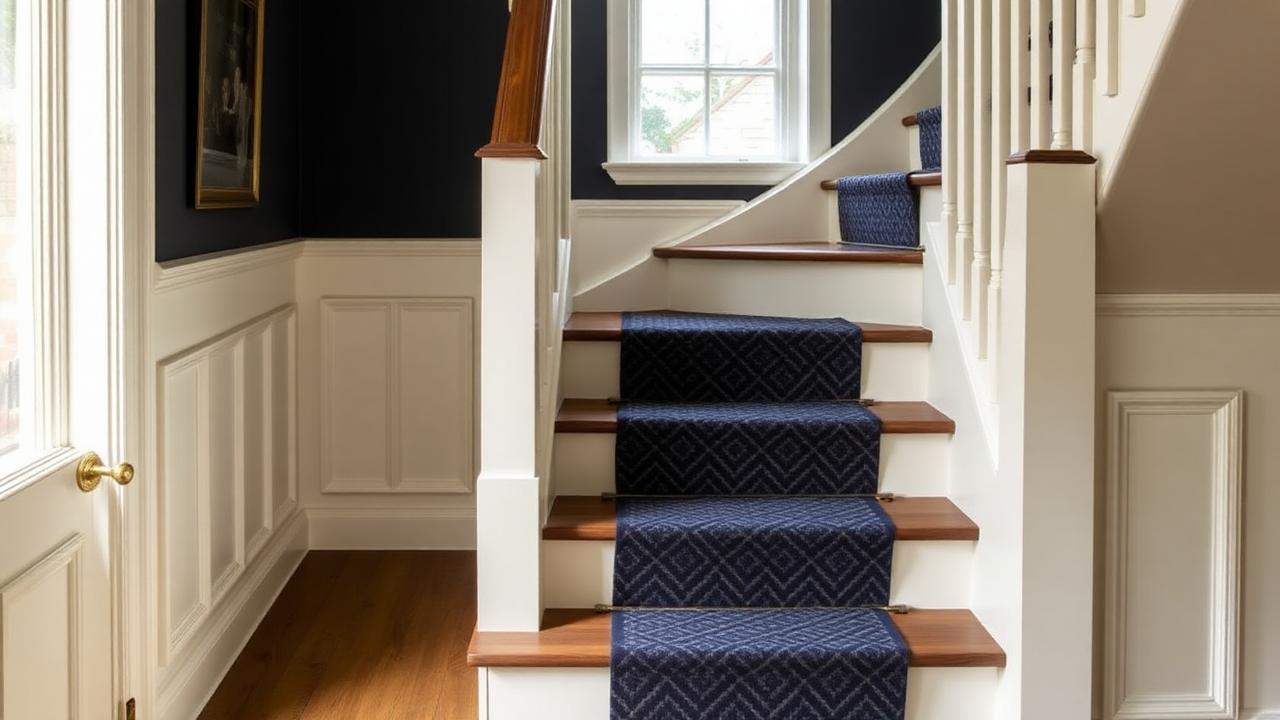
Long staircases very often include a half-landing or a turn partway up. Measure each straight section separately using the per-step formula, then measure the landing area itself as a flat length (its depth, typically 36-48 in / 91-122 cm, added once per landing). Sum all sections together, then apply your waste margin to the total. Winders or curved sections need individual measurement at the narrow and wide points, since a single average figure isn't accurate enough for cutting.
Plan your seam location
If your total run exceeds a single roll's length, work with your fitter to place any necessary seam at a landing rather than mid-flight. Seams on a landing are far less visible and don't interrupt the visual flow of a patterned runner.
Ordering considerations for long runs
Because long runners use significantly more material, small measurement errors compound quickly. A 2% shortfall on a 13-step flight might mean half a foot of missing carpet, an easily fixed problem; the same 2% error on a 24-step flight can mean nearly a foot short, which could force a costly reorder and delay. Always double, and ideally triple, check your measurements before placing a large order, and lean on the higher end of your waste margin (10% rather than 8%) for long or complex runs.
- Measure each straight section and landing separately, then total them.
- Use a 10% waste margin rather than 8% for long or multi-section flights.
- Confirm your chosen product's maximum roll length before ordering.
- Plan seam locations at landings, not mid-flight.
- Get a professional measure for anything beyond a simple straight run.
Choosing fiber for long, high-use flights
Long staircases are often the primary route through multi-story homes and see significant daily traffic. A dense nylon or wool-blend fiber will hold up far better over a long run than a lightweight or loosely-woven option, and the investment is worthwhile given the larger quantity of material and installation labor involved.
Budgeting for a long flight
Because long flights use significantly more yardage, material cost scales up quickly, and it pays to shop by total project cost rather than per-foot price alone. A mid-range nylon or wool-blend runner at 35 to 55 USD (28 to 44 GBP) per linear foot, applied to a 20-step flight needing roughly 35-36 ft (10.4-11 m), puts material cost in the 1,225 to 1,980 USD (980 to 1,580 GBP) range before underlay, fitting, and any seam allowance. Fitting labor for a long or multi-section flight also runs higher than a short straight run, typically 500 to 1,100 USD (400 to 880 GBP), since more time is needed for pattern alignment, seaming, and securing gripper rods at each landing.
If your flight includes a seam, ask your fitter for a dedicated seam allowance on top of the base calculation, usually an extra 6 to 12 in (15 to 30 cm) of material per seam so the two pieces can be aligned and trimmed precisely rather than forced together with insufficient overlap.
A worked example for a 24-step flight with one landing
Say your staircase has 24 steps split into two runs of 12 steps each, joined by a landing 42 in (107 cm) deep. Each run: 10 in tread + 7.5 in riser + 0.75 in nosing wrap = 18.25 in per step, times 12 = 219 in. Two runs = 438 in. Add the landing depth once, 42 in, plus a 24 in finishing allowance at top and bottom = 504 in (42 ft). With a 10% waste and seam margin, order roughly 46 ft. Metric: each run is 45.9 cm x 12 = 550.8 cm, two runs = 1,101.6 cm, plus 107 cm landing, plus 60 cm finishing = 1,268.6 cm (12.7 m), plus waste, roughly 14 m.
| Flight config | US length (with waste) | UK length (with waste) |
|---|---|---|
| 13 straight steps | 23.5-24 ft | 7-7.3 m |
| 20 straight steps | 35-36 ft | 10.4-11 m |
| 24 steps + 1 landing | 45-46 ft | 13.7-14 m |
- Add 6-12 in (15-30 cm) of extra material per planned seam for precise alignment.
- Budget 500-1,100 USD in fitting labor for long or multi-section flights.
- Price by total project cost, not just per-foot material rate, when comparing suppliers.
- Measure each straight run and landing separately for the most accurate total.
- Get a written quote that itemizes material, underlay, labor, and seam allowance separately.
Whatever you decide, get the numbers first: the stair runner calculator doubles as a stair runner length calculator, adding nosing wrap, landings, winders, pattern repeat and waste so you order the right length the first time.
Still deciding on material, width or pattern? Our hub on stair runners compares weaves, widths, backings and fitting styles side by side, then hands the numbers straight to the calculator.
Frequently asked questions
How much runner do I need for a 20-step staircase?
Roughly 35-36 ft (10.4-11 m), including nosing wrap, finishing allowance, and an 8-10% waste margin.
Do long runners need a seam?
Only if the total length exceeds the maximum roll length of your chosen product; check with your supplier before ordering.
Where should a seam be placed?
Ideally at a landing or half-landing, where it's far less visible than a seam mid-flight.
Should I measure landings separately?
Yes, measure each straight run of steps and each landing separately, then total them together.
Is a higher waste margin needed for long flights?
Yes, use around 10% rather than 8%, since measurement errors compound more significantly over longer lengths.
What fiber is best for a long, busy staircase?
A dense nylon or wool-blend fiber holds up best under sustained daily traffic on long flights.
Can I use the stair runner calculator for multi-section flights?
Yes, calculate each section individually and sum the results for your total order length.
Is professional measuring recommended for long staircases?
Strongly recommended, especially if the flight includes landings, turns, or winders, since errors are costlier at scale.
Know your numbers in 30 seconds
Enter your step count, tread depth and riser height — the stair runner calculator gives you the exact length to order, in metres and feet, with waste included.
Calculate your long flight with the stair runner calculatorReady for real prices?
Get quotes from vetted stair runner suppliers and fitters near you. Free, no account, no obligation.
Every guide is written from hands-on measuring and fitting experience, checked against the calculator’s own maths, and re-reviewed whenever prices or methods change. Read our editorial standards.