
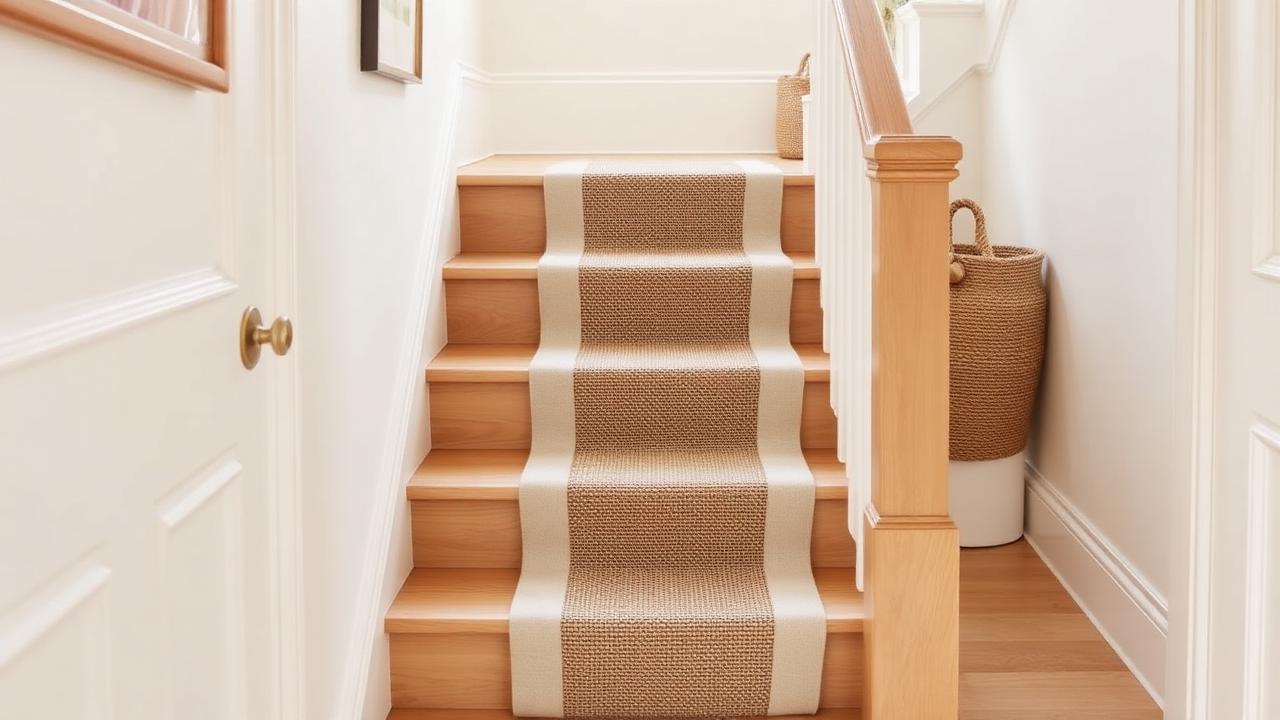
The Moroccan berber look
Traditional Moroccan berber rugs and runners are known for their bold geometric diamond motifs, often in cream or ivory with black or dark brown accents, though modern reproductions come in many colourways. Authentic Moroccan runners are typically hand-knotted or hand-woven, giving each piece slight irregularities that add to its character. Machine-made reproductions offer the same visual style at a lower price point and with more consistent sizing, which can be a practical advantage for stair use.
When shopping, decide early whether you want a genuine handmade Moroccan piece or a machine-woven interpretation. Handmade runners are usually one-off lengths, which can make it harder to find an exact fit for a long staircase, whereas machine-made versions are typically available custom cut to length from a broadloom roll.
Pattern scale and stair fit
Because Moroccan diamond patterns repeat at a fixed interval, it is important to check the repeat size against your tread depth. A large-scale diamond pattern can look stunning but may only show a partial motif on some steps if the repeat does not divide evenly into your total run. Ask your supplier for the exact pattern repeat measurement so you or your fitter can plan the cut to centre the pattern as evenly as possible down the flight.
How much runner do I need?
For a 13-step flight in US units: 10 in tread + 7.5 in riser + 0.75 in nosing wrap = 18.25 in per step. Across 13 steps this totals 237.25 in, plus 24 in finishing allowance gives 261.25 in, or 21.77 ft. Because pattern matching often requires extra length, add a 10-12% waste margin, bringing your order to roughly 24-24.5 ft. In metric: 25 cm + 19 cm + 1.9 cm = 45.9 cm per step, 13 steps totals 596.7 cm, plus 60 cm finishing equals 656.7 cm, and with a pattern-matching waste margin, around 7.3-7.5 m.
| Item | US (in/ft) | UK (cm/m) |
|---|---|---|
| Per-step total | 18.25 in | 45.9 cm |
| 13 steps | 19.77 ft | 5.97 m |
| With finishing | 21.77 ft | 6.57 m |
| With pattern-match waste | 24-24.5 ft | 7.3-7.5 m |
Know your numbers in 30 seconds
Enter your step count, tread depth and riser height — the stair runner calculator gives you the exact length to order, in metres and feet, with waste included.
Open the stair runner calculatorFibre and construction
Most Moroccan-style runners are made from wool, which suits the traditional look and offers good durability, though flatter kilim-style weaves are also common and provide a thinner, more casual profile. A thicker, plush berber-style Moroccan runner will need a slightly firmer underlay to prevent excessive compression at the nosing edge of each stair.

- Decide between handmade and machine-made before searching for length options.
- Check pattern repeat size against your tread depth.
- Choose wool for durability and authenticity, or a flatter weave for a casual look.
- Order extra length if pattern matching is important to you.
Colour variation is normal
Genuine Moroccan-style wool runners often show gentle colour variation across the length, which is a hallmark of the style rather than a fault.
Worked example with a larger pattern repeat
Suppose your chosen Moroccan diamond design has a repeat of 14 in (35.5 cm). Across a 13-step flight totalling roughly 261.25 in (663.6 cm) before waste, that repeat divides in just over 18 times, meaning at least one step is likely to show a partial motif unless extra length is ordered to shift the starting point. Adding a 12% margin, around 31 in (79 cm) of extra length, gives your fitter enough room to reposition the cut so the partial repeat lands at the very top of the flight, under the landing nosing, rather than on a prominent step.
Checking colourfastness and light exposure
Staircases near windows, skylights, or glazed front doors can receive more direct sunlight than other parts of the home, which accelerates fading in wool runners over time, particularly in darker traditional colourways. If your stairwell gets strong afternoon sun, ask your supplier about colourfastness treatments or consider a runner with a slightly more UV-resistant fibre blend.
| Pattern repeat | Recommended waste margin | Approx. extra length (13 steps) |
|---|---|---|
| Under 6 in (15 cm) | 8-10% | 1.7-2.2 ft (0.5-0.7 m) |
| 6-12 in (15-30 cm) | 10-12% | 2.2-2.6 ft (0.7-0.8 m) |
| Over 12 in (30 cm) | 12-15% | 2.6-3.3 ft (0.8-1 m) |
Cost expectations
Authentic hand-knotted Moroccan runners typically command a significant premium over machine-made reproductions of similar size, reflecting the labour involved in traditional weaving. Machine-made wool or wool-blend versions offer a genuinely similar look at a fraction of the cost and are usually the more practical choice for a full staircase run, reserving handmade pieces for smaller accent rugs elsewhere in the home.
- Confirm the exact pattern repeat in inches or centimetres before ordering.
- Increase your waste margin for repeats over 12 in (30 cm) to allow flexible cut placement.
- Ask about colourfastness if your staircase receives direct sunlight.
- Compare handmade versus machine-made pricing before committing to a full flight length.
Maintenance for a patterned wool runner
Vacuum regularly using a setting suited to a plush or looped wool pile, and have the runner professionally cleaned by a specialist familiar with wool and natural dyes, since some traditional dye methods can be more sensitive to harsh cleaning chemicals than synthetic alternatives. Rotate any loose accent rugs at the base of the stairs periodically to even out sun exposure and foot traffic wear.
Overall, a Moroccan berber stair runner adds warmth and pattern to a staircase but requires a little extra planning around pattern repeat and fibre choice. Take accurate measurements, confirm the repeat with your supplier, and always allow extra length for pattern matching.
Whatever you decide, get the numbers first: the stair runner calculator doubles as a stair runner length calculator, adding nosing wrap, landings, winders, pattern repeat and waste so you order the right length the first time.
Still deciding on material, width or pattern? Our hub on stair runners compares weaves, widths, backings and fitting styles side by side, then hands the numbers straight to the calculator.
Frequently asked questions
What defines a Moroccan berber pattern?
Bold geometric diamond or lozenge motifs, traditionally in cream and black or brown, originating from Berber weaving traditions in Morocco.
Are Moroccan runners handmade?
Authentic pieces often are, though many modern reproductions are machine-woven and available custom cut to length.
How much extra length do I need for pattern matching?
Allow a 10-12% waste margin above your basic measurement to accommodate centring the pattern repeat evenly.
What fibre is best for a Moroccan-style runner?
Wool is the traditional and most durable choice, though flatter kilim-style weaves in cotton or wool blends are also popular.
How much runner do I need for 13 steps?
Roughly 24-24.5 ft (7.3-7.5 m) once pattern matching, nosing wrap, and finishing allowances are included.
Will colour vary along the runner?
Some gentle variation is normal and expected in authentic wool weaves, adding to the handcrafted character.
Can I get a Moroccan pattern in any colour?
Machine-made reproductions are widely available in many colourways beyond the traditional cream and black.
Do I need special underlay for a thick berber weave?
A firmer underlay is often recommended to support a plush pile and prevent excessive compression at the nosing.
Know your numbers in 30 seconds
Enter your step count, tread depth and riser height — the stair runner calculator gives you the exact length to order, in metres and feet, with waste included.
Check your total length with the stair runner calculatorReady for real prices?
Get quotes from vetted stair runner suppliers and fitters near you. Free, no account, no obligation.
Every guide is written from hands-on measuring and fitting experience, checked against the calculator’s own maths, and re-reviewed whenever prices or methods change. Read our editorial standards.