
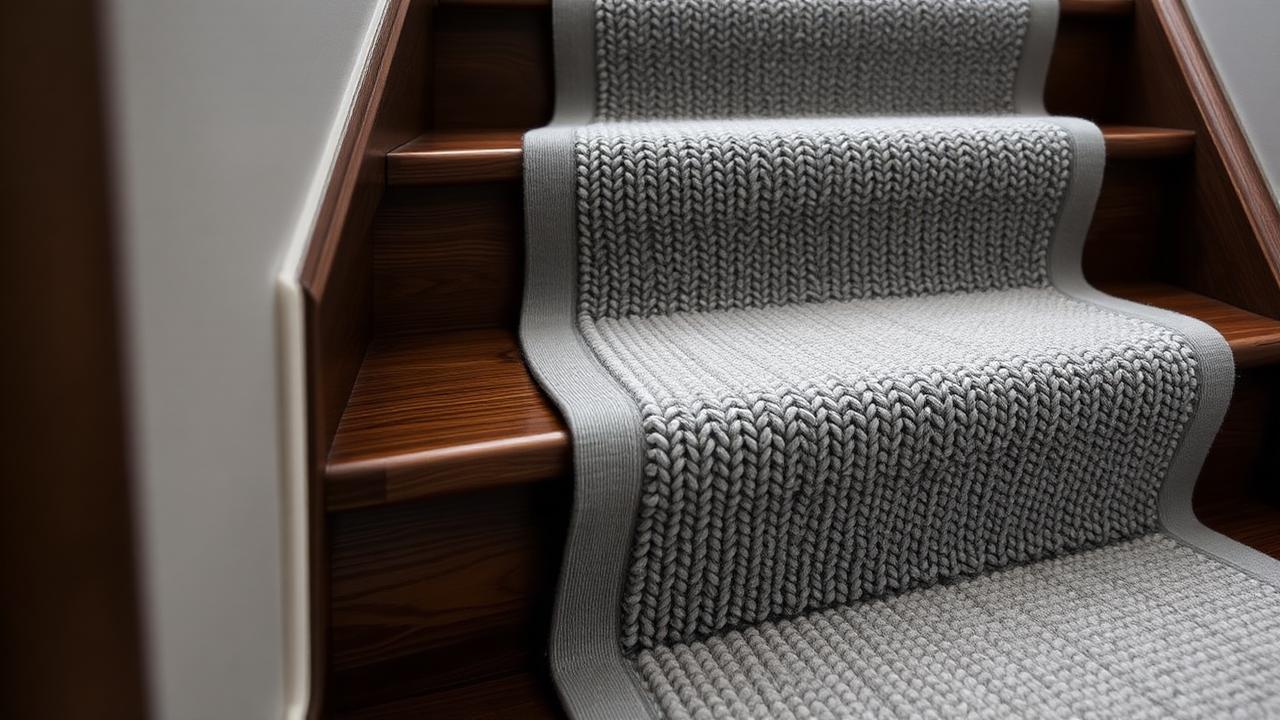
Why nylon leads on abrasion resistance
Nylon fibre has the highest tensile strength of any common carpet fibre, which translates directly into abrasion resistance at the stair nosing. Solution-dyed nylon, where colour is added to the molten polymer rather than applied after weaving, also resists fading and bleach-based stain treatment far better than yarn-dyed alternatives.
Spec sheet
| Property | Typical value |
|---|---|
| Fibre type | Solution-dyed or yarn-dyed nylon |
| Pile type | Cut pile, loop, or berber |
| Face weight | 800–1,400 g/m² |
| Abrasion rating | Excellent |
| Stain resistance | Very good, especially solution-dyed |
| Roll widths | 66cm, 68cm, 4m broadloom |
| Price per linear ft (US) | $12–$38 |
Nylon vs wool on the stair-specific factors
| Factor | Nylon | Wool |
|---|---|---|
| Raw abrasion resistance | Excellent | Very good |
| Crush recovery at nosing | Good | Excellent |
| Stain resistance | Excellent (solution-dyed) | Good |
| Static generation | Higher, unless treated | Low |
| Feel underfoot | Slightly harder, synthetic hand | Soft, natural |
| Typical price | Lower | Higher |
Know your numbers in 30 seconds
Enter your step count, tread depth and riser height — the stair runner calculator gives you the exact length to order, in metres and feet, with waste included.
Open the stair runner calculatorStatic is nylon's known weak spot
Untreated nylon can build static, especially in dry winter heating conditions, causing small shocks on stairs with metal handrails. Look for an anti-static treatment or a nylon-wool blend if this matters in your home.
Shedding and appearance retention
Nylon does not shed like wool during break-in and holds its colour and texture appearance well over years of foot traffic, provided the pile density is adequate. Budget nylon runners with a low face weight will still flatten at the nosing faster than a dense, well-constructed range.
Wear rating and warranty comparison
Nylon posts the highest raw abrasion-resistance numbers of any common stair fibre and typically carries the longest wear warranties in absolute terms, with premium branded nylon (type 6,6) ranges offering 25 year wear warranties on residential stairs, ahead of even top-tier wool blends, though nylon's crush recovery lags slightly behind wool at the nosing specifically.
| Nylon grade | Typical wear warranty | Stain warranty |
|---|---|---|
| Type 6 nylon | 10-15 years | 10 years |
| Type 6,6 nylon (branded) | 20-25 years | Lifetime (topical stains) |
| Solution-dyed nylon | 20 years | Lifetime, fade-resistant |
Buying checklist with price bands
Nylon spans a huge price range from generic builder-grade to premium branded fibre systems like those used in top commercial and hospitality carpet, so ask specifically which nylon type and denier is used rather than relying on the word nylon alone as a quality signal.
| Spec tier | Price per linear ft (US) | Price per linear m (UK) |
|---|---|---|
| Generic type 6 nylon | $15-$25 | £20-£32 |
| Branded type 6,6 nylon | $30-$50 | £42-£68 |
| Premium solution-dyed nylon | $45-$65 | £62-£90 |
- Ask whether the nylon is solution-dyed (colour fixed in the fibre) or piece-dyed (colour applied after, more prone to fading).
- Check the denier per filament figure if available; higher generally means better wear.
- Confirm anti-static treatment is included, since untreated nylon can shock in dry, centrally heated homes.
Cost ranges and value comparison
Nylon offers some of the best cost-per-year value of any stair fibre because it combines a mid-range purchase price with a long realistic lifespan. A branded type 6,6 nylon at $40/ft lasting 20 years works out to roughly $2 per foot per year, comparable to premium wool at nearly double the upfront price, making it a strong choice for buyers who want durability without a wool-level budget.

Trade tips for nylon installs
- Ask specifically for anti-static treatment if the home has dry winters and metal handrails.
- Request the denier per filament figure in writing; higher generally means better long-term wear.
- Solution-dyed ranges tolerate diluted bleach for stain removal, useful in households with red wine or turmeric-heavy cooking.
- Pair with a mid-firmness underlay; the resilience of nylon itself means it does not need an especially soft pad.
Type 6 versus type 6,6 nylon explained
Not all nylon is equal: type 6,6 nylon has a denser molecular structure that gives it superior resilience and abrasion resistance compared with type 6 nylon, which is more common in budget ranges. Branded carpet fibre systems, the kind used in premium hospitality and residential stair carpet, are almost always type 6,6, and this distinction explains much of the price and warranty gap between generic and branded nylon runners.
| Nylon type | Resilience | Typical use |
|---|---|---|
| Type 6 | Good | Budget to mid-range residential |
| Type 6,6 | Excellent | Premium residential, commercial, hospitality |
Solution-dyed vs piece-dyed: what it means for a stair runner
Solution dyeing adds colour pigment to the nylon polymer before it is extruded into fibre, locking colour throughout the strand, whereas piece dyeing applies colour to finished yarn or carpet afterward. Solution-dyed nylon resists fading from sunlight and household chemicals dramatically better, which matters most on a staircase near a window or skylight, or in a household that uses stronger cleaning products on spills.
Nylon and pet households
Nylon's high tensile strength makes it one of the most snag- and claw-resistant stair fibres available, a genuine advantage over wool berber or sisal in a household with dogs that use the stairs constantly. Solution-dyed nylon also tolerates enzymatic pet-stain cleaners far better than natural fibres, which can discolour or weaken under repeated chemical cleaning.
How much nylon runner do I need? A worked 13-step example
Nylon is usually sold as broadloom, which makes it flexible on width but the yardage maths is identical to any other fibre. On a straight 13-step staircase with a 10in going and 7.5in rise (25cm going, 19cm rise), the pitch-line run is 13 x 17.5in = 227.5in, or 13 x 44cm = 572cm. A typical nylon loop or berber at 6-8mm pile needs about 1.5in (4cm) of nosing wrap per tread, bringing the subtotal to roughly 246in (625cm). Add a 7% waste allowance for cutting and any pattern repeat in a branded range, and the final order comes to approximately 263in or 6.7m for a standard 27in / 70cm wide runner. Because nylon broadloom can usually be cut to a custom width without wasting a fixed roll size, running these figures through a stair runner calculator is worth doing before you commit to a width, since a slightly narrower runner on the same 13-step flight can reduce total yardage cost meaningfully on a premium branded nylon.
Know your numbers in 30 seconds
Enter your step count, tread depth and riser height — the stair runner calculator gives you the exact length to order, in metres and feet, with waste included.
Open the stair runner calculatorNylon grade cost-per-year comparison table
| Nylon grade | Price per linear ft (US) | Realistic stair life | Approx cost per ft per year |
|---|---|---|---|
| Generic type 6 | $20 | 10 years | $2.00 |
| Branded type 6,6 | $40 | 22 years | $1.82 |
| Premium solution-dyed | $55 | 20 years | $2.75 |
- Branded type 6,6 nylon posts the lowest cost-per-year figure of the three grades compared here, despite not having the lowest upfront price.
- A stair runner calculator paired with these per-foot figures lets you compare total installed cost across grades before you commit to a specific range.
- Solution-dyed nylon costs more per year than branded type 6,6 mainly because its main advantage is fade and stain resistance rather than raw abrasion life, so it earns its keep on sun-exposed or spill-prone staircases specifically.
- Always price nylon stair runners including underlay and fitting, not just fibre cost per foot, since underlay choice affects nylon's realistic lifespan almost as much as the fibre grade itself.
Nylon on winders and half-landings
Nylon's flexibility as a broadloom fibre makes it noticeably easier to wrap continuously around a winder or half-landing turn than a stiffer natural fibre like sisal, which usually needs to be seamed at that point instead. This is a genuine practical advantage for stair runners on staircases with a turn partway up the flight, since a continuous wrap looks cleaner and has one less potential failure point than a seamed join. When measuring a flight with winders for a nylon order, treat each winder tread as its own measurement rather than averaging it with the straight treads, and feed those individual figures into a stair runner calculator so the extra fibre a winder consumes is properly accounted for before the roll is cut.
Whatever you decide, get the numbers first: the stair runner calculator doubles as a stair runner length calculator, adding nosing wrap, landings, winders, pattern repeat and waste so you order the right length the first time.
Frequently asked questions
What is the difference between type 6 and type 6,6 nylon?
Type 6,6 nylon has a denser molecular structure giving better resilience and abrasion resistance than type 6, and it is the standard fibre in most premium branded carpet systems, which is why it commands a higher price and longer warranty.
Does solution-dyed nylon really last longer than piece-dyed?
Solution-dyed nylon does not last longer structurally but resists fading and chemical damage far better, since colour is locked throughout the fibre rather than applied afterward, which matters especially on sun-exposed stairs.
Is branded nylon worth paying more for than generic nylon?
Generally yes for a main staircase. Branded type 6,6 nylon systems carry documented wear testing and longer warranties, and the difference in real-world durability at the nosing over ten years usually justifies the extra cost over unbranded generic nylon.
Is nylon a good material for stair runners?
Yes, particularly solution-dyed nylon, which offers the best raw abrasion resistance of common stair fibres along with strong stain resistance, at a lower price than wool.
Does nylon feel as good as wool underfoot?
No, nylon has a slightly harder, more synthetic hand than wool, though high-quality nylon ranges with soft-touch yarn treatments narrow the gap considerably.
Does nylon carpet cause static shocks on stairs?
Untreated nylon can build static in dry conditions. Anti-static treated nylon or a wool-nylon blend largely eliminates the issue.
Is solution-dyed nylon worth the extra cost?
Generally yes for stairs, since solution dyeing resists fading and allows more aggressive stain removal, including diluted bleach, without colour loss.
Is nylon better than wool for a stair runner?
Nylon typically wins on raw abrasion resistance and warranty length, while wool wins on natural stain resistance, feel and crush recovery at the nosing. For pure durability on a punishing high-traffic stair, premium type 6,6 nylon is a genuine rival to wool at a lower price.
Know your numbers in 30 seconds
Enter your step count, tread depth and riser height — the stair runner calculator gives you the exact length to order, in metres and feet, with waste included.
Cost my nylon runnerReady for real prices?
Get quotes from vetted stair runner suppliers and fitters near you. Free, no account, no obligation.
Every guide is written from hands-on measuring and fitting experience, checked against the calculator’s own maths, and re-reviewed whenever prices or methods change. Read our editorial standards.