
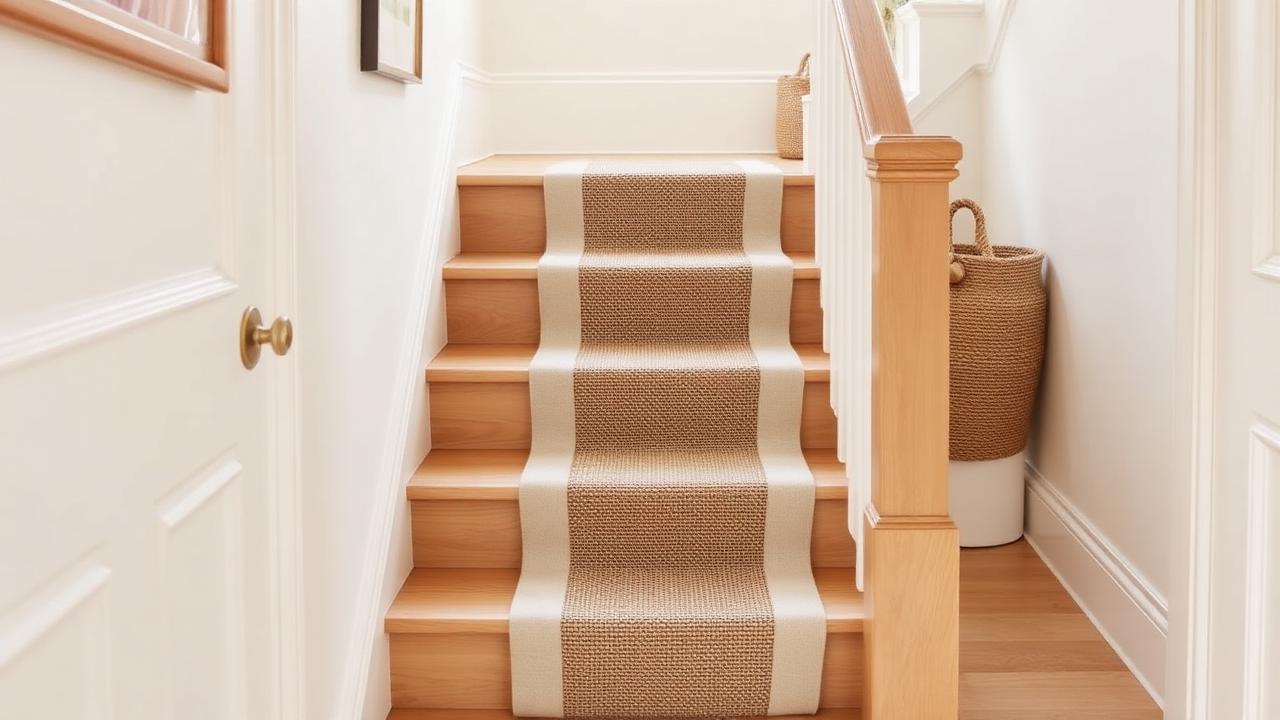
Why hard stairs are a real problem for dogs
Dogs, especially older dogs and larger breeds, rely on nail grip on hard flooring in a way that's easy to underestimate. Timber, laminate, tile and polished stone offer almost no traction for a paw pad, and stairs concentrate that risk because a slip happens on a moving, cascading surface rather than a flat floor. A temporary stair runner solves this directly by putting a textured, grippy surface under the paw exactly where the slip risk is highest, without necessarily committing to a full permanent carpet installation.
Materials that actually help traction
| Material/construction | Paw traction | Nail wear | Washability |
|---|---|---|---|
| Low-pile looped nylon | Very good | Low — loops resist snagging | Good, most are machine washable in sections |
| Cut-pile synthetic (short) | Good | Moderate — loose fibres can catch nails | Fair |
| Sisal or coir | Poor for paws | High — abrasive on pads and nails | Poor — not washable, water-sensitive |
| Rubber-backed carpet runner mats | Very good | Low | Very good — often hose-washable |
| Deep cut-pile wool | Fair | Low | Poor — hard to dry fully, retains odour |
Skip natural fibre for a dog stair runner
Sisal, jute and coir are popular for their look and durability underfoot for humans, but their coarse texture is abrasive on paw pads and their nail-catching weave can cause snagging injuries, and they can't be washed the way accidents on a dog stair demand. A synthetic loop-pile or a rubber-backed mat runner performs far better for this specific use case.
Fitting method for a dog stair runner
The fitting choice should prioritise being removable and washable over being invisible. Full-length stapled or glued carpet is harder to lift for cleaning; individual stair treads pads, fixed with grip pads or double-sided tape per step, can be pulled up one at a time for washing without disturbing the whole flight. For a full-length runner, use the no-drill methods from the renter-friendly guide, which double as an easy-removal system when a section needs cleaning.
- Individual tread pads or treads are the most practical format — wash or replace one at a time.
- Choose a pad or runner slightly narrower than the tread so mess doesn't pool at the edges against the wall or baluster.
- Round or bevel the leading edge of any pad rather than leaving a hard lip a paw can catch on mid-step.
- For senior or arthritic dogs, prioritise a slightly thicker pad for cushioning, balanced against not creating an uneven step height.
- Avoid heavily textured natural fibre edges (raw sisal binding) anywhere a paw pad will make contact.
Cleaning and lifespan
Dog stairs see more frequent soiling than an average household flight — mud, wet paws, occasional accidents — so plan for weekly vacuuming and a wash or deep clean far more often than the standard 12-18 month schedule in the general care guide. Machine-washable pad systems make this realistic; a full glued or stapled synthetic runner does not, and will need professional cleaning instead.
| Format | Typical lifespan with a dog | Cleaning method |
|---|---|---|
| Individual washable tread pads | 1-3 years, pads replaced individually as needed | Machine wash or hose down |
| Full synthetic loop-pile runner, no-drill fit | 2-4 years | Vacuum weekly; professional clean every 6-9 months |
| Full synthetic runner, permanently fitted | 4-7 years | Vacuum weekly; professional clean every 6-9 months |
Know your numbers in 30 seconds
Enter your step count, tread depth and riser height — the stair runner calculator gives you the exact length to order, in metres and feet, with waste included.
Open the stair runner calculatorCost of a dog-friendly stair setup
Individual tread pads for a 13-step flight typically run £70-160 or $95-215 for a mid-range loop-pile or rubber-backed set. A full synthetic loop-pile runner, no-drill fitted with grip pads and rods, comes in around £180-350 or $240-470 including hardware. Both are considerably below the cost of a full wool installation, which suits the shorter realistic lifespan of any dog-stair surface.
Beyond the runner: complementary traction aids
A runner alone doesn't have to do all the work. Nail grip caps, paw wax, and keeping a dog's nails trimmed short all reduce slip risk independently of what's on the stairs, and are worth combining with a grippy runner for senior dogs or breeds prone to hip or joint issues where a fall carries higher risk.

Breed and age-specific traction needs
Larger and heavier breeds put more downward force through each paw on a stair descent than small dogs, which means the traction demands scale with size — a Great Dane or Labrador benefits more from a dense, tightly-looped pile than a small terrier who puts far less force through each step. Senior dogs and breeds prone to hip dysplasia (German Shepherds, larger retrievers) benefit specifically from a slightly thicker pad underfoot for joint cushioning on the descent, balanced against the risk of an uneven step height noted earlier, so consulting a vet about a specific dog's mobility needs is worth doing before finalising pad thickness for an older or larger dog.
Multi-pet households and durability planning
A household with multiple dogs, or a dog alongside cats who also use the stairs, sees compounded wear at the nosing and centre of each tread compared with a single-pet home, and it's worth planning replacement cycles accordingly rather than assuming the lifespans quoted above apply uniformly. In a multi-pet household, individual washable tread pads become even more valuable relative to a full runner, since the ability to replace a single heavily-worn pad without redoing the whole flight matters more when wear is faster and more concentrated.
Odour control considerations specific to dog stairs
Beyond visible mess, dog stairs accumulate odour from paw oils, occasional accidents, and general pet dander faster than a human-only staircase, and material choice affects how well a runner resists holding odour rather than just how it looks. Synthetic loop-pile and rubber-backed mats generally resist odour retention better than any natural fibre or deep wool pile, both because they're washable and because synthetic fibre doesn't absorb oils and moisture into the fibre core the way wool can. If odour has been a persistent issue with a previous stair covering, prioritise a washable synthetic format over a natural fibre one even if the natural fibre otherwise appeals on look.
Sizing a dog-friendly runner correctly
Getting the width and length right matters as much for a dog stair runner as for any other, since an undersized or poorly centred runner leaves more exposed slippery surface at the edges precisely where a dog is likely to place a paw while descending at any angle other than dead centre. Measure the flight with a stair runner calculator the same way you would for a purely decorative installation, and if anything, err toward a slightly wider runner or fuller tread coverage than the standard reveal proportions suggest, since maximising the grippy surface area matters more here than the visual proportion considerations that drive width choice on a purely decorative flight.
Whatever you decide, get the numbers first: the stair runner calculator doubles as a stair runner length calculator, adding nosing wrap, landings, winders, pattern repeat and waste so you order the right length the first time.
Still deciding on material, width or pattern? Our hub on stair runners compares weaves, widths, backings and fitting styles side by side, then hands the numbers straight to the calculator.
Frequently asked questions
What's the best stair runner material for dogs?
Low-pile looped nylon or a rubber-backed carpet runner mat give the best paw traction with good washability. Sisal and other natural fibres should be avoided — they're abrasive on paw pads and can snag nails.
Should I use individual tread pads or a full runner for a dog?
Individual tread pads are usually the more practical choice because they can be lifted and washed one at a time. A full runner needs to be fully removable for realistic cleaning with a dog in the house.
How often should a dog stair runner be cleaned?
Vacuum weekly and wash or deep clean far more often than a standard household schedule — dog stairs see more frequent soiling from mud, wet paws and occasional accidents.
How long does a dog stair runner last?
Individual washable pads typically last 1-3 years with pads replaced as needed; a full synthetic runner lasts 2-4 years in a no-drill fit, or 4-7 years permanently fitted.
Is sisal good for a dog staircase?
No. Sisal and other natural fibres are abrasive on paw pads, their coarse weave can snag nails, and they can't be washed, which makes them a poor fit for a dog's stair traffic and accidents.
How much does a dog-friendly stair runner cost?
Individual tread pads for a 13-step flight run roughly £70-160 or $95-215. A full no-drill synthetic runner with hardware is around £180-350 or $240-470.
Does a stair runner really help prevent dog slips?
Yes — hard stair surfaces like timber, tile and stone offer very little paw traction, and stairs concentrate slip risk because it happens on a cascading rather than flat surface. A textured, grippy runner addresses that directly.
What else helps besides a runner for a dog on stairs?
Nail grip caps, paw wax and keeping nails trimmed short all reduce slip risk independently and are worth combining with a grippy runner, especially for senior dogs or breeds prone to joint issues.
Know your numbers in 30 seconds
Enter your step count, tread depth and riser height — the stair runner calculator gives you the exact length to order, in metres and feet, with waste included.
Price a dog-friendly runnerReady for real prices?
Get quotes from vetted stair runner suppliers and fitters near you. Free, no account, no obligation.
Every guide is written from hands-on measuring and fitting experience, checked against the calculator’s own maths, and re-reviewed whenever prices or methods change. Read our editorial standards.