

What seagrass actually is
Seagrass is a grass, not a grain fibre like sisal or jute, and it grows in paddies rather than dry fields, which is what gives it that closed, almost waxy surface once woven and dried. Because the individual strands don't split into fine hairs the way sisal does, a seagrass weave feels smooth and cool underfoot rather than bristly, and it doesn't shed lint or fluff the way a coir or jute runner can in its first few months. I've fitted it on a handful of holiday-home staircases where the brief was 'something natural that won't show sand', and it does that job well - grit brushes off the surface instead of working down into the pile, because there is no pile to work into.
That same smoothness is the trade-off. Seagrass fibre has a naturally low surface friction, noticeably lower than sisal or wool, and on a stair (as opposed to a flat floor rug) that matters far more than it does in a hallway. I would not put bare seagrass on a stair runner without a grippy underlay and, ideally, a rubber-backed construction or stair rods to hold it firmly to the nosing, because the fibre itself does very little to resist a foot sliding forward on the tread edge.
Abrasion, moisture and everyday wear
Abrasion resistance on seagrass is genuinely good for a natural fibre - the individual strands are tough and don't fray or bloom (that fuzzy, worn look you sometimes see on sisal after a couple of years) nearly as readily. Where it falls down is compression damage: because the weave is flat and fairly rigid rather than resilient, a seagrass runner that gets consistently heavy foot traffic on the same three or four steps near the top or bottom of a flight can develop a flattened, slightly shiny track years before the rest of the run shows wear. It's a fibre that rewards being used across a full household's worth of steps rather than concentrated on a short, heavily used flight.
Moisture resistance is one of seagrass's genuine strengths, a legacy of growing partly submerged. It doesn't absorb water readily and dries quickly if it does get damp, which is exactly why it turns up in boot rooms, coastal properties and porches. That said, a spill left standing on a stair runner - any material - for hours rather than minutes will still eventually work through to the backing and pad, so quick blotting still matters even with a naturally water-resistant fibre.
Always add a slip-rated pad
Seagrass on its own is one of the more slip-prone natural fibres available for stairs. Fit it over a firm, grippy pad and consider stair rods for extra hold at the nosing, especially on steeper flights.
How much runner do I need?
Take a US example: 13 steps, 10 in tread run, 7.5 in riser height, and because seagrass has a slightly stiffer nosing wrap than a soft pile carpet, allow a full 1 in per step rather than the 0.75 in you'd use on wool. Per step that's 10 + 7.5 + 1 = 18.5 in. Across 13 steps that's 240.5 in, or 20.04 ft. Add a 24 in top-and-bottom finishing allowance (12 in each end) for 264.5 in, or 22.04 ft, then apply a 7-8% waste margin because seagrass weaves are usually sold with a visible selvedge that needs squaring off cleanly - that lands you at roughly 23.7-23.8 ft, so order 24 ft to be safe.
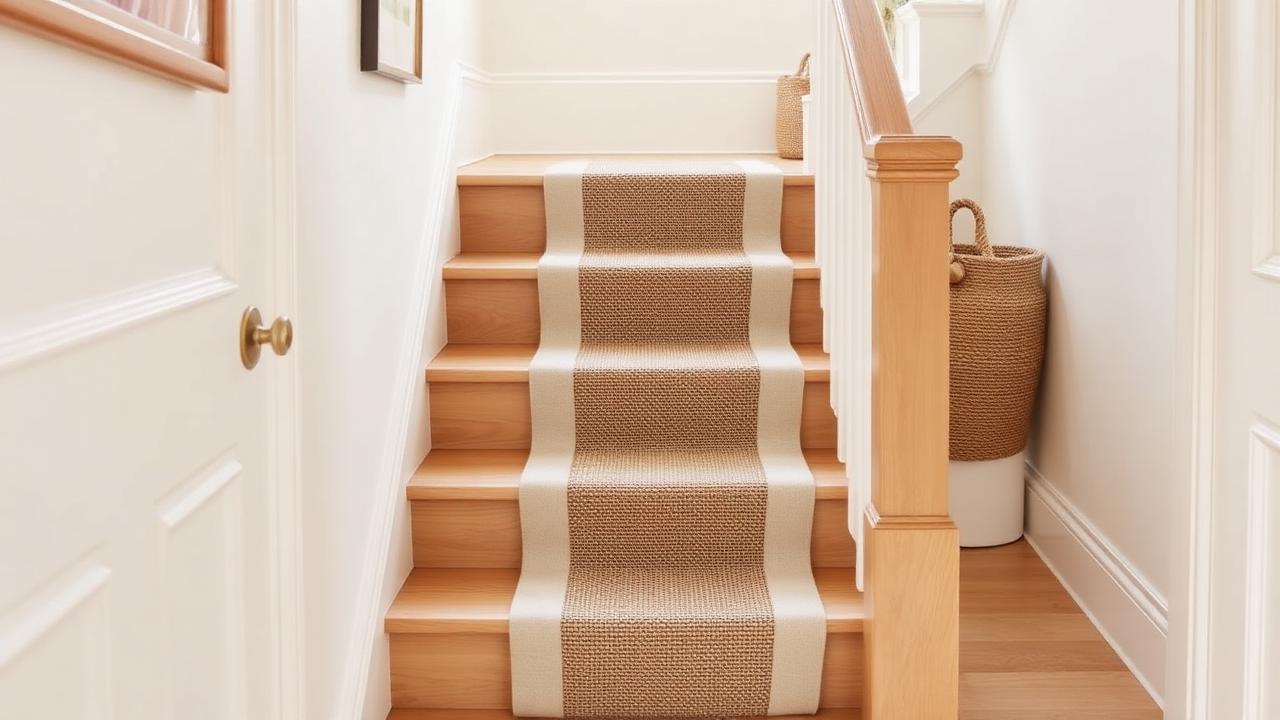
In UK metric terms: 25 cm tread, 19 cm riser, 2.5 cm nosing wrap, giving 46.5 cm per step. Across 13 steps that's 604.5 cm, plus 60 cm finishing allowance for 664.5 cm, then a 7-8% waste margin brings you to roughly 7.1-7.2 m. Both routes land on the same conclusion: seagrass needs a slightly larger nosing allowance than soft pile because the fibre doesn't compress and mould around the curve as readily, and a stair runner calculator applies that extra margin automatically rather than you adjusting the formula by hand each time.
| Measurement | US (in/ft) | UK (cm/m) |
|---|---|---|
| Tread run | 10 in | 25 cm |
| Riser height | 7.5 in | 19 cm |
| Nosing wrap per step | 1 in | 2.5 cm |
| Per-step total | 18.5 in | 46.5 cm |
| 13-step subtotal | 20.04 ft | 6.05 m |
| Plus finishing allowance | 22.04 ft | 6.65 m |
| With 7-8% waste margin | ~24 ft | ~7.2 m |
Know your numbers in 30 seconds
Enter your step count, tread depth and riser height — the stair runner calculator gives you the exact length to order, in metres and feet, with waste included.
Open the stair runner calculatorWhere seagrass works best on a staircase
I'd recommend seagrass for a straight, single-flight staircase in a coastal or country home, a boot room stair, or anywhere the priority is easy sweeping and resistance to grit rather than plush comfort underfoot. It's a poor choice for a house with young children, anyone unsteady on their feet, or a steep, winding staircase, purely on slip-risk grounds - the fibre's low friction is a real, measurable characteristic, not a marketing quibble, and no amount of underlay fully cancels it out on a pitch over about 40 degrees.
- Good fit: straight flights, low-to-moderate traffic, coastal or country interiors.
- Poor fit: steep or winding stairs, households with small children or older residents.
- Always pair with a grippy, firm-density pad rather than a soft one.
- Expect a flat, matte-to-slightly-sheen finish rather than a soft pile texture.
- Bind or border the edges - raw seagrass edges fray faster than a bound edge under stair traffic.
Cleaning and long-term care
Seagrass doesn't take dye particularly well because the fibre surface is closed and waxy, so most seagrass runners come in natural, undyed tones rather than the wide colour range you'd get with wool or synthetic stair runners; if you want colour, look for a seagrass-look synthetic blend instead and treat true seagrass as a natural-tone-only choice. For cleaning, a stiff (not wire) brush and regular vacuuming on a low-suction, no-beater-bar setting keeps grit from working into the weave joints. Avoid wet shampooing - seagrass can water-stain and the fibre doesn't fully dry evenly within a woven construction, so spot-clean with a barely damp cloth and blot rather than rub.
Where seagrass sits among the wider family of stair runners is worth knowing before you commit: it's harder-wearing against surface abrasion than jute, more water-tolerant than either jute or wool, but noticeably less grippy than sisal or a cut-pile wool. If underfoot comfort and slip confidence matter more to you than the coastal, grasscloth look, it's worth reading across the natural fibre range of stair runners before ordering, since the right material genuinely depends on the specific flight and household rather than a single universal best answer.
Whatever you decide, get the numbers first: the stair runner calculator doubles as a stair runner length calculator, adding nosing wrap, landings, winders, pattern repeat and waste so you order the right length the first time.
Frequently asked questions
Is seagrass a good choice for stairs?
It works well on straight, low-traffic flights in coastal or country homes thanks to its moisture resistance and easy sweeping, but its naturally low surface friction makes it a weaker choice for steep, winding, or high-traffic household stairs without a strong non-slip pad.
Is seagrass slippery on stairs?
Yes, more so than sisal, jute or wool. The fibre's closed, waxy surface gives it low friction, so it should always be fitted over a firm, grippy underlay, and stair rods add useful extra hold at the nosing on steeper flights.
Can seagrass stair runners get wet?
Seagrass tolerates brief dampness well and dries faster than most natural fibres, which is why it's popular in boot rooms and coastal homes. Standing water left for hours will still eventually reach the backing, so blot spills promptly regardless.
Does seagrass come in different colours?
Not really - seagrass has a closed fibre surface that resists dye, so most true seagrass runners are sold in natural, undyed tones. If you want a wider colour range, look at a seagrass-look synthetic weave instead.
How long does a seagrass stair runner last?
With moderate, even traffic across the full flight, expect 7-10 years before noticeable wear, though heavily used steps near the top or bottom of a flight can show flattening sooner since the fibre doesn't compress and recover the way a resilient pile does.
How much seagrass runner do I need for 13 steps?
For a 13-step flight with 10 in (25 cm) treads and 7.5 in (19 cm) risers, budget roughly 23-24 ft (7-7.2 m) once you add nosing wrap, top and bottom finishing allowance and a 7-8% waste margin for squaring the selvedge.
Can seagrass be fitted on a winding staircase?
It can, but it's not ideal - the flat, fairly rigid weave doesn't shape around a winder as neatly as a softer pile carpet, and the added slip risk on angled treads compounds the fibre's already low friction, so a softer natural fibre is usually a better fit for turns.
What underlay should I use under a seagrass stair runner?
Use a firm-density, grippy stair pad rather than a soft, springy one - seagrass needs support that keeps it flat and stable against the nosing, since the fibre itself provides very little grip on its own.
Know your numbers in 30 seconds
Enter your step count, tread depth and riser height — the stair runner calculator gives you the exact length to order, in metres and feet, with waste included.
Work out your exact yardage with the stair runner calculatorReady for real prices?
Get quotes from vetted stair runner suppliers and fitters near you. Free, no account, no obligation.
Every guide is written from hands-on measuring and fitting experience, checked against the calculator’s own maths, and re-reviewed whenever prices or methods change. Read our editorial standards.