

Why landings change the calculation
A straight flight calculation is simple: tread depth plus riser height plus nosing wrap, repeated per step. A landing breaks that pattern because it is a flat horizontal run rather than a stepped one, and it often marks a turn in direction, which affects how the runner is cut, joined, or pattern-matched. Ignoring the landing length, or guessing at it, is one of the most common reasons homeowners under-order for a two-flight staircase.
You need three numbers: the length of the lower flight, the length of the landing run itself (measured as the horizontal distance the runner needs to cover, typically the width of the landing floor it crosses), and the length of the upper flight. Add these together, then apply your finishing and waste allowances.
Worked example with a landing
Take a lower flight of 7 steps and an upper flight of 6 steps, both with 10 in (25 cm) treads and 7.5 in (19 cm) risers, connected by a 4 ft (1.2 m) landing. Each step totals 18.25 in (45.9 cm) as before. Lower flight: 7 x 18.25 in = 127.75 in. Upper flight: 6 x 18.25 in = 109.5 in. Landing: 48 in (1.2 m). Total before finishing: 127.75 + 109.5 + 48 = 285.25 in. Add 24 in finishing allowance for the top and bottom of the full run, giving 309.25 in, or 25.77 ft. With a 10% waste margin for the extra cutting and turn at the landing, order roughly 28.3 ft. In metric: lower flight 7 x 45.9 cm = 321.3 cm, upper flight 6 x 45.9 cm = 275.4 cm, landing 120 cm, total 716.7 cm, plus 60 cm finishing is 776.7 cm, and with 10% waste that is about 8.5 m.
| Section | US (in/ft) | UK (cm/m) |
|---|---|---|
| Lower flight (7 steps) | 127.75 in | 321.3 cm |
| Upper flight (6 steps) | 109.5 in | 275.4 cm |
| Landing run | 48 in | 120 cm |
| Total with finishing + waste | 28.3 ft | 8.5 m |
Know your numbers in 30 seconds
Enter your step count, tread depth and riser height — the stair runner calculator gives you the exact length to order, in metres and feet, with waste included.
Open the stair runner calculatorHandling the turn at the landing
If the staircase turns 90 or 180 degrees at the landing, the runner usually needs to be cut and rejoined, or specially shaped, at that point. This is where a stair runner calculator with landing support becomes genuinely useful, since it lets you enter each flight and the landing separately rather than guessing at a single blended average.
Measure the landing run, not just its width
The landing length you need is the distance the runner physically travels across it, which depends on the direction of the turn. Measure this on-site rather than assuming it equals the staircase width.
Pattern matching across the landing
For patterned or striped stair runners, plan the turn at the landing carefully so the pattern reads correctly on both flights. A skilled fitter will often centre a bold motif on the landing itself to draw the eye naturally through the turn.
Half landings versus full landings
A half landing, common in many US and UK homes, is a small platform where the staircase turns 90 or 180 degrees partway up, often only a few feet deep. A full landing, more common between floors in larger homes, can be considerably longer and may even have its own separate rug or runner treatment rather than a continuous piece. Measure a half landing's run carefully since its short length means a measuring error has a proportionally bigger impact on your total order than the same error on a full landing.
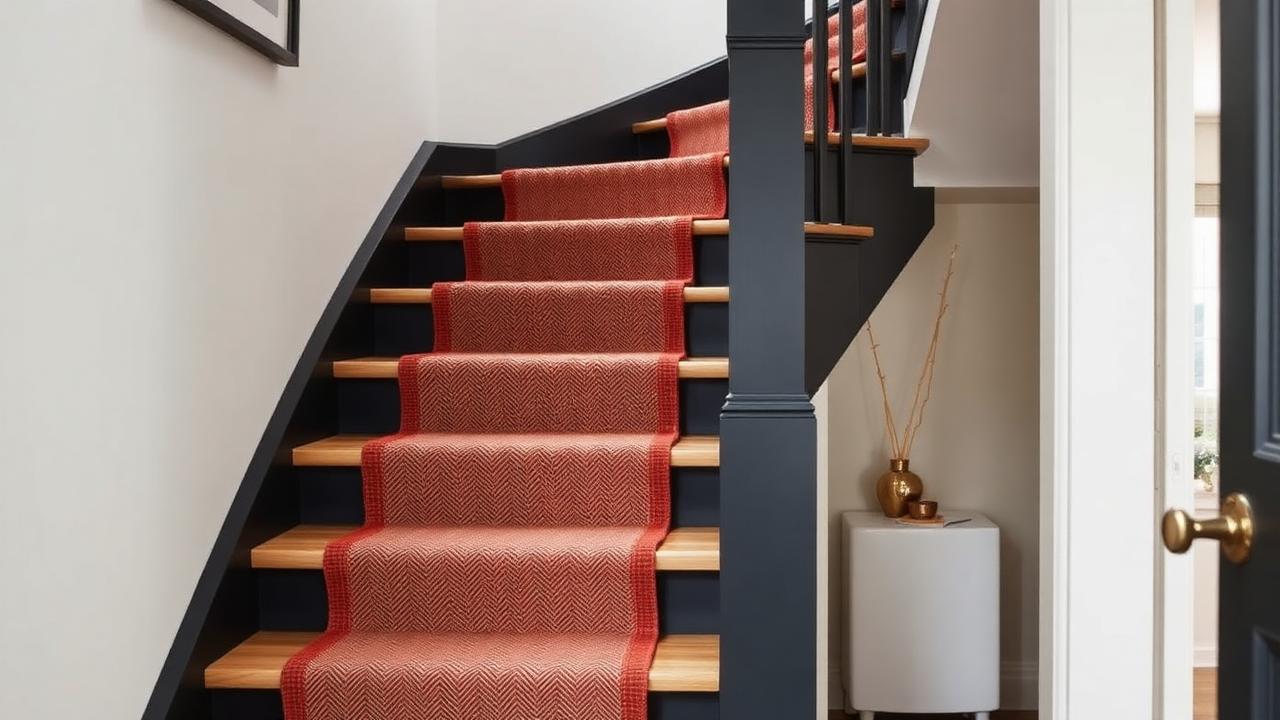
If the landing is unusually wide or serves as a small hallway in its own right, some homeowners choose to stop the runner at the landing edge and treat the landing floor separately with matching carpet or a rug, rather than running the stair runner fabric across it. This is a valid option and can simplify a tricky turn considerably.
Cost impact of a landing
| Job type | US cost | UK cost |
|---|---|---|
| Straight 13-step flight only | $600-1200 | £450-900 |
| 13 steps + landing, standard turn | $850-1600 | £650-1250 |
| 13 steps + landing, custom shaped pieces | $1200-2200 | £950-1750 |
Measuring checklist for a landing job
- Measure each flight separately, never as a single blended average
- Measure the landing run along the actual path the runner will travel, not the room width
- Note the direction and degree of any turn (90 or 180 degrees)
- Check ceiling height clearance if the landing sits under a sloped roofline
- Confirm whether the landing needs a separate seam or a continuous woven piece
Multiple landings on tall staircases
Some homes, particularly split-level or three-storey properties, have more than one landing between floors. In this case, treat each flight and each landing as its own line item in your calculation, then sum them all before adding a single finishing and waste allowance for the whole run. For a three-flight staircase with two landings, for example, you might have flight lengths of 8, 5, and 8 steps with landings of 3 ft (0.9 m) and 4 ft (1.2 m) between them, giving a total quite different from what a simple ‘average flight’ estimate would suggest.
This is also where continuous versus pieced runners becomes a real cost decision. A continuous woven runner across multiple flights and landings looks seamless but is expensive and harder to source in longer lengths, while a pieced approach with matched joins at each landing is more affordable and easier for most suppliers to produce, at the cost of a visible (though usually neat) seam at each landing.
Common landing measurement mistakes
- Measuring the landing's width instead of the direction the runner actually travels across it
- Forgetting to add a separate finishing allowance if the runner is pieced rather than continuous
- Not accounting for a turn in stripe or pattern direction at the landing
- Assuming both flights have identical tread and riser dimensions without checking
Whatever you decide, get the numbers first: the stair runner calculator doubles as a stair runner length calculator, adding nosing wrap, landings, winders, pattern repeat and waste so you order the right length the first time.
Frequently asked questions
How do I calculate stair runner length with a landing?
Add the length of each flight to the horizontal length of the landing run, then add your finishing allowance and waste margin.
Does a landing use more runner than expected?
Yes, homeowners often underestimate landing length because it is flat rather than stepped, leading to under-ordering.
Can one calculator handle both flights and a landing?
Yes, a stair calculator with landing support lets you enter each section separately for an accurate total.
What waste margin should I use for a staircase with a landing?
Around 10%, slightly higher than a single straight flight, to account for the extra cutting and turn at the landing.
Does the runner need to be cut at the landing?
Often yes, especially at a 90 or 180 degree turn, unless the supplier can weave or sew a continuous shaped piece.
How do I measure the landing run correctly?
Measure the actual horizontal distance the runner travels across the landing floor, not simply the landing's width.
Should pattern matching be considered at a landing?
Yes, plan for the pattern or stripe direction to read correctly on both the lower and upper flights.
Is it more expensive to fit a runner over a landing?
Usually yes, due to the extra cutting, joining, or custom shaping required at the turn.
Know your numbers in 30 seconds
Enter your step count, tread depth and riser height — the stair runner calculator gives you the exact length to order, in metres and feet, with waste included.
Measure your full flight with the stair runner calculatorReady for real prices?
Get quotes from vetted stair runner suppliers and fitters near you. Free, no account, no obligation.
Every guide is written from hands-on measuring and fitting experience, checked against the calculator’s own maths, and re-reviewed whenever prices or methods change. Read our editorial standards.