

Shape and fixing
| Feature | Stair rod | Stair bar |
|---|---|---|
| Profile | Round, 9.5–16mm diameter | Flat or half-round, often wider and slimmer in height |
| Typical position | Crotch between tread and riser | Same position, or sometimes on the nosing |
| Fixing | End brackets each side | End brackets, sometimes lower profile clips |
| Look | Traditional, ornamental, visible finials | Cleaner, more discreet, minimal or no finials |
Which suits which staircase
Round rods with decorative finials are the traditional choice and read as classic or period detail. Flat bars sit lower and disappear more into the step line, which suits contemporary interiors where the goal is a clean look with a hint of hardware rather than a visible ornament.
Know your numbers in 30 seconds
Enter your step count, tread depth and riser height — the stair runner calculator gives you the exact length to order, in metres and feet, with waste included.
Open the stair runner calculator- Choose rods for period homes, formal hallways, or where you want a decorative finial detail.
- Choose bars for contemporary interiors or where a very slim visual line is wanted.
- Bars typically cost slightly less than an equivalent finished rod set since there is no finial hardware.
- Both need the same underlying fixing of the runner itself; neither is structural.
Sizing works the same way for both
Whether you choose a bar or a rod, length is based on runner width plus roughly 4 inches for bracket overhang, and quantity is one per step where fitted.
Price comparison
| Option | Typical price per step set (with brackets) |
|---|---|
| Standard round brass rod with finials | $25–$60 / £20–£45 |
| Flat/half-round bar, no finials | $18–$45 / £14–£35 |
| Premium solid brass bar | $40–$80 / £32–£62 |
Installation implications
Stair rods sit individually in the tread-riser angle of each step, while stair bars (sometimes called eyelet bars or carpet bars) run flat across a single transition point, most often at a doorway or landing join rather than up a full flight. Confusing the two products when ordering leads to hardware that physically cannot be fitted the way the buyer expected, since bars are not designed to be spaced one per tread up a staircase.
| Feature | Stair rods | Stair/carpet bars |
|---|---|---|
| Typical use | One per step, full flight | Single transition point |
| Visual style | Decorative, visible finials | Functional, low profile |
| Fixing | Bracket pairs per rod | Single fixed track |
Buying checklist with price bands
Because bars and rods serve different purposes, price them separately rather than as substitutes; a full flight of decorative rods costs considerably more than the single bar needed for a landing transition.
| Item | Price (US) | Price (UK) |
|---|---|---|
| Single transition carpet bar | $8-$25 | £6-£20 |
| Full 13-step decorative rod set | $150-$600 | £120-£460 |
- Confirm with your fitter which product actually suits your junction before ordering either.
- Bars are typically sold by length to match doorway or landing width, not by step count.
- Rods are sold by step count and diameter, matched to runner width.
Which one resists wear better
Round rods tend to shed foot contact more evenly across their curved surface, while flat bars can show wear lines along the top face where shoes make repeated contact, particularly in a lighter finish. On a heavy-traffic main flight, a rounded profile in a durable metal generally holds its finish longer than a flat bar of the same material.
DIY vs hiring for bars or rods
Both bars and rods install the same way and are equally approachable DIY projects on a straight staircase. The choice between them is almost entirely aesthetic, so make the decision based on samples viewed on your own stairs rather than assuming one is inherently easier to fit than the other.
Cost ranges at a glance
| Budget level | What it buys, 13-step flight |
|---|---|
| Under $300 / £240 | Flat bars, budget finish |
| $300-600 / £240-460 | Standard round rods with finials, mid finish |
| $600+ / £460+ | Premium solid brass rods or bars |
Trade tip: view samples on your own stairs
Bar and rod finishes photograph almost identically online but read quite differently once installed under real stairwell lighting. Borrow or order a single sample of each before committing to a full flight of either.
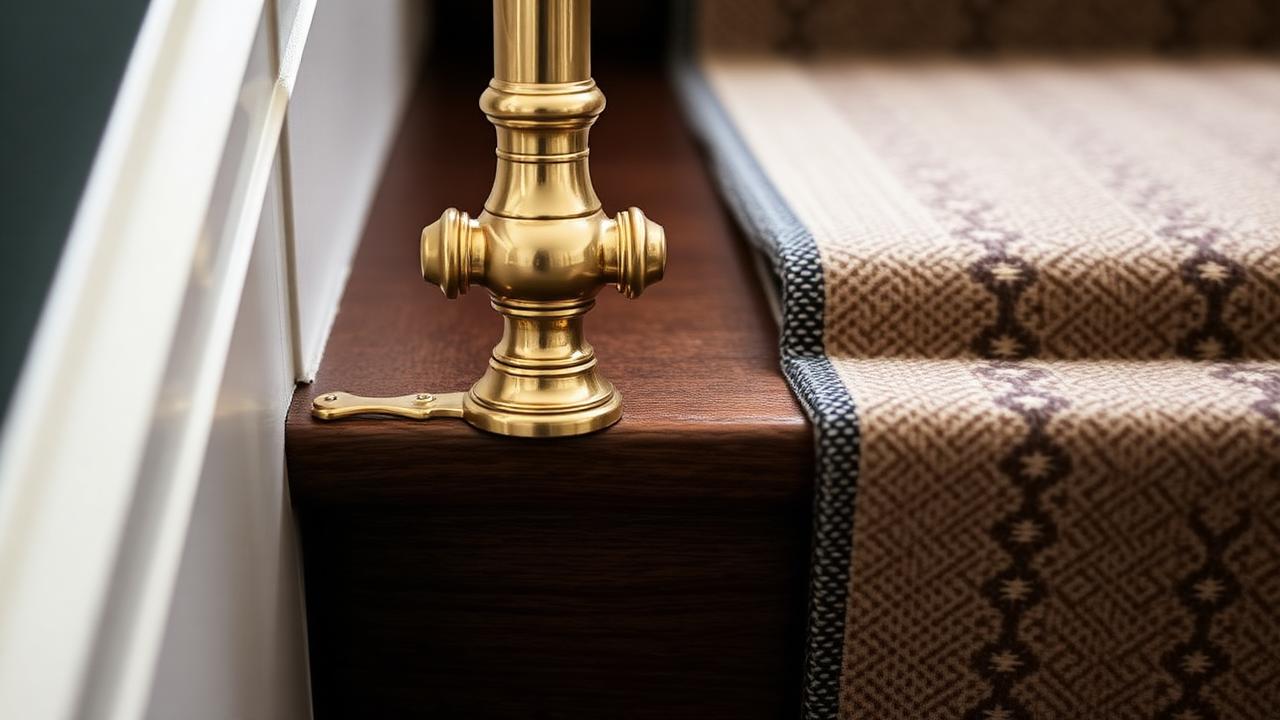
Whichever profile you pick, keep spare hardware from the same batch stored safely, since replacing a single lost or damaged bar or rod years later without a matching spare can mean re-ordering an entire new finish range.
Historical origin of the two products
Round stair rods date back to when runners were genuinely loose-laid and needed to be held and periodically shifted to spread wear evenly along the flight; the rod's practical job was to keep the runner taut and roughly in place. Flat stair bars and carpet bars developed later, largely for transition points such as doorways, where a low profile prevents a trip hazard better than a raised round rod would.
Choosing between the two for a renovation project
If you are restoring a period property and want to be historically accurate, round rods with decorative finials are the correct choice for the full flight. If you are renovating a contemporary home and only need a neat transition at a single doorway or landing, a bar is both more appropriate and considerably cheaper than buying rods for a single junction.
Combining bars and rods in one project
A common approach on a renovation with both a main flight and a hallway threshold is to use decorative round rods up the visible staircase and a simple flat bar at the ground-floor doorway transition, since the two products are solving different problems even within the same project. Order them as separate line items with separate measurements rather than trying to source one product that does both jobs.
Trip hazard and safety considerations
A round rod sits slightly proud of the tread surface and, while this is standard and safe on a staircase where users expect steps, a raised rod is a genuine trip hazard if used at a flat threshold such as a doorway, which is exactly why flat bars exist for that application. Always match the product to its intended location rather than substituting one for the other purely on appearance.
Which product a professional fitter will usually recommend
Most experienced stair fitters default to recommending rods for a full flight unless a client specifically asks for the flatter bar look, simply because rods are the more commonly stocked and requested product and give more scope for a decorative finial. If you want bars for a full flight rather than a single transition, mention this clearly when getting quotes, since some fitters may assume rods by default and quote accordingly.
Ultimately, walk both options past a physical sample on your own staircase before ordering a full set of either, since photographs rarely convey how each profile catches light on your particular treads.
Whatever you decide, get the numbers first: the stair runner calculator doubles as a stair runner length calculator, adding nosing wrap, landings, winders, pattern repeat and waste so you order the right length the first time.
Still deciding on material, width or pattern? Our hub on stair runners compares weaves, widths, backings and fitting styles side by side, then hands the numbers straight to the calculator.
Frequently asked questions
Are stair bars cheaper than stair rods?
Usually slightly, since bars typically skip decorative finial hardware. The difference is modest, so choose based on look rather than price alone.
Do stair bars fit the same way as stair rods?
Yes, both sit in the angle between tread and riser and are held by end brackets. Sizing follows the same rule: runner width plus roughly 4 inches for the brackets.
Which is more traditional, a rod or a bar?
Round rods with visible finials read as the traditional, period choice. Flat bars are a more contemporary option that sits lower and less visibly on the step.
Can I mix bars on some steps and rods on others?
It is possible but not recommended visually, since the inconsistency is noticeable going up a flight. Choose one profile for the whole staircase.
Can I use a stair bar instead of stair rods up a full flight?
No, they serve different purposes. Bars are designed for a single transition point such as a landing or doorway join, not for repeating up a full flight of stairs. For a decorative full-flight look, stair rods spaced one per step are the correct product.
Know your numbers in 30 seconds
Enter your step count, tread depth and riser height — the stair runner calculator gives you the exact length to order, in metres and feet, with waste included.
Work out how many rods I needReady for real prices?
Get quotes from vetted stair runner suppliers and fitters near you. Free, no account, no obligation.
Every guide is written from hands-on measuring and fitting experience, checked against the calculator’s own maths, and re-reviewed whenever prices or methods change. Read our editorial standards.