

Start with width, not colour
Most people begin a stair runner design project by browsing colours and patterns, but width should come first because it fixes the proportions everything else has to sit inside. The standard convention leaves an equal margin of exposed tread on each side: on a common 36 in (91 cm) US staircase or a 900 mm UK staircase, a runner of 26-27 in (66-69 cm) leaves roughly 4.5 in (11 cm) of visible timber either side, the classic proportion most people picture when they picture a runner.
Narrower runners, down to 25 in (64 cm), read as more formal and make a staircase look taller and slimmer. Wider runners, up to 32-33 in (81-84 cm), give a fuller, more upholstered look and cover more of the tread, which matters if the timber underneath is worn or mismatched. Measure your own staircase width carefully before deciding, since a design that looks right in a magazine photo may not suit your particular flight's proportions.
Matching fibre and construction to the design brief
Once width is set, choose the construction. A flat weave (like a Wilton or a flatweave wool) gives the crispest, most graphic pattern definition, which suits bold stripes, checks or geometric designs. A loop pile (Berber-style) softens pattern edges slightly but wears exceptionally well and suits heathered, textured colourways. A cut pile gives the deepest, richest colour saturation but shows footprints and wear lines faster than either alternative, which matters most in a plain, solid colour design.
| Design goal | Best construction | Trade-off to accept |
|---|---|---|
| Bold graphic pattern (stripe, chevron) | Flat weave or Axminster | Less plush underfoot than a cut pile |
| Quiet, forgiving neutral | Loop pile / Berber | Loops can snag with pets or dragged cases |
| Deep saturated solid colour | Cut pile (twist or velvet) | Shows footprints and wear lines fastest |
| Natural, textural look | Sisal, jute or wool-sisal blend | Coarser underfoot, needs binding for stairs |
| Small repeating pattern (herringbone, houndstooth) | Woven wool or wool-blend | Pattern must be centred and squared to the flight |
Colour: work from the fixed elements, not the sample card
The staircase timber, wall colour and any existing balustrade or handrail finish are fixed; the runner is the one element you are choosing freely, so let it respond to what is already there rather than picking a colour in isolation. Dark stained timber generally reads best with a mid-tone or patterned runner that lifts the staircase visually; pale or painted timber can carry a much deeper, richer colour without the whole run feeling heavy.
Test in real light, not showroom light
Stairs are viewed at a steep angle and lit from above, so a colour that looks perfect flat on a sample board can shift noticeably on a riser in shadow. Tape a sample to both a tread and a riser and look at it in the morning and again after dark under your own lighting before ordering, especially with any saturated colour like navy, forest green or burgundy.
Pattern scale and the staircase's own geometry
A pattern repeat that looks balanced on a flat floor can look completely different climbing a staircase, because the runner width is usually much narrower than a room-sized rug. As a rule of thumb, aim for at least four to five full pattern repeats visible across the runner's width; fewer than that and a bold geometric design starts to look accidental or cut off rather than intentional.
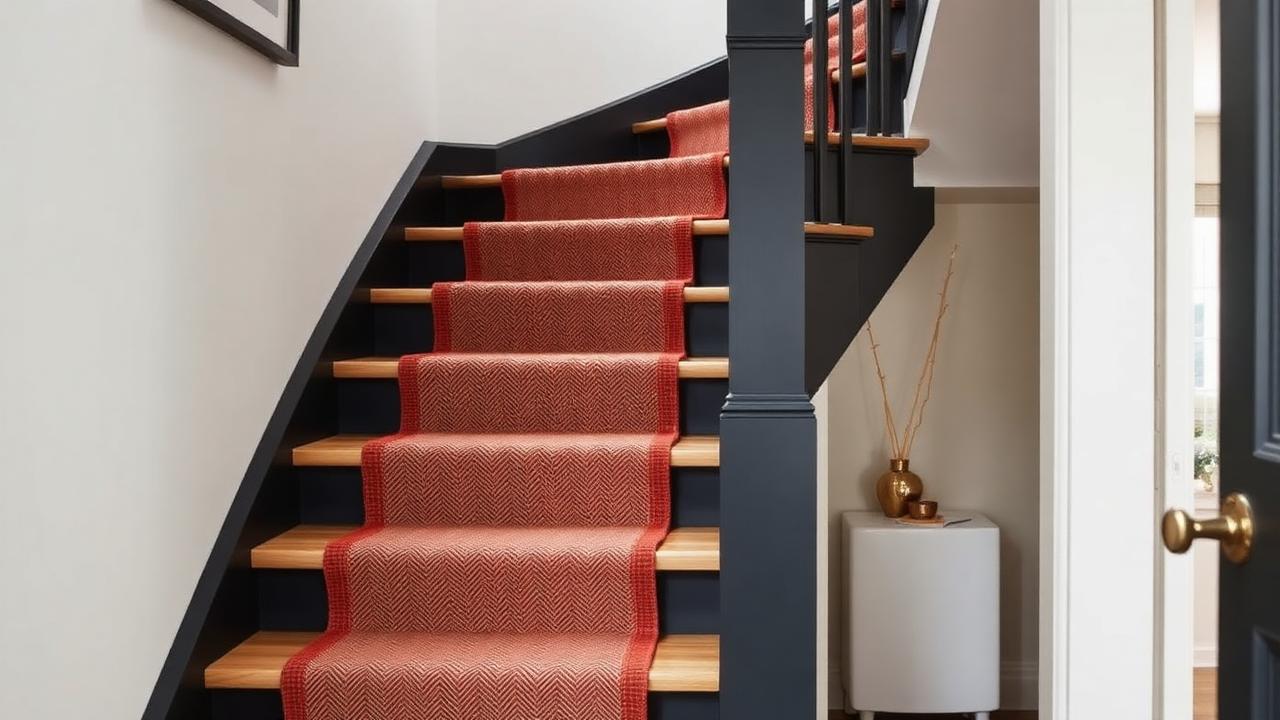
Directional patterns - stripes running across the width, or a herringbone with an obvious lean - also need to be centred and squared to the first tread before fitting starts, or the drift compounds visibly by the top of the flight. This is a fitting detail as much as a design one, and it is worth discussing explicitly with whoever installs the runner.
A practical design process, step by step
- Measure your staircase width, tread depth, riser height and total step count accurately, noting any winders or a landing.
- Decide on runner width and margins based on the proportions you want and the condition of the exposed timber either side.
- Choose construction (flat weave, loop, cut pile or natural fibre) based on how the design should read and how the household actually uses the stairs.
- Narrow colour options against the fixed elements in the space, then test samples in your own lighting at different times of day.
- Check the pattern scale against your chosen width - count repeats across the width before ordering, not after.
- Calculate total length needed, including tuck allowance top and bottom and any pattern-matching allowance, before placing an order.
What good design costs versus what it saves
Design decisions rarely change the base cost per yard or metre much, but they do change waste and fitting complexity. A pattern with a large repeat, or a design requiring precise centring on winders, adds fitting time and material waste compared with a plain colourway or a small, forgiving repeat.
| Design choice | Typical US cost impact | Typical UK cost impact |
|---|---|---|
| Plain colour, flat weave or loop pile | Baseline, $22-50 per sq yd | Baseline, GBP 20-45 per sq m |
| Small pattern repeat (herringbone, fleck) | +5-15% for pattern-matching waste | +5-15% for pattern-matching waste |
| Large pattern repeat (bold stripe, wide check) | +10-25% for waste and centring labour | +10-25% for waste and centring labour |
| Custom border or contrast edge | +$3-8 per linear ft for extra binding work | +GBP 3-7 per linear m for extra binding work |
Run your final design - width, fibre, and estimated pattern waste - through a stair runner calculator before ordering, so the material quantity and rough cost are confirmed against your real staircase rather than a generic estimate.
Know your numbers in 30 seconds
Enter your step count, tread depth and riser height — the stair runner calculator gives you the exact length to order, in metres and feet, with waste included.
Open the stair runner calculatorWhatever you decide, get the numbers first: the stair runner calculator doubles as a stair runner length calculator, adding nosing wrap, landings, winders, pattern repeat and waste so you order the right length the first time.
Still deciding on material, width or pattern? Our hub on stair runners compares weaves, widths, backings and fitting styles side by side, then hands the numbers straight to the calculator.
Frequently asked questions
What is the single most important decision in stair runner design?
Width and margin, decided before colour or pattern. It sets the proportion of the entire staircase and constrains every later choice; a beautifully coloured runner in the wrong width will always look pinched or overwhelming, while a well-proportioned neutral runner rarely looks wrong.
How many pattern repeats should be visible across a stair runner's width?
Aim for at least four to five full repeats across the runner width. Fewer than that and a bold geometric or herringbone pattern tends to look cut off or accidental rather than intentional, especially viewed from the top of the stairs looking down.
Should the runner match the wall colour or the timber colour?
Neither directly - treat both as fixed elements the runner responds to rather than matches exactly. A close colour match can make the staircase visually disappear; a deliberate contrast or a complementary tone usually reads as more considered and gives better definition to the stair edges.
Is a patterned or a plain stair runner easier to design around?
Plain is easier and more forgiving of measurement or centring error, and it hides less well against everyday wear such as footprints and vacuum lines. Patterned runners hide daily wear better but require careful centring and add material waste, so they suit projects with a slightly larger design and fitting budget.
How do I check if a runner colour will work before ordering a full length?
Order a sample large enough to tape across both a tread and a riser, and view it at different times of day under your own household lighting rather than only in a showroom. Stairs are lit from above and viewed at a steep angle, so colour often reads differently on stairs than on a flat sample board.
Does a runner design need to change on winders or a landing?
The material and colour usually stay the same, but directional patterns need extra care on winders because each pie-shaped tread is a different width, which can distort a stripe or check pattern. Discuss pattern handling on winders with your fitter before ordering.
What is a safe, low-risk design choice for a first-time stair runner project?
A heathered or lightly flecked neutral in a loop-pile or small woven texture is the lowest-risk choice: it hides wear well, suits most timber and wall colours without clashing, and does not require the precise pattern-centring that a bold geometric design demands.
How much extra material should I budget for a patterned design?
Add one full pattern repeat to your measured stair run so it can be centred and squared, plus the standard 4-6 in (10-15 cm) tuck allowance at each end. On a small repeat this is negligible; on a large repeat it can add roughly the equivalent of one extra step's worth of material.
Know your numbers in 30 seconds
Enter your step count, tread depth and riser height — the stair runner calculator gives you the exact length to order, in metres and feet, with waste included.
Plan my stair runnerReady for real prices?
Get quotes from vetted stair runner suppliers and fitters near you. Free, no account, no obligation.
Every guide is written from hands-on measuring and fitting experience, checked against the calculator’s own maths, and re-reviewed whenever prices or methods change. Read our editorial standards.